
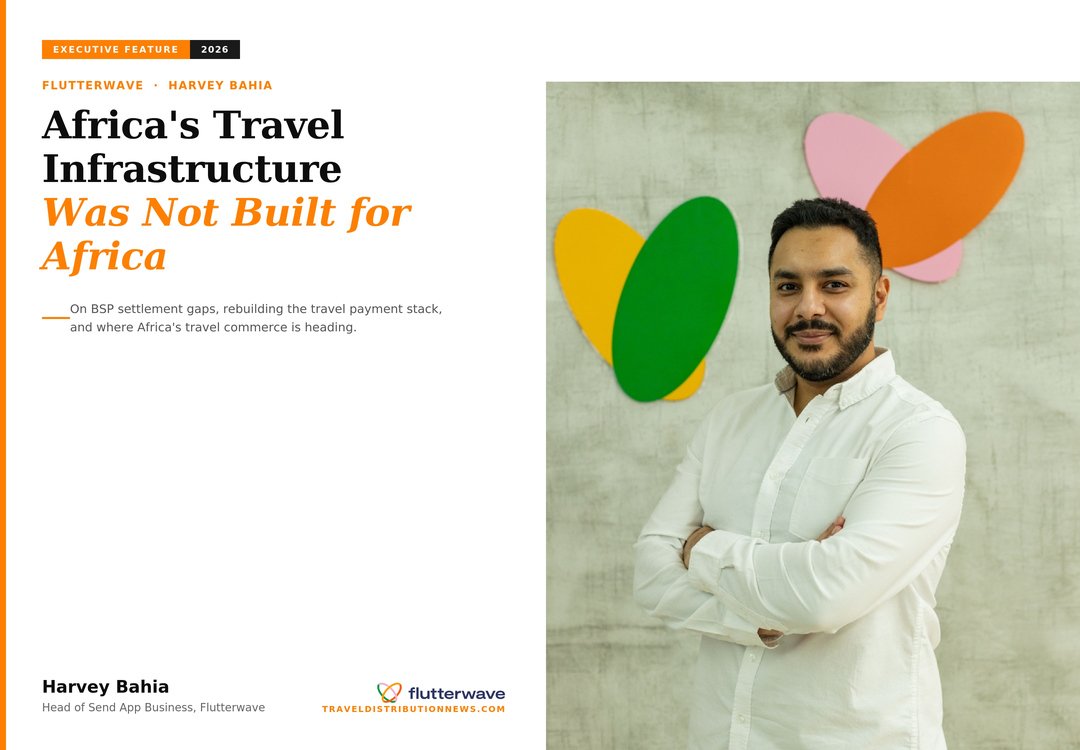
The Head of Send App Business at Flutterwave on why the continent’s travel payment stack is being rebuilt from the ground up, what BSP settlement is missing, and where Africa’s travel commerce is heading.
The problem with Africa’s travel payment infrastructure is not that it does not work. It is that it was not built for Africa.
Card rails designed around Western consumer behaviour, settlement models built for large carrier ecosystems, reconciliation tools that assume a single currency and a single market. The architecture is functional, in a narrow sense. But it handles the complexity of moving money across 54 countries, dozens of currencies, fragmented regulatory regimes, and rapidly evolving consumer payment preferences with the kind of friction that has a measurable commercial cost.
Harvey Bahia, Head of Send App Business at Flutterwave, has spent considerable time in that gap between what the infrastructure promises and what Africa’s travel market actually needs. His framing of where Flutterwave sits, and where the whole stack is heading, is one of the more grounded perspectives on African travel payments currently available.
Infrastructure First
Flutterwave’s positioning in the travel ecosystem is not that of a payment processor. Bahia is deliberate about the distinction.
“Flutterwave sits at the infrastructure layer that helps businesses move money across fragmented markets,” he says. “For airlines, OTAs, and travel platforms, the challenge is not simply accepting a payment. It is accepting payments across different countries, currencies, payment methods, and regulatory environments, and then reconciling those flows reliably.”
That framing defines the competitive ground. Basic payment processing is a commodity. The value, and the margin, sits in what surrounds the transaction: settlement, compliance, fraud prevention, local payment access, and the reporting layer that lets a finance team understand what actually happened after money changed hands.
For travel businesses operating across multiple African markets, that surrounding infrastructure is often the thing that does not exist, or exists only partially, forcing manual reconciliation and the kind of operational overhead that erodes the economics of already thin-margin businesses.
NDC and the New Payment Flows
As NDC adoption expands across African carriers, the distribution architecture between airlines, OTAs, and travel sellers is shifting. Content is moving more directly. Pricing is becoming more dynamic. The commercial relationships between parties are being renegotiated in real time.
That creates new payment flows the existing infrastructure was not designed to handle.
Flutterwave is working within that shift with carriers including Air Peace and travel platforms like Wakanow, enabling payment collection and cross-border settlement as distribution channels multiply and become less standardised.
“The opportunity is to move beyond basic payment processing into services that sit around the transaction,” Bahia says. “Reconciliation, fraud management, compliance, data insights, and multi-currency settlement. Those are the capabilities travel businesses need as distribution becomes more fragmented and payment expectations become more real-time.”
As airlines build more direct retailing capability and NDC-enabled content reaches more sellers, the payment layer connecting those parties needs to handle volume, complexity, and speed that current infrastructure was not built for. Whoever owns that layer owns a structurally important position in the value chain.
What BSP Is Missing
The Billing and Settlement Plan has been the default architecture for airline ticket settlement in Africa for decades. It provides standardisation and a degree of trust. It also has gaps that are becoming harder to ignore.
Bahia is careful not to position Flutterwave as a BSP replacement. The argument is more precise.
“The BSP has played an important role in standardising airline ticket settlement. Flutterwave does not necessarily need to replace that model to create value. The opportunity is to complement and modernise the payment layer around it.”
In practice, that means solving for what BSP does not reach: customers who want to pay through local methods BSP cannot accommodate, agents dealing with settlement delays and limited visibility across markets, treasuries managing currency exposure across multiple jurisdictions without adequate tooling, and OTAs trying to reconcile booking flows that span four countries and six payment methods.
“The BSP handles the interline. Flutterwave handles the market.”
The broader direction, in his view, is towards interoperable networks where no single closed settlement model dominates. Different markets, currencies, and rails, connected by infrastructure flexible enough to move across all of them.
Beyond Acquiring
The distance between what Flutterwave offers and what a traditional acquiring bank provides is where the commercial case sits.
Traditional acquiring processes the transaction. It does not tell you where the money came from across twelve markets, what fees applied in each jurisdiction, how to reconcile a failed payment in a currency you do not hold, or how to manage a dispute across a cross-border booking that involved three payment methods.
“Travel businesses need to understand where money comes from, where it is going, what fees apply, what needs to be settled, and how to resolve failed or disputed payments,” Bahia says.
The profit pools in payments are shifting in exactly this direction. Basic processing is being commoditised. The value is accruing to the layer above it: fraud management, compliance, data, and embedded financial services. The OTAs and travel platforms that build on infrastructure capable of delivering that layer will operate with a structural advantage over those that do not.
The Regulatory Reality
One of the more practically important dimensions of Bahia’s perspective is on regulation. The instinct in fintech is often to position around legacy structures rather than within them. His framing is different.
“Travel is highly regulated and relationship-driven, so the future is more likely to be collaborative than purely disruptive.”
That is not diplomatic hedging. It is an accurate reading of how African travel payments actually work. IATA frameworks, Central Bank licences, BSP relationships, GDS contracts — these are the operating environment. The infrastructure that wins in African travel payments will work within that environment while extending its capability, not around it.
Send App is illustrative of this approach. In Nigeria, it operates under a Central Bank of Nigeria licence as an International Money Transfer Operator. The consumer experience is simple. The regulatory foundation beneath it is not. Building both simultaneously is the actual work.
Where Africa’s Travel Stack Is Heading
Bahia’s outlook for the next three years is specific enough to be useful. Africa’s travel distribution stack is becoming more digital, more direct, and more embedded. Consumer expectations are being set by the mobile-first, real-time payment experiences that have already become standard in everyday African commerce.
The payment infrastructure that travel needs to match those expectations is more demanding than what currently exists. Real-time payments, account-to-account models, stablecoins for cross-border settlement, local payment method integration, automated fraud controls. None of these are emerging technologies in Africa’s broader fintech context. In travel specifically, they remain largely aspirational.
“Customers will expect to pay instantly, in familiar ways, across borders and currencies,” Bahia says. “The future will require a payment infrastructure that is globally connected but locally compliant. That is the balance Flutterwave is building towards.”
The Send App Travel Card is a concrete signal of that direction. It addresses real friction points for African travellers moving internationally: foreign card failures, exchange rate uncertainty, cash dependency. The infrastructure behind it is the same infrastructure Flutterwave is building for the B2B travel stack.
That thesis is straightforward. Africa’s travel market is growing. The payment infrastructure serving it is not keeping pace. The gap between the two is where the commercial opportunity sits.
The businesses that close that gap first will not just capture the growth. They will define what Africa’s travel commerce infrastructure looks like for the next decade.
Harvey Bahia is Head of Send App Business at Flutterwave. Flutterwave is Africa’s leading payments technology company, enabling businesses to make and accept payments across the continent and beyond.
Travel Distribution News covers the business of airline distribution, NDC, GDS dynamics, payments, and emerging markets. Subscribe at traveldistributionnews.com