London, 28 July 2026. HBX Group and Sabre announced a strategic partnership today that will bring HBX Group’s global accommodation portfolio, around 250,000 properties, into Sabre Mosaic Marketplace. The two companies already had an established relationship, with Sabre sourcing Bedsonline content through aggregator channels. Today’s announcement formalizes and expands that relationship by making HBX Group’s full accommodation portfolio available through Mosaic Marketplace. Agencies already holding HBX Group credentials will be able to continue using them through Sabre’s APIs without additional commercial or technical integration.
David Amsellem, Chief Distribution Officer at HBX Group, described the move as part of where distribution is heading: closer collaboration and more shared value across the ecosystem. Chinmai Sharma, Sabre’s Global Head of Lodging, Ground and Sea, was more direct about the underlying motive, framing the priority as reducing content fragmentation and complexity so agents and suppliers can connect more effectively in one place.
One phrase in Sabre’s announcement deserves particular attention: content fragmentation. It is also the point where this announcement begins to connect with broader changes taking place across the GDS landscape.
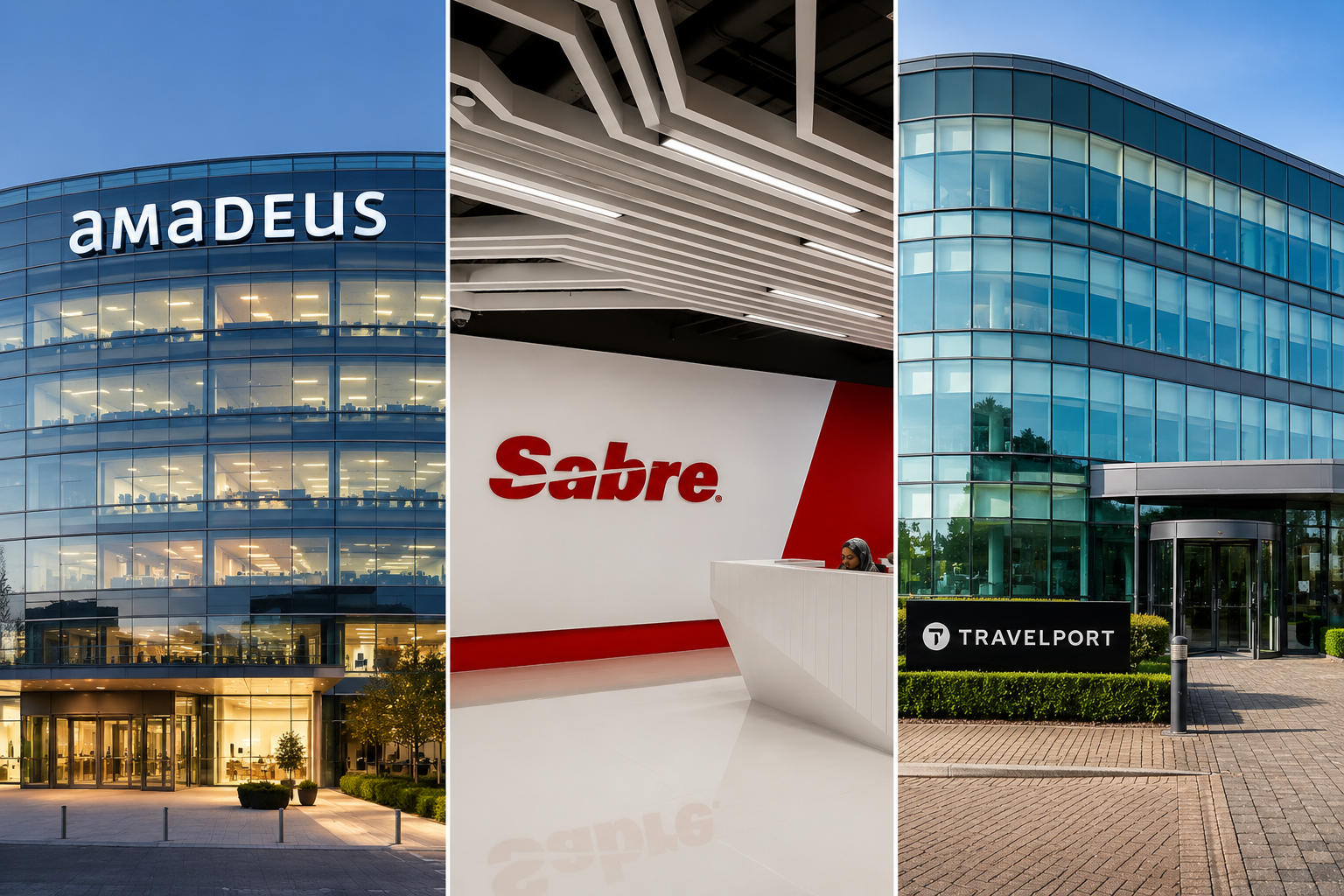
In June, Travelport launched TripServices, an API platform built to carry air, hotel, and ancillary content through a single layer of what the company calls intelligent content curation technology. Travelport said further deployments with major agency groups and travel management companies were already in discussion, with more announcements expected later in the year.
Amadeus has been building toward the same target from a different angle for longer. Its hotel offering already blends GDS-sourced chain content, its own Value Hotels net rate program, private agreements, and third-party aggregator supply into a single booking flow. In June, Amadeus extended that ambition further, joining Google and other partners to co-develop the Universal Commerce Protocol for Lodging, a framework intended to let hotels plug into AI-driven travel commerce without managing a separate integration for every channel.
Three different structures, three different timelines, and no shared supplier tying them together. Sabre is deepening and formalizing an existing bedbank relationship into full-portfolio scale. Travelport is building a unified API layer across product types. Amadeus is stacking content sources internally while reaching outward toward an industry-wide standard. There is no evidence HBX Group is running the same play with Amadeus or Travelport, in fact HBX and Amadeus are generally viewed by market analysts as peers competing in overlapping parts of the travel technology stack, not as supplier and customer. So the connection between these three moves is not a common vendor. It is that each GDS, independently and on its own terms, is treating hotel content fragmentation as urgent enough to act on within weeks of one another.
This is not a new problem in travel distribution. TDN has tracked the same dynamic on the airline side for over a year, where NDC adoption produced its own version of fragmentation: multiple content sources, inconsistent formats, and integration overhead that aggregators like Verteil, TPConnects, and AirGateway have built businesses around solving. What is notable here is that the accommodation side appears to be following the same arc, several years after the airline industry’s NDC rollout began exposing the same structural issue.
There is a case that this matters more in emerging markets than in mature ones. Agencies in markets with thinner direct hotel connectivity, weaker technical resourcing, and less leverage to negotiate their own supplier agreements are typically the ones bearing the highest operational cost of fragmented content today, whether that cost shows up as slower search results, inconsistent availability, or simply fewer options surfaced at the point of sale. If GDS-led consolidation genuinely reduces that fragmentation, the agencies with the least capacity to work around it stand to gain the most. This is a reasonable hypothesis based on how fragmentation costs are typically distributed, not a claim backed by data specific to this deal, and none of the three announcements referenced above include any Africa or MENA-specific detail.
What is verified: the Sabre-HBX Group partnership was announced today, HBX Group’s supply figure of 250,000 properties is stated directly in the release, Sabre’s prior use of HBX Group’s Bedsonline content as an aggregator source is documented independently, and both the Travelport TripServices launch and the Amadeus-Google collaboration on the Universal Commerce Protocol for Lodging are dated public announcements from earlier this year. What is inference: the idea that these three moves reflect a shared read of the same industry pressure, and the suggestion that emerging market agencies have the most to gain from it.
Whether these moves are competitive reactions to one another or independent responses to the same market pressure is not something any of the three companies has addressed publicly, and nothing in the public record settles the question either way. What can be said is narrower but still worth noting: three GDS platforms have each committed real resources, on different mechanisms and different timelines, to the same underlying problem within weeks of one another. Whether that pattern holds beyond this year, or turns out to be coincidence, is something worth watching for in the next round of GDS announcements rather than something this piece can settle now.