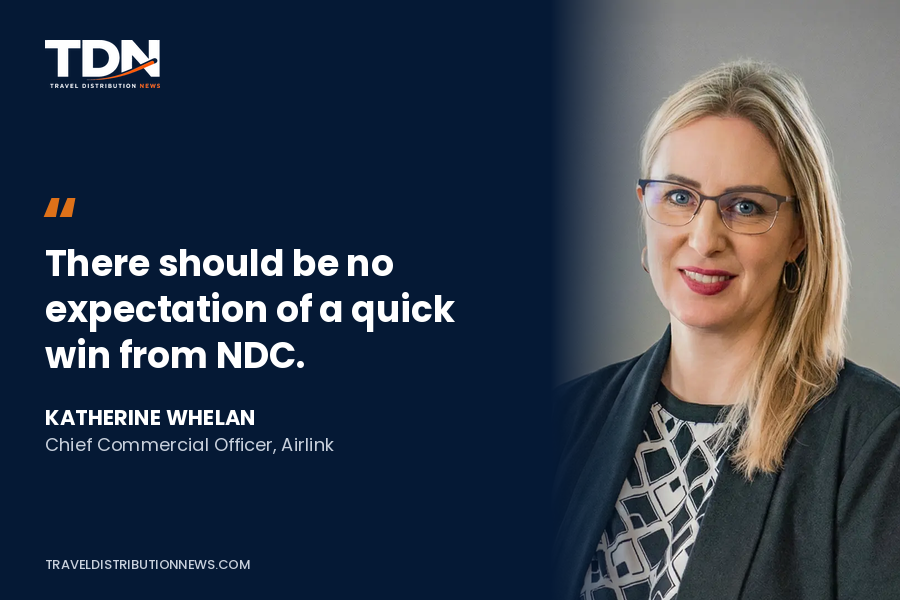
Airlink went live with NDC in July 2024. Nearly two years later, the South African carrier’s Chief Commercial Officer has a message for airlines still deciding whether to start.
“There should be no expectation of a quick win,” Katherine Whelan told Travel Distribution News. “This is especially true if there is a general lack of knowledge on the subject.”
It is a different kind of statement from the one usually attached to an NDC milestone. It comes after two years of running the programme, not before signing up to build it.
What Going Live Did Not Solve
Whelan describes the decision to start as a matter of timing, not confidence.
“Airlink was aware that the integration of NDC into the business would not be a quick process,” she said. “Since it had to be done, it made sense to get going early.”
Airlink knew the process would take time, and starting earlier meant starting that clock earlier. Two years after go-live, Whelan is still describing a build in progress.
That distinction matters because the industry often treats go-live as the defining NDC milestone. Technically, it is an important one. Commercially, it is only one point in a much longer process.
The Standard That Did Not Standardise
The technical difficulty Whelan describes was not simply that NDC was complicated. Airlink found that the standard did not translate into as much consistency between airline implementations as it had expected.
“We realised that there were fewer standardised features amongst airlines than we had originally thought,” she said. “This meant several enhancements needed to be made, which prolonged the project even further.”
The implication is straightforward. A common specification does not guarantee identical implementations. Once those differences surface in a live project, an airline has to build around them. For Airlink, that added time to the process.
Knowledge That Only Implementation Produces
The most frustrating part of the project, Whelan said, was technical, and the reason was Airlink’s limited prior experience with NDC. The team encountered problems it had no way of anticipating in advance.
That is a narrower point than it first appears. Airlink did not lack capable people. It lacked accumulated, hands-on NDC experience, and some of what the team needed to know only became visible once the build was under way.
That experience matters for airlines starting now. They are not beginning with a blank sheet in the same way early adopters did. The industry has accumulated implementation experience, including from carriers such as Airlink, that can help set more realistic expectations before a project begins.
Live Does Not Mean Valuable
On the numbers, Whelan is precise rather than promotional.
“The volumes are not big enough yet to see a marked improvement, but based on the numbers we do have, the savings are evident,” she said. “This will improve over time as more NDC adoption occurs.”
The savings are evident, but the volumes are not yet large enough to produce a marked improvement. That makes agent adoption as important to the economics as the airline’s technical implementation.
An airline can therefore reach go-live before it reaches meaningful commercial scale. The two milestones run on different clocks.
Why Airlink Has Not Turned Off The Old Model
Airlink still runs NDC alongside traditional GDS distribution. Whelan’s reasoning is practical.
“At this stage, within the Southern African market, it certainly seems like the most viable option,” she said. “It gives agencies the time they need to familiarise themselves with this new form of distribution.”
She does not predict when that might change or describe the hybrid model as a failure of the transition. For now, it reflects the fact that airline implementation and agency adoption are moving at different speeds.
What An African Carrier Starting In 2026 Now Knows
Whelan is clear that Airlink’s path is not a template.
“This is not a one size fits all scenario,” she said. “It will very much depend on individual airline aspirations as well as the markets they are working in.”
What her account offers instead is a record of where the delays emerged: in differences between implementations, in knowledge that could only be developed through the work itself, and in commercial returns that depend on adoption beyond the airline’s own systems.
A carrier starting NDC now can plan around that uncertainty. Airlink had to discover it.
The roster itself has kept moving since Whelan spoke to TDN. At the time of the interview, she named live connections through Accelya to AirGateway, Verteil, Thomalex, TravelIT and Nucore, with seven more aggregators in various stages of onboarding. Airlink’s website now lists seven approved aggregator partners: AirGateway, NDC Gateway, NuFlights, Thomalex, Travel IT, TravelNDC and Verteil. Nucore no longer appears on that list. The change is a small illustration of the point Whelan was making. An aggregator roster is not a fixed outcome an airline announces once. It continues to shift as onboarding completes, connections are added, and others fall away.
The connection going live was not the end of Airlink’s project. It was the point at which the airline began finding out how the new distribution model would work in practice.
And that may be the most useful message in Whelan’s warning about a quick win: the NDC launch is a milestone. It is not the result.