
Gulf airlines are separating the companies that run their core systems from the companies that distribute their content. The contracts are visible. The distribution power they confer is not.
Riyadh Air announced a global distribution agreement with Amadeus in August 2025, covering access to the Amadeus Travel Platform’s seller network in more than 190 countries and distribution of its future NDC content. On 20 November it announced a multi-year deal with Travelport covering both NDC and traditional fares, with NDC as the primary integration and legacy content in second place. In both announcements the airline’s chief commercial officer credited the partner with supplying the reach, distribution power and retailing capability needed for a 100-destination network by 2030. The wording barely changed. Neither announcement says whether the content was already bookable by agencies.
Read as a scorecard, that is one announced relationship each. It was not the whole picture. At Arabian Travel Market in May 2025, Riyadh Air had already announced agreements with Amadeus, Sabre, TPConnects, Verteil Technologies and Air Retailer, without detailing their scope. The Amadeus and Travelport announcements sit inside a broader multi-provider distribution strategy, not a two-provider choice. Read as a signal, that suggests a new carrier treating GDS distribution as a layer to be multi-sourced from the start. But an airline can make its content available through several systems without generating equal volumes through each, and a technology provider can run an airline’s core systems without controlling its relationships with sellers. The Middle East’s GDS competition is therefore harder to map than a list of contracts suggests. This article analyses the Gulf-centred evidence available, with limited comparisons elsewhere in MENA, and treats multi-GDS distribution as a hypothesis rather than a settled structure. It also asks what the public record cannot show: which provider actually captures the bookings.
Three kinds of power, not one
Most commentary on GDS positions collapses three different things. Core systems power belongs to whoever runs the passenger service system and, increasingly, the offer and order engine behind NDC. Distribution power belongs to whoever can put an airline’s content in front of agencies and TMCs, and on what terms. Retailing power, the third, belongs to whoever controls which offers, servicing functions and differentiated content reach which sellers. They overlap, but they are not interchangeable. A PSS vendor can supply the NDC engine without owning a single agency relationship. A GDS can own the agency desktop without touching the airline’s inventory.
What Saudia, Etihad and Emirates show
Saudia runs Amadeus Altéa and Altéa NDC, and Amadeus extended its distribution agreement to cover Saudia’s NDC content from the first quarter of 2025. On 14 January 2025 Sabre announced Saudia NDC content on its own marketplace, describing it as the first time Saudia had offered NDC content through any GDS. The public announcements do not establish which arrangement was operational first, so the sequence should not be treated as settled. Travelport announced a renewal that included NDC in October 2025 and announced the content on Travelport+ on 28 April 2026, around six months later. One carrier, one core systems vendor and three announced distribution routes. What the record shows is how quickly each became available to agencies, not how many bookings each generates.
Etihad tells a similar story with sharper edges. It agreed to move to Altéa in September 2021 and completed the cutover in March 2023. In January 2024 Travelport extended its agreement to NDC content and servicing, available once the complete solution was ready, with no date given. In June 2024 Sabre announced Etihad NDC content, but only for agencies in Oman and Bahrain, with a wider rollout to follow after a review. That is a regional launch, not a global deployment, and it sits alongside an Amadeus core system.
Emirates adds a third route. Sabre signed a multi-year worldwide agreement in October 2021 that restored access to Emirates content and promised NDC distribution from the first half of 2022. Travelport launched Emirates NDC content and servicing in June 2024, initially for agencies in Australia, Indonesia, the UAE and the UK. Spotnana had announced a direct NDC integration with the airline a month earlier, and Navan followed in January 2026, gaining access to fares distributed only through NDC and not available through EDIFACT GDS channels. There is no public confirmation of when Sabre’s planned Emirates NDC went live. The gap is itself instructive: an announcement is not availability.
Three lessons follow. Core systems incumbency did not produce exclusive distribution at either Saudia or Etihad. An announcement describes intent: markets, servicing depth and dates vary, and a contract is not the same as content that agencies can book and service. And direct connections can carry specific content around the GDS entirely.
Not one Middle East
Low-cost carriers appear to follow a different logic. Air Arabia signed a group-level distribution agreement with Amadeus on 2 October 2026, reported as a light ticketing model that lets sellers book its flights through standard GDS workflows. That is access to the trade, not retailing sophistication, and the announcement says nothing about other GDS, so nobody should infer exclusivity.
The evidence thins further outside the Gulf. Royal Jordanian’s NDC content was announced on Travelport in May 2026, and Amadeus named Royal Air Maroc alongside British Airways as adopting Altéa NDC. Two data points do not make a pattern, and four major Gulf carriers do not establish a region-wide one. Extending this thesis to Amman, Cairo or Casablanca would be premature.
Three GDS, three competing interpretations
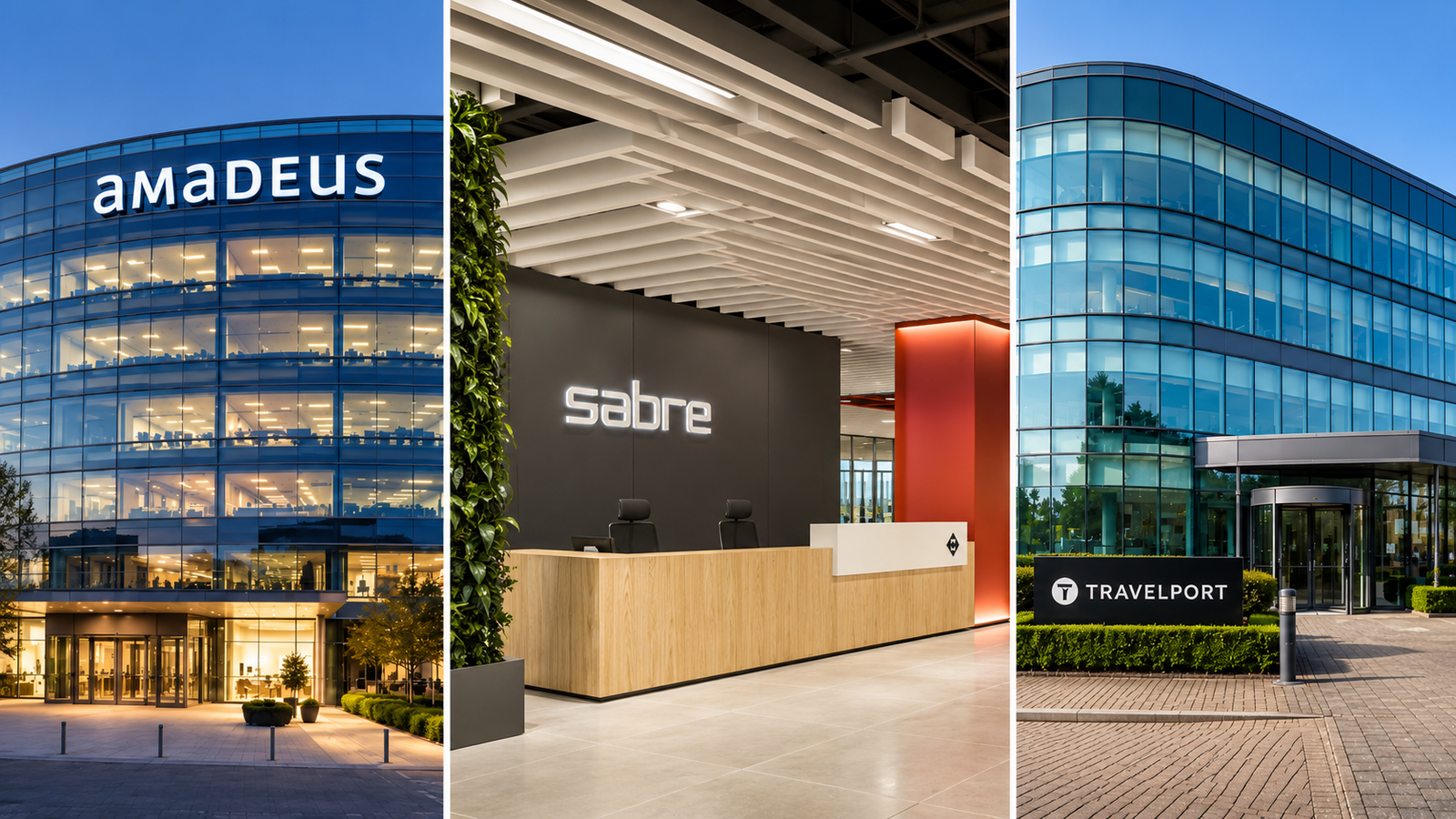
These are interpretations, not rankings. Announced integrations are not booking volumes, and the public evidence does not show which provider captures the most bookings or commercial value in the Gulf. Amadeus can argue that it sits where the strategic technology is: it runs the core and NDC systems at Saudia and Etihad, and its Air IT Solutions revenue grew 8.7% at constant currency in the first half of 2026. The counter is that the same cases show technology incumbency buying neither agency exclusivity nor a protected distribution position. Its group-wide booking decline in 2026 is not evidence of weakness in the region, because the available disclosures cannot separate Gulf exposure from the rest.
Sabre’s argument is corporate reach. Its chief executive says corporate and TMC volume is nearly half of its marketplace bookings, against an industry estimate of 25–30% cited on the same call. Gulf carriers chasing premium yield have reason to want that audience. The counter: in none of the five main cases here is Sabre documented as the core systems vendor, and its Etihad NDC launch covered two markets, so its Gulf position depends on continuing to win content.
Travelport appears in nearly every case: Riyadh Air, Saudia, Etihad, Emirates, Royal Jordanian, and Oman Air, where it says it was the first GDS to secure an NDC agreement. Its pitch is multi-source content that agents can compare, and it has the most announced Gulf integrations in this sample. That is not the same as the most bookings or the most commercial value. It has no core systems business to anchor a relationship and publishes no volumes, so outsiders cannot test whether its breadth converts into share.
The strongest case against the thesis is that multi-homing entrenches the incumbents rather than eroding them. Every airline here has added a GDS rather than replaced one, and every addition is a member of the same three. A carrier paying all three may simply be buying complete agency coverage, with the diversification contained inside a closed set. Announcements also flatter fluidity. Only booking shares by airline would show whether one GDS still carries most of the agency traffic, and nobody publishes them.
Who gains, who carries the cost
Airlines gain negotiating room, because each GDS has to compete on NDC servicing and market coverage. They also inherit three integrations and the task of keeping content consistent. Agencies and TMCs absorb the rest. A multi-market TMC sees a different Etihad or Emirates depending on desktop, country and date, and that unevenness is the commercial opening for aggregators. Trade reports list Travelfusion carrying Riyadh Air’s NDC content. Contract economics are not public, so who ultimately pays for fragmented distribution cannot be stated. Complexity lands on the seller side first.
What 2026 can and cannot tell us
The 2026 figures should carry little weight in this argument. In the second quarter, Amadeus bookings fell 7.6% while Sabre’s air distribution bookings rose 1%, but the two companies have different mixes, Sabre credits corporate resilience, and neither number isolates the Gulf. The one regional disclosure is Sabre’s: on its first-quarter call on 7 May 2026, its chief executive said about 11% of its air distribution bookings originate in or transit the Middle East. Amadeus has published no equivalent in the materials reviewed. The point is not who suffered more but that regional dependence is largely invisible.
The question that remains
The Gulf’s distribution market presents a paradox. Airlines can widen access to their content without surrendering their core technology relationships, while GDS providers can secure distribution agreements without revealing how much traffic those agreements generate. That makes the contract an incomplete measure of power. The decisive question is what happens after the integration: which provider delivers the content sellers need, supports the servicing they require and captures the bookings that make the relationship commercially valuable. Until those figures become visible, the GDS map will show who has secured access, not who has won the market.
When an airline distributes through all three GDS, is it diversifying its power, or simply giving three incumbents another way to remain indispensable?