

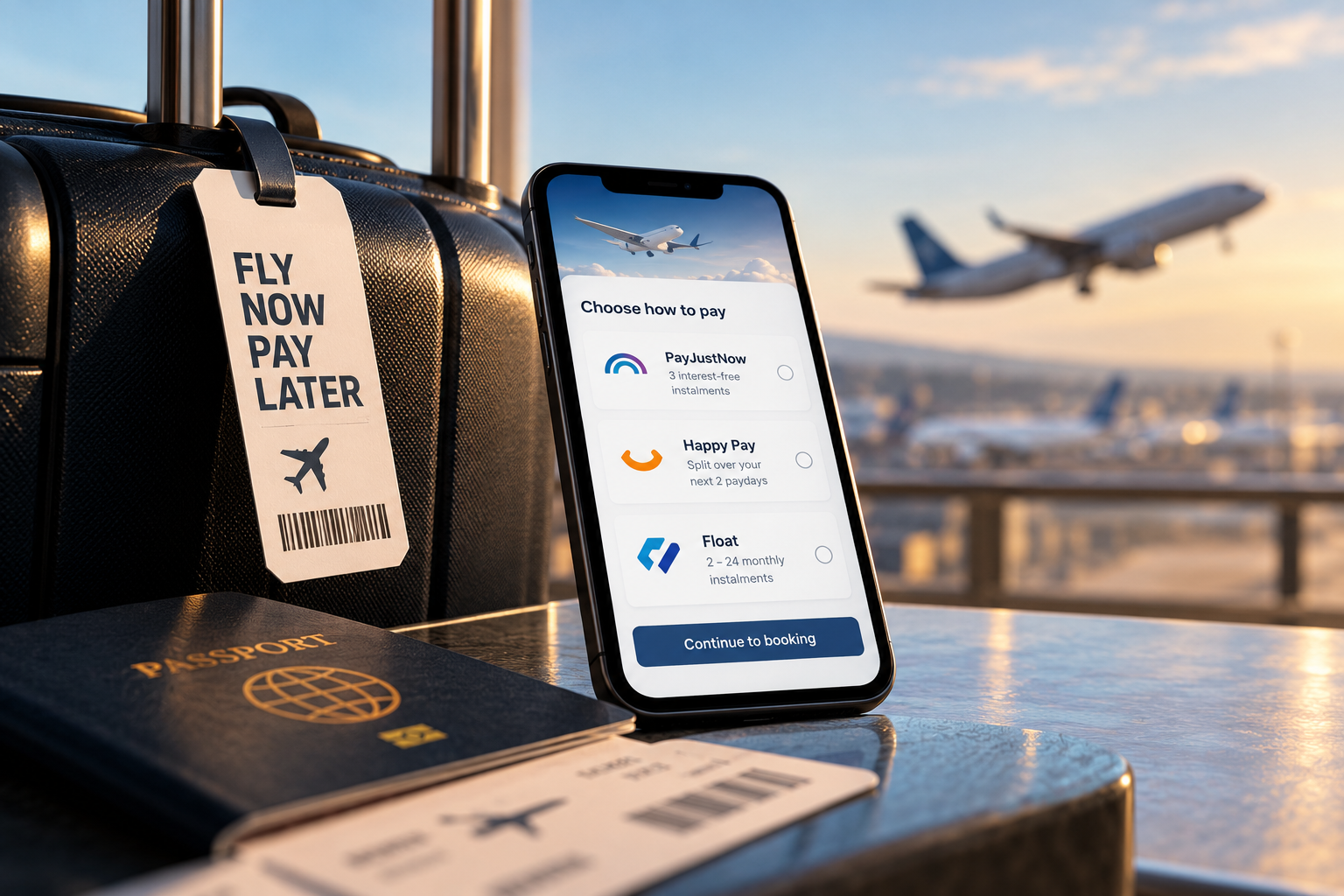
A South African flight retailer lets travellers choose PayJustNow, Happy Pay or Float at checkout, and says the fare it shows already includes the cost of the option chosen. Whether that makes it a distribution story or a payments story depends on who is paid for what.
The fare Fly n Pay Later displays depends on the payment partner a traveller picks. According to the company’s website, the price includes a booking fee and a payment fee, the payment fee differs by provider, and Happy Pay’s is slightly higher than those charged through PayJustNow and Float. The company says the total and repayment schedule are shown before the booking is confirmed. No figures for the fees have been published.
That detail separates the proposition from a simple promise to pay later. Payment choice is not neutral to price. What the disclosure does not establish is the size of the fees, the retailer’s margin or whether the fees recover financing costs.
A travel agent with three payment routes
Fly n Pay Later describes itself as an IATA-accredited travel agent, not an airline operator. It says it searches fares across the airlines it works with, issues tickets as an accredited agent and confirms bookings once a customer’s payment plan has been approved. All of this is the company’s own description. TDN has not independently confirmed the accreditation, and the airlines involved are not named beyond a curated selection of South African and international carriers. A business-data listing places the company in Sandton with 11 to 50 employees, though those are third-party estimates.
It should not be confused with similarly named businesses. The UK fintech Fly Now Pay Later is a separate company, as is Alternative Airlines, the UK-based OTA that offers South African customers instalments at checkout. TDN found nothing linking either to Fly n Pay Later.
The three partners are not interchangeable. PayJustNow’s standard product splits a purchase into three interest-free instalments, and eligibility includes a South African ID, residence and a Visa or Mastercard, according to Alternative Airlines. Fly n Pay Later says Happy Pay splits the cost across a customer’s next two paydays with no initial payment. Float draws on the available limit of an existing Visa or Mastercard credit card, and its own materials cite two to 24 monthly instalments with no application or credit check. Which of those terms apply to flights on Fly n Pay Later, and whether fare values are capped, is not established.
A traveller without an eligible credit card cannot use Float, and one without South African documents may not qualify for the others. The menu on the homepage is not necessarily the menu every customer sees.
Who is paid for what
Instalments marketed as interest-free can still carry a cost, and the relevant comparison for a traveller is the total payable, not the absence of interest. The fee structure is also where the commercial model shows through. Happy Pay describes itself as charging merchants rather than shoppers, and Float’s merchant materials say it takes on the risk of collecting repayments. Those are general descriptions of each provider’s model, not of its agreement with Fly n Pay Later. If similar terms applied here, the retailer could be bearing a provider fee, and a customer-facing payment fee could be one way of recovering it, but nothing published establishes that. Fly n Pay Later has not disclosed its partner terms, its margins or what it pays each provider.
“Renting the credit” is shorthand for what the public evidence suggests: the lending sits with the named providers while the retailer sells the ticket. It is not a description of any contract between them, and none has been published.
Late fees are a separate cost. Happy Pay’s terms set a late fee of R115 including VAT per missed instalment, charged weekly up to three times and capped at R360 per instalment, and they allow interest of 2 percent a month on overdue amounts. Whether Fly n Pay Later passes any such charges through is not known.
Payment choice moves upstream
Does an instalment change how people find and commit to flights? The evidence does not say. TDN found no credible data that buy-now-pay-later raises conversion, booking values, loyalty or airline revenue in this market, and Fly n Pay Later publishes no transaction volumes or performance figures. Alternative Airlines claims that 80 percent of its PayJustNow and Payflex customers fly FlySafair. That is a company statement, and it cannot show whether instalments created trips or only settled planned ones.
What is observable is where the choice sits. FlySafair introduced Mobicred instalment credit in 2019 as one option inside its own checkout, with the airline holding the customer relationship. Alternative Airlines lists three providers at checkout across what it says are more than 600 airlines. At both, payment is the last decision. At a retailer whose name announces the payment plan, and whose fare moves with the provider, financing becomes part of what is being compared. That is TDN’s reading, not a finding. If it holds, payment becomes a customer-acquisition channel as well as a settlement step.
Control splits accordingly. The retailer owns the booking interface and presumably the booking data. The partner owns the approval, repayment relationship and collections. The airline operates the flight. The customer experiences one purchase, but three companies control different parts of it.
When a trip changes
The company’s terms say cancellations are subject to the airline’s conditions and that customers should contact Fly n Pay Later, and they limit its liability for services supplied by third parties. How refunds are reconciled with outstanding instalments is not published. Partner terms show some of the machinery, though they are general terms and may differ for flights bought through this retailer. Happy Pay’s terms say refunds are processed only when the merchant requests them in writing, and that a customer refunded directly by a merchant remains responsible for the payment schedule. PayJustNow’s merchant integration includes a refund function. None of this settles the awkward case, a non-refundable ticket cancelled mid-repayment. Does the traveller keep paying, who refunds what, and was the ticket issued before the final instalment?
The regulatory position is moving. According to TimesLive, the National Credit Regulator has concluded that BNPL agreements are not credit agreements at inception, although they may become incidental credit agreements under the National Credit Act where default charges follow a missed payment. The regulator has also directed providers to begin reporting repayment behaviour to credit bureaus from February 2027, with an industry subcommittee to set how the data is submitted. Happy Pay and PayJustNow are reported to be sharing repayment data with the credit-reporting body Sacrra already. A July write-up of a Sacrra industry roundtable adds that more than two million BNPL records were submitted in May but are not yet shown on consumer credit profiles while a reporting framework is finalised. TDN has not reviewed the regulator’s notice itself, and how missed payments will be recorded, and for which providers, depends on the detail still to be set. Law-firm commentary has described the classification question as unsettled.
What it means for the ecosystem
For airlines, the open question is whether instalment-led retailers steer demand towards the carriers they curate, and what financing costs do to net revenue. Publicly available data does not establish either effect. For OTAs, instalments at checkout are already offered by at least one established player, so the differentiator is the front end, the partner mix and the fee design, not the capability. For payment providers, a retail channel for high-value purchases comes with cancellation and refund exposure the retailer may not own. TDN found no sign the model touches managed travel.
Fly n Pay Later may be a distinct commerce proposition or a front end for its partners’ products. The evidence leans towards the second without settling it. The company’s answers are needed to establish the model’s economics. The questions that matter most are what the booking and payment fees are for each provider and how they are set, whether the company holds any credit, intermediary, NCR or FSCA registration and who is merchant of record, and which airlines, plans and fare caps apply to flights. Equally important are when a ticket is issued relative to approval and the first payment, how refunds on cancelled tickets are reconciled with remaining instalments, and what the commercial terms with each partner look like. Until those are answered, the model’s economics remain unproven in either direction.