
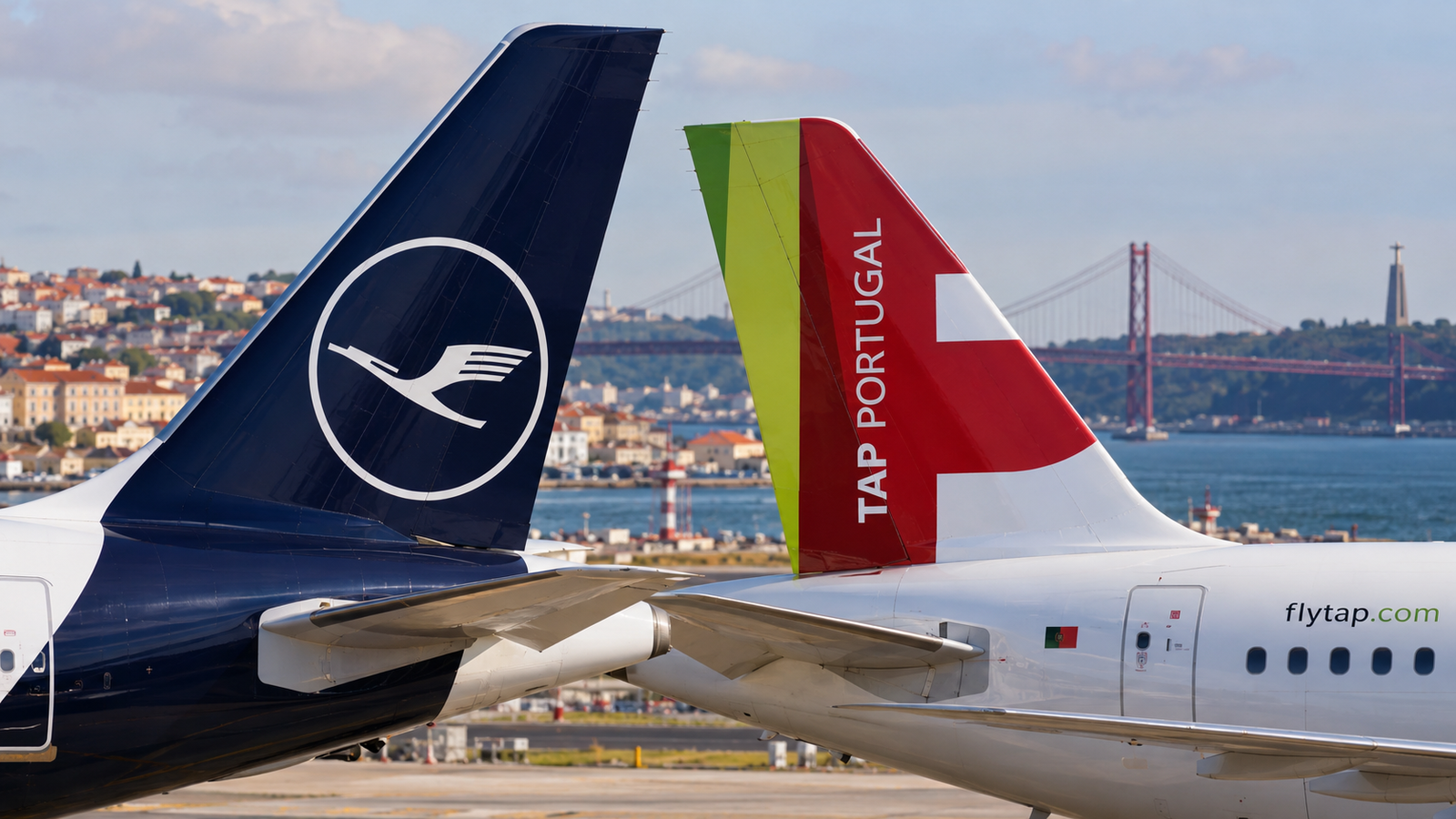
Portugal has chosen Lufthansa Group to take 44.9 per cent of TAP Air Portugal and run its management, and is already seeking support to sell it the rest. Ownership is moving fast. What agencies selling TAP’s Brazil and Africa connections will be asked to accept has barely been discussed.
Portugal’s decision to give Lufthansa Group a stake in TAP Air Portugal answers a question about who will run the airline. It opens a more useful one for the agencies, travel management companies and online agencies that sell TAP: whether the airline will eventually be distributed on Lufthansa Group’s terms. Nothing announced so far says it will. But a second development has raised the stakes. On 15 October Reuters reported that Lufthansa’s chief financial officer said separate talks were under way about taking the remaining 50.1 per cent in future, while the Portuguese finance minister was seeking opposition support for such a sale. If that second step happens, the distribution question stops being about a minority partner and becomes about a subsidiary.
What has been agreed, and what has not
The government announced its choice on 14 October after a cabinet meeting, closing the first phase of TAP’s privatisation. Lufthansa is to acquire 44.9 per cent for €1.025 billion. A further 5 per cent is reserved for employees, and if they do not take it up Lufthansa can buy the unsubscribed shares, which would bring its stake to as much as 49.9 per cent and the first-phase total to €1.201 billion. The state keeps 50.1 per cent for now. According to the government, Lufthansa will nominate three of TAP’s executive directors and the state one, and prime minister Luís Montenegro said Lufthansa will be responsible for executive and operational management.
None of this is final. The first phase needs European Commission approval, and finance minister Joaquim Miranda Sarmento has put completion 18 to 24 months away, around 2028. The second phase is a proposal. The government says Lufthansa’s offer includes a further €1.351 billion for the remaining shares, made up of €863 million in cash and Lufthansa Group shares worth €488 million, about 5 per cent of the group. Reuters reports that it needs parliamentary backing and could complete around mid-2028. Until then, Lufthansa would be a minority shareholder with management responsibility, which is not the same as owning TAP. The timetable suggests nothing about TAP’s distribution terms will change quickly, though neither company has said what the sequence will be.
What Lufthansa’s model looks like
Lufthansa Group has charged a Distribution Cost Charge on GDS-issued tickets since 2015. Under the guideline valid from 1 January 2026, it applies to Lufthansa, Austrian, Brussels Airlines, SWISS and Air Dolomiti as a fixed amount per ticket, collected as a tax code. In the guideline’s examples the euro amounts, €22.50 on Sabre and €23 on Travelport, apply to travel originating in Germany, with local-currency equivalents for other origins and a short list of exempt origins. Amadeus moved from €18 to €19 on 5 May 2026, according to trade reports.
The charge is levied per ticket, on first issues rather than reissues, and does not apply to EMDs. A lower €8 charge applies only to tickets issued through GDS NDC aggregators under the Group’s public NDC model, the channel that gives access to its base offer. It is collected as a carrier ticketing fee, and the guideline says it applies once the public model is available for the specific aggregator and market. Tickets issued under the Group’s bilateral NDC model, which gives access to its smart offer, carry no charge, and neither do the Group’s own sales bookings. The charge therefore follows how a ticket is sold, not whether NDC technology is used. Lufthansa executives have described the charge as both a cost pass-through and a way to steer agencies towards NDC, and a Group sales executive has said the Group was on track to handle about 75 per cent of bookings through NDC or direct channels. That figure is a company claim and has not been independently verified.
TAP’s published approach differs in detail. It sells NDC content through Sabre, under an agreement announced in October 2024, and through Travelport, which signed in November 2024 and made the content available to agencies in 29 countries in September 2025. Agents can also connect through a direct API, or through a white-label platform aimed at smaller agencies. At a 2025 trade conference, a TAP representative said the airline aims for content parity across channels and will keep paying commission on NDC bookings. Whether that model survives under Lufthansa’s management has not been disclosed.
The ITA precedent, and its limits
ITA Airways is the closest comparison. Lufthansa took 41 per cent in early 2025. From 5 May 2026 ITA’s content became available through the Group’s NDC channels, including direct API connections, the SPRK web platform and approved aggregators. ITA signed new NDC agreements with Travelport in March and Sabre in May, and described the changes as alignment with the Group’s distribution approach. Lufthansa said it was responsible only for technical onboarding and that ITA remains commercially and operationally independent. The DCC guidance names five Group airlines, and ITA is not among them.
The sequence shows that the technical layer of distribution can align within about fifteen months of an investment while the commercial layer is described as separate. It does not show that TAP will follow the same path. The comparison is particularly relevant because Lufthansa’s investment in ITA is also staged, with its stake expected to reach 90 per cent in 2027. But ITA’s commercial terms were described as independent, and nothing yet says how TAP’s will be treated.
What it could mean for sellers
For agencies and TMCs, the practical questions are commercial rather than technical. TAP content is already available as NDC alongside traditional content in the major GDSs, so the existence of an API is not the issue. What matters is whether fares, ancillaries, servicing and remuneration change, and whether selling TAP alongside Group airlines becomes simpler or costlier. Agencies already connected to Group NDC infrastructure could find onboarding easier if TAP moves onto it. Agencies that rely on traditional GDS content, or sell TAP on multi-carrier itineraries, could face more complexity. TAP has said full interline capability through NDC is a future goal.
Modern offer technology does not by itself show that an agency earns more or that a traveller is better served. The evidence needed is concrete: published agency guidelines, any new GDS charge, changes to commission, and fare and ancillary parity across channels. None of it exists yet.
Why Africa and Latin America sit at the centre
TAP flies to 14 African destinations and 13 Brazilian cities. In figures it published in December 2025, that meant about 80 weekly flights to Angola, Mozambique, Cape Verde, Guinea-Bissau, São Tomé and Príncipe, Morocco, Senegal, Gambia and Ghana, and 91 weekly flights to Brazil, with Curitiba added from 2026. Frequencies move with the season. Lufthansa has said it wants Lisbon as a strategic hub and a stronger Group position on the South Atlantic.
Any change in TAP’s commercial or distribution terms would reach agencies on these routes through whichever channel they use today. The public record does not show how much African or Brazilian agency business depends on TAP, so any claim about who would pay more would be conjecture. That gap matters because agencies selling these routes still lack public clarity on whether TAP’s distribution terms will change under Lufthansa’s management.
The limits of consolidation
Lufthansa’s investments in ITA, airBaltic (10 per cent) and now TAP are three different structures. ITA is heading towards near-full Group control, airBaltic is a small minority holding, and TAP is a staged route, with 44.9 per cent and management now and full ownership possible only if parliament and the Commission agree. Regulatory clearance, existing contracts and each airline’s own brand and commercial policy all limit how far the Group can standardise.
TAP also reported a €99.2 million loss for the first half of 2026, according to Portuguese press reports. That matters here because distribution cost, ancillary revenue and channel mix are levers a management team under pressure can reach, and Lufthansa’s own model treats distribution as one of them. That is analysis, not a stated plan. Air France-KLM’s unsuccessful bid is a reminder that TAP’s Atlantic and African network was valuable enough to contest.
What to watch
The signals that will matter are an announced distribution roadmap for TAP, any changes to its GDS and NDC agreements, a move of TAP’s NDC onto Lufthansa Group infrastructure as happened at ITA, any DCC-style charge or revised commission terms in TAP’s agency guidelines, and the outcome of the parliamentary vote on the second phase. The sharper reading of this deal is that it tests how far Lufthansa can standardise distribution across airlines it acquires in stages. ITA suggests the technology can converge while commercial independence is maintained. TAP will show whether that separation survives when ownership deepens. For agencies, the decisive question is not which system an airline uses, but what it costs to access its content, service its bookings and earn revenue from selling it.