

Two multi-vendor teams replayed at IATA’s World Passenger Symposium showed one order moving from offer to settlement across software from different companies. They show that integration can work in a controlled setting, not that airlines are ready to carry the accountability that comes with it.
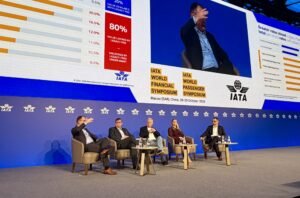
At the World Passenger Symposium in Macao on 28 and 29 October, IATA put two multi-vendor retailing demonstrations in front of airline executives. Each followed a customer order through systems supplied by different technology companies, covering functions usually delivered inside one integrated airline IT environment.
They were chosen from 13 projects built for IATA’s Airline Retailing Consortium, after airline representatives voted on which were most relevant. They were separate projects with different participants and different airline partners. Neither is evidence that airlines are already replacing their platforms with modular systems.
Two ecosystems, two airlines
The first was led by TPConnects, whose Astra Nova platform orchestrated the other participants: ATPCO, Lufthansa Systems, Ink Innovation, M2P Consulting, IATA Financial Gateway, FlyNava Technologies, Ancileo and Neoke. Gulf Air was the airline supplier partner. The scenario followed a family of three travelling from Dubai to London via Bahrain on two carriers, across eight stages of retailing and servicing. TPConnects describes it as nine vendors and one order, a live interline in which Astra Nova acted as both supplier and retailer, with two independent, legacy-free systems transacting.
The partners’ own accounts point to distinct roles. FlyNava’s Jupiter engine supplied dynamic pricing that Astra Nova turned into a distributable offer, and Ancileo supplied insurance within offer construction. Ink Innovation was the service delivery partner. M2P’s Orbit tool assessed passenger and product impact when a flight was disrupted, and Astra Nova connected that decision to order management. Lufthansa Systems’ SIRAX/ONE Order handled accounting and settlement between the carriers.
The disruption case is the revealing one. When a return flight was cancelled, TPConnects says the affected passengers were rebooked the same day by updating the existing order, with no ticket-based exchange. M2P’s Orbit tool is the disruption component in TPConnects’ published ecosystem. TPConnects also says the full order, flights and ancillaries alike, was settled between both carriers, with revenue allocated across each. These are the company’s own claims about a staged scenario. TDN found no public description of what ATPCO, Neoke and IATA Financial Gateway each did, and has not assigned them roles.
The second demonstration was led by Datalex, with PROS, Verteil, Ink and Sutherland. Air Macau was the reference airline, supplying the flights, products and services used. Cavu and myclimate took part as third-party providers, alongside an unnamed travel insurer.
Datalex’s own account is detailed. Verteil’s agency interface connected to PROS for product catalogue, stock, offer creation and dynamic pricing. Once the customer chose an offer, Verteil created the order in Datalex’s Stellex Order Management and paid through Datalex’s DLX Pay orchestration product. PROS checked availability and updated stock, and Ink’s delivery system and Sutherland’s order accounting system were notified of the services to be delivered and accounted for.
The servicing leg tested continuity across channels. An order created through NDC in the indirect channel was retrieved and changed through the airline’s own website, where the traveller added insurance and myclimate carbon projects. At check-in, Ink’s system sold Cavu fast-track security. Check-in, boarding and flown statuses flowed back to the order system and to Sutherland, which recognised revenue only after delivery. Datalex presents Stellex Order Management as the single source of truth.
What is different about this model
An airline connecting to several NDC channels changes how offers are distributed, often while its core still runs on PNRs and tickets. An integrated platform delivers pricing, inventory, orders, check-in and accounting from one vendor against one data model. A loose set of suppliers has no shared record at all. The demonstrations sit between these: separate modules acting on one order, with a change in one system reflected in the others. NDC can connect a sales channel to that order, as it did in the Datalex scenario, but it does not manage the order’s whole lifecycle.
Both demonstrations still had a centre. Astra Nova orchestrated one ecosystem and Stellex held the order in the other. The model does not remove the central platform. It moves it from a vendor’s whole stack to the layer that coordinates the order, and whoever runs that layer holds the leverage over how everything else connects.
Who gains
Specialists gain a route into airline retailing without displacing an incumbent platform. A pricing engine, an insurer or an airport service provider can reach an airline through defined interfaces, and competition shifts from breadth of portfolio to the strength of individual products.
The position of the established providers is less clear. Amadeus, Sabre, Travelport and the integrated PSS vendors are not excluded. They can supply modules, integrate with others or compete as orchestrators. IATA’s own 2026 readiness survey says providers can show a demo in over 90% of cases, but that is a count of demonstrations, not deployments.
What airlines would inherit
The vendors have shown their systems exchanging information in a controlled proof of concept. Production is a different test. Someone has to answer when a rebooking decision from one supplier, an order change in another and an accounting entry in a third disagree. During a disruption, an airline cannot leave responsibility divided while passengers wait. Contracts, service levels and escalation paths would need to settle that in advance.
Data ownership is the companion question. A single order record is valuable only if the airline controls it, decides who can read it and can take it elsewhere. Datalex says its modules are interchangeable and can be swapped for another provider. That is a design claim. Nothing was replaced inside a live operation in Macao, and the ability to change a supplier without destabilising the rest is the claim a demonstration is least able to prove.
Reliability and cost remain open. A chain of real-time calls across five or eight companies is only as dependable as its weakest link. Neither team published implementation costs or a comparison with an integrated alternative. TPConnects has cited a modular value gain of $7 per passenger, drawn from older McKinsey and IATA work, which is a prospective estimate and not a result.
The airline partners also need careful reading. TDN found no public evidence that Gulf Air or Air Macau runs the architecture shown in Macao in live commercial service. Gulf Air has been a TPConnects NDC customer and Air Macau has announced a partnership with Datalex, but a reference airline is not a production deployment.
The emerging-market question
For airlines in Africa and other emerging markets, the appeal is plausible. A carrier that cannot fund a platform replacement could add dynamic pricing, insurance or a modern order layer in stages, and automated order-based settlement could help those with many interline partners.
The obstacles are equally real. Orchestrating several suppliers demands integration skill, technical governance and the capacity to manage multiple contracts, which smaller airlines often lack, and several contracts can cost more than one. No African airline featured in either demonstration, so any conclusion for the region is inference. A more realistic route may be a single integration partner that packages and manages specialist modules, which would make the model reachable but put the accountability question back on one supplier.
The next test is not another demonstration. It is a named airline running a multi-vendor order chain in production, with evidence of how it is governed, what it costs and who answers on its first bad day.