
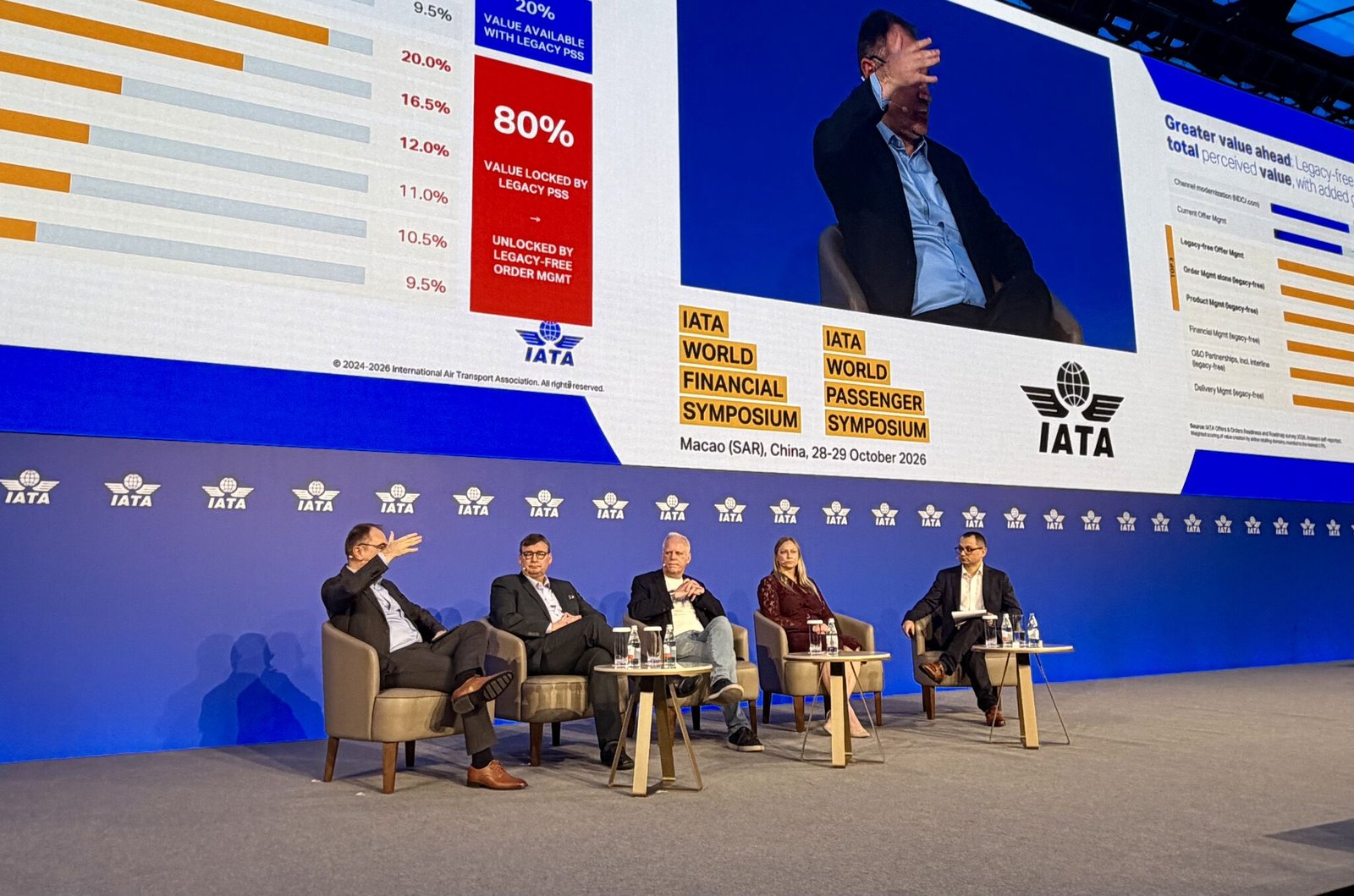
IATA said on 27 October that airlines spent $24.5bn processing payments in 2025, an average payment cost of $5 per passenger. The same association forecasts that airlines will keep $4.50 a passenger in net profit this year. The two figures sit side by side in a release issued from Macao, a day before IATA’s World Financial Symposium and World Passenger Symposium opened there.
The $5 is a 2025 cost and the $4.50 a 2026 profit forecast, and a cost per passenger and a profit per passenger are different kinds of number. The comparison is IATA’s own, made by an association with products to sell. The trend underneath it is the more useful finding. Every figure in this piece comes from IATA, and TDN has not verified any of them independently.
Costs are outrunning sales
Payment costs reached $24.5bn on $1.05tn of sales in 2025, roughly 2.3 per cent of every dollar sold. Against 2023, total payment costs rose 10.4 per cent while sales grew 7.7 per cent from $977bn. A cost that grows faster than the sales it serves puts pressure on margins, however large the underlying revenue. IATA’s Interim Director General Sandrine Le Borgne has put the industry’s expected net margin this year at around 2 per cent.
The method of payment decides the bill. Card fees averaged 2.53 per cent, against an estimated 1.97 per cent across all methods, while the cheapest options cost 0.01 per cent. On IATA’s figures, the average card-fee rate is more than 250 times the cheapest reported rate, and that is the arithmetic behind IATA’s push for alternatives to cards.
Most of it is fees
Of the $24.5bn, $20.7bn, or 84.5 per cent, was direct payment fees. A further $2.9bn (11.8 per cent) covered airline operating costs such as payment systems, delayed cash flow, staff and compliance, and $0.9bn (3.7 per cent) was lost to fraud or uncollected sales.
There is a revenue side as well. IATA says about one in five ancillary purchase attempts fails because the first payment is refused and no other method is offered. The release gives no sample size or method for that finding, so it should be read as indicative rather than measured.
IATA’s answer is a set of IATA products
The remedies in the release are IATA Pay, which IATA says is live in 34 countries across 38 payment schemes; IATA Financial Gateway, covering more than 170 countries and 300 payment methods; Transparency in Payments, which lets airlines set agency-card policy within the BSP; and EASY PAY, a prefunded alternative for accredited agents. A new Airline Payment Framework helps carriers weigh their options, and IATA is working on a different approach to corporate travel payments, timed with the move to Offers and Orders.
Each of these is an IATA service or IATA-led programme, so the release is as much a case for them as a finding about costs. The headline comparison also sets a 2025 cost per passenger against a 2026 profit forecast. IATA’s June fact sheet set a cost of about $4 a passenger, derived from a 2024 Edgar, Dunn & Company study putting annual payment costs at $22bn, beside a 2025 net profit figure of $7.70 a passenger. The two came from different sources and periods, so neither is a like-for-like measure of the other. The more defensible comparison is the one between cost growth and sales growth.
On the face of it, there is also a small inconsistency. The June fact sheet put IATA Pay in more than 36 countries, while this release says 34. The two documents may count countries differently, and the release does not say.
What the release leaves out
IATA gives no breakdown by region. Whether a carrier in Lagos, Nairobi or Riyadh pays the same 2.53 per cent card cost as one in Frankfurt is not stated, nor is how much of the $24.5bn falls on airlines selling in currencies they struggle to repatriate. For emerging markets, where local instant payment schemes are often the realistic alternative to cards, the only relevant data point is a 2025 passenger survey finding that 8 per cent of passengers prefer a local instant payment, against 29 per cent who prefer a digital wallet.
The point is not that these markets pay more. It is that the release gives no evidence either way, and no basis for judging which alternative would save most. Failed transactions, foreign exchange and settlement delay are exactly the costs a global average can hide. Some may sit inside the $2.9bn operating line and some outside it, and the release does not say which.
The sharpest line in IATA’s release is not $5 against $4.50. It is 10.4 per cent against 7.7 per cent. Airlines can debate whether a payment cost per passenger belongs beside a profit forecast for a different year, but costs growing faster than sales are harder to dismiss. IATA has the standing to identify the problem and a clear commercial interest in promoting its remedies, and the missing regional data makes that tension clearest. Until airlines in Africa, the Middle East and other emerging markets can see what payments actually cost them, a global average will tell them little about which alternatives are worth adopting. The case for any solution, IATA’s or anyone else’s, has to rest on savings demonstrated in the markets where airlines operate.