

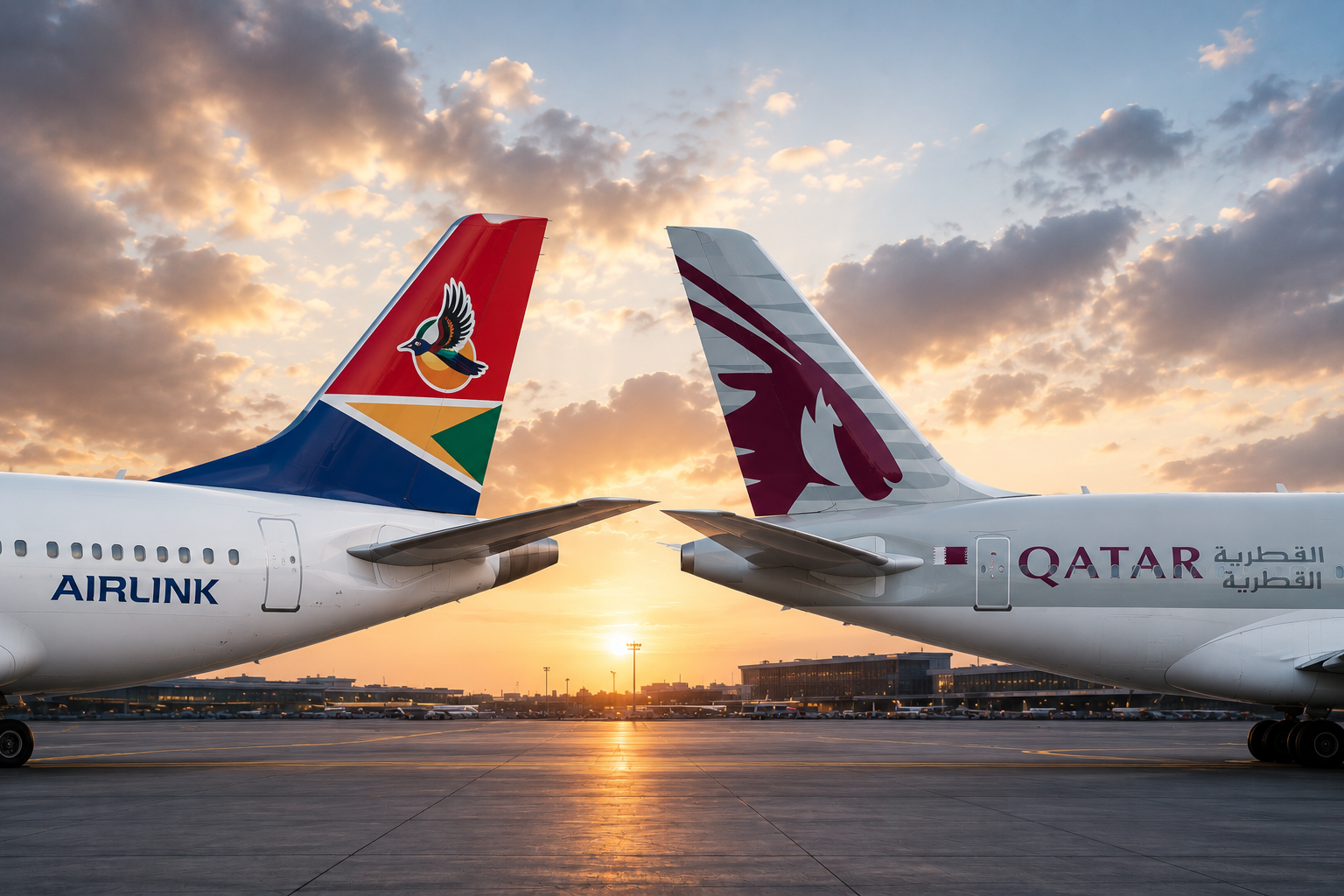
Airlink will begin placing its code on Qatar Airways-operated flights to Doha from 31 August 2026, giving the South African carrier its first long-haul codeshare destination and access to Qatar Airways’ network via its Hamad hub.
The arrangement covers Qatar Airways’ existing double-daily Johannesburg-Doha service, up to twice-daily Cape Town-Doha flights, and a daily Durban-Doha service routed via Maputo, all operated with Airbus A350 aircraft. Qatar Airways has said the codeshare partnership will extend to additional points across its network in the months ahead.
The move builds on a relationship that already runs deeper than a typical interline arrangement. Qatar Airways placed its own code on Airlink’s domestic and regional South African routes under a 2022 codeshare, and holds a 25 percent minority stake in Airlink acquired in 2024. The two carriers have also linked loyalty programmes since early 2025, with Airlink and Qatar Airways stating that Skybucks and Privilege Club members can earn and redeem across both carriers’ flights under the arrangement.
For Airlink, the Doha codeshare gives a regional carrier a credible long-haul on-ramp without the capital cost of widebody aircraft or new route authorities, leaning instead on Qatar Airways’ Hamad hub for onward connectivity. For Qatar Airways, it reinforces a South African footprint that the airline has built since its first flight to the continent in 1994, and adds feed from Airlink’s regional network at a time when Gulf carriers continue to compete aggressively for African connecting traffic.
An emerging pattern in Gulf-Africa distribution
The Airlink-Qatar Airways structure is a useful lens on a pattern we are watching take shape rather than a settled model. Qatar’s 25 percent stake makes this relationship unusually deep for the region, and it is not yet clear how representative it is of how Gulf carriers will approach African distribution more broadly. But it does illustrate one direction that relationship can take: an equity stake giving the Gulf carrier a degree of influence over network planning and loyalty integration that a standalone codeshare, negotiated at arm’s length, would not provide on its own.
For African carriers, the trade-off is straightforward: access to widebody long-haul capacity and a global hub in exchange for ceding some strategic independence to a partner with deeper pockets. Whether more African carriers follow this path, or whether Gulf carriers continue to rely primarily on conventional codeshare and interline arrangements elsewhere on the continent, is one of the open questions we expect to keep tracking in African distribution.
The Skybucks-Privilege Club tie-up is also worth watching on its own terms. Loyalty currency interoperability between an African regional carrier and a major Gulf programme is still uncommon, and any move toward reciprocal elite recognition or shared redemption inventory would be one of the more advanced loyalty integrations on the continent to date.
We will be watching whether the codeshare deepens into tighter reciprocal pricing arrangements as it expands beyond Doha.