
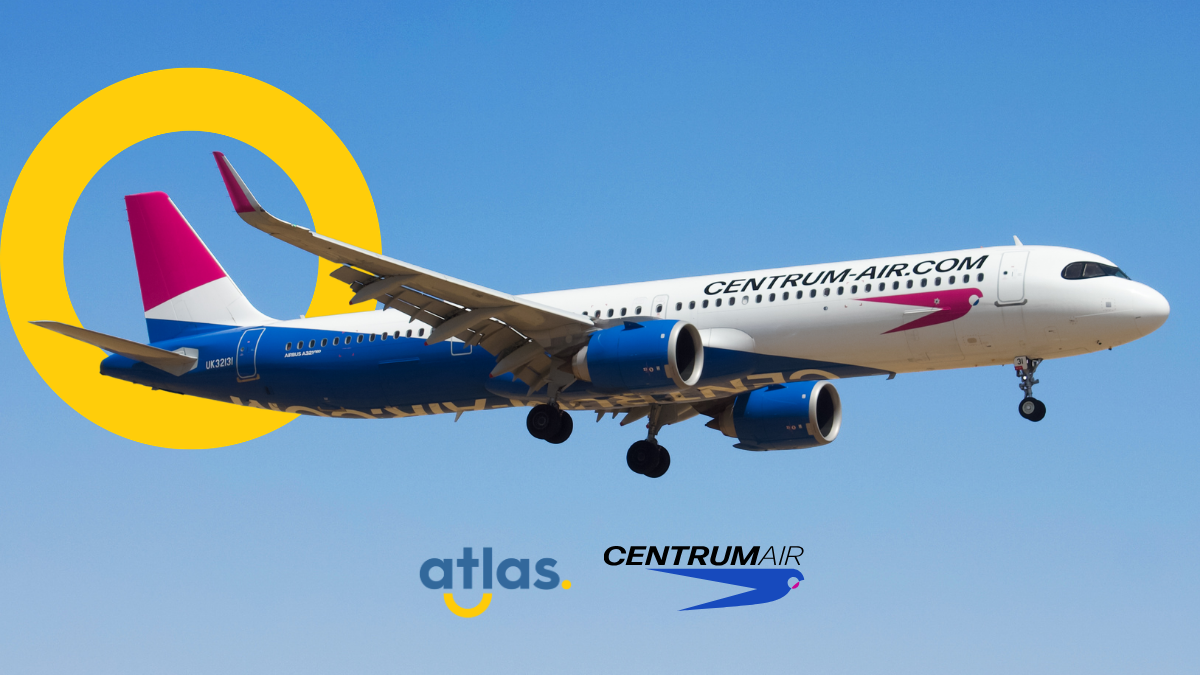
Atlas, the LCC-focused retailing and distribution platform, has signed a direct partnership with Centrum Air, Uzbekistan’s largest private airline, giving travel sellers connected to Atlas single-API access to a carrier that has been largely invisible to global distribution technology until now.
The mechanics of the deal are straightforward. Centrum Air operates a fleet of 16 Airbus narrow and widebody aircraft to more than 50 destinations spanning Central Asia, the CIS, the Middle East, South Asia and Europe. Through Atlas, travel sellers now get real-time fares, ancillaries and servicing on that network through one integration, rather than negotiating bilateral connections or relying on indirect channels. Atlas, in turn, extends Centrum Air’s reach into its network of OTAs, travel management companies and travel technology platforms.
What makes the announcement worth more than a passing mention is the framing both companies put around it. Clive Ashmore Butler, Atlas’s COO, described Central Asia as a region where “entirely new travel corridors emerge,” language that echoes a pattern TDN has tracked across other emerging markets: a fast-growing air travel market whose airlines are ready to sell internationally, but structurally out of reach of the distribution technology that would let them do so efficiently.
That gap is not unique to Central Asia. It is close to the exact shape of what this publication has called the Second-Speed Market problem in Africa, where carriers with real growth and real demand remain hard to book through modern retailing infrastructure because integration effort, aggregator economics and payments plumbing have not caught up with route growth. Uzbekistan’s aviation market has been growing quickly on the back of visa liberalization and tourism promotion, and Centrum Air itself has been expanding its Airbus fleet and route count for several years. What it has lacked, on Atlas’s account, is not demand but reachability.
That is a claim worth treating with some caution, since it comes from the companies announcing the deal rather than from independent data. Atlas’s own positioning, unifying “140+ LCCs” and citing “1B+ daily global searches” in its boilerplate, is the kind of scale claim trade press should note as asserted rather than verified. The commercial logic of the partnership, however, does not depend on those figures being exact. Atlas has built a business specifically around aggregating LCCs and value carriers that larger GDS-centric distribution has been slower to prioritize, and Centrum Air fits that profile closely: a private, fast-growing, non-legacy carrier in a market most global sellers have had little reason to study closely.
For travel sellers, the more interesting question is what this signals about Central Asia as a corridor, rather than about Centrum Air specifically. Uzbekistan Airways remains the flag carrier and dominant player in the market, but the appearance of a well-distributed private competitor changes the calculus for OTAs and TMCs building itineraries that route through or around the region, particularly for CIS-Middle East and CIS-South Asia connections that have historically depended on a small number of legacy hubs. If Centrum Air’s traffic responds to broader distribution the way comparable moves have played out elsewhere, this becomes a template other Central Asian carriers, and their eventual distribution partners, will want to study.
The deal also adds to a pattern in Atlas’s own strategy. The company has spent the past year building out partnerships with low-cost and value carriers in markets that sit outside traditional GDS priority lists, positioning itself as the connective layer for airlines that are growing quickly but were not built distribution-first. Centrum Air is the latest data point in that strategy, and probably not the last from a region where several private carriers are chasing similar growth without similar distribution infrastructure.
The real test is not the announcement itself but what happens to Centrum Air’s indirect booking volume over the next two or three quarters. Partnerships like this are common in travel technology PR and easy to announce; the harder proof is whether reachability actually converts into bookings for a carrier that, until now, most of the world’s travel sellers simply could not see. That is where TDN’s Second-Speed Market framework earns its keep: it is not enough for a market to be growing, or for an airline to sign an API deal. What matters is whether the distribution catches up to the demand quickly enough to matter, and Central Asia, like Africa before it, will be judged on that gap closing rather than on the press release that says it will.