
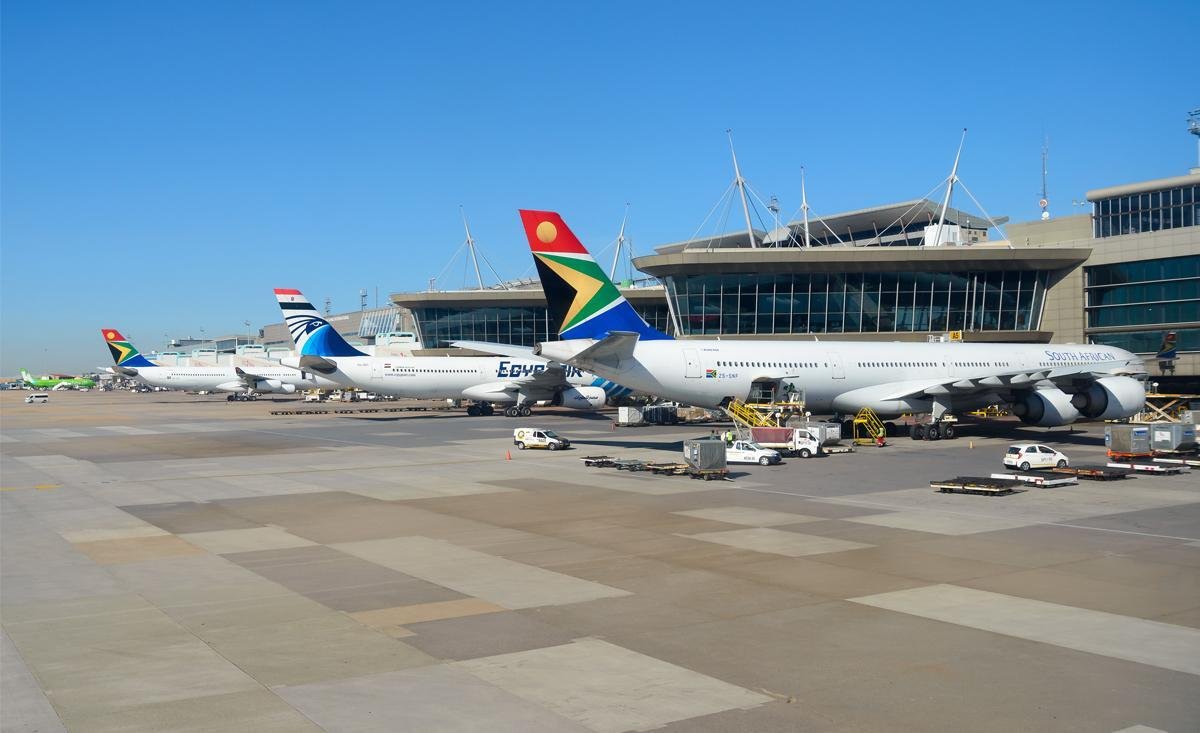
For nearly three decades Emirates and South African Airways have run a codeshare that only worked in one direction. SAA put its code on Emirates metal into Johannesburg, Cape Town, and Durban, and its passengers got interline access to Emirates’ network beyond Dubai. Emirates got nothing back on SAA’s own routes. That asymmetry ends now.
The two carriers have secured regulatory approval for an expanded, reciprocal codeshare covering nine cities, with Emirates placing its code on SAA-operated flights for the first time. Three of the new routes are domestic, linking Johannesburg with Cape Town, Durban, and Port Elizabeth. The other six reach into the region: Kinshasa, Gaborone, Windhoek, Lusaka, Harare, and Victoria Falls.
The commercial logic is straightforward. Emirates has spent thirty years building demand into Johannesburg from Europe and beyond, and until now that demand hit a wall at OR Tambo. Passengers wanting to continue on to Victoria Falls or Lusaka had to rebook, re-clear baggage, or find their own connection. A reciprocal code closes that gap without Emirates having to fly a single additional aircraft into the region itself. It borrows SAA’s domestic and regional network instead of building one.
For SAA, the value runs the other way. The airline gets to present itself as a genuine gateway carrier rather than a regional operator riding on Emirates’ long-haul reach, and Acting Group CEO Matshela Seshibe leaned into that framing directly, positioning the deal as reinforcing Johannesburg’s role as a continental hub for trade and tourism rather than simply a stopover.
What makes this worth watching from a distribution standpoint is less the route map and more the mechanics behind it. Reciprocal codeshares of this size only work cleanly when both carriers’ inventory, fare, and baggage systems talk to each other without friction, and getting South African domestic fares to behave properly inside an Emirates booking flow is not a trivial integration exercise. If it holds up at scale, it is a template other long-haul carriers serving Africa through a single gateway partner may look at closely, particularly ones facing the same one-way codeshare limitation SAA and Emirates have just resolved.
The bigger question is whether this marks a genuine SAA recovery story or simply Emirates hedging its African access through the partner it already trusts most. Either read is plausible. What is not in dispute is that Johannesburg just became a meaningfully easier single-ticket connection point for a swath of central and southern Africa that previously required separate bookings to reach.