
A co-branded card deal is less about plastic and more about who owns the customer relationship in African travel
Ethiopian Airlines and Visa have expanded their co-branded card partnership as the carrier pushes further into loyalty-driven commerce and digital payments. The announcement, made in late April, is short on specifics. But read against the broader architecture of airline retailing strategy, it reflects a deliberate commercial shift that other African carriers would do well to study closely.
Airlines Want More Than Ticket Revenue
For the past decade, the world’s largest airlines have been quietly restructuring their businesses around a core insight: the most resilient airline revenues increasingly come from activities beyond ticket sales.
Delta Air Lines generated approximately $7 billion from its SkyMiles loyalty program in 2023, with much of that value flowing from its co-branded card partnership with American Express. United Airlines and Chase have built a comparable machine. These programs are not peripheral; they are, in a meaningful sense, the profit engine of the airline. The ticket is increasingly the entry point to a broader commercial relationship.
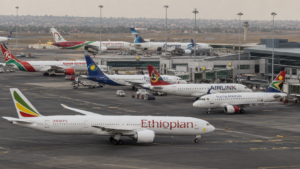
Ethiopian Airlines is Africa’s largest carrier by nearly every metric, operating to more than 145 destinations with a growing intercontinental footprint. It runs ShebaMiles, one of the continent’s most recognized frequent flyer programs. The partnership with Visa is, at its core, an attempt to convert that loyalty currency into a financial product that generates revenue independent of whether a passenger is actively flying.
The Card Is the Distribution Channel
Co-branded credit cards matter in airline strategy for reasons that go beyond fee income. They create a daily touchpoint with the customer that the airline would otherwise never have. Every transaction made on a ShebaMiles Visa card becomes both a loyalty interaction and a source of customer data. The airline becomes present in the customer’s life in a way that no flight notification or booking reminder can replicate.
This is precisely why airlines that have built strong co-branded card programs tend to exhibit higher customer lifetime value and lower churn from their loyalty programs. The card creates a financial habit layered on top of a travel habit, and the two reinforce each other.
For Ethiopian, expanding this product family across its African network means pursuing a customer base that has historically been underserved by traditional banking infrastructure, but is increasingly reachable through digital and card-based financial products. That is not a trivial opportunity.
Visa’s African Aviation Calculus
Visa’s interest in this partnership is equally strategic. Africa remains one of the fastest-growing regions for intra-continental air travel, and the shift from cash to card-based payments in aviation is still at an early stage across much of the continent. Airline point-of-sale environments, particularly in markets with complex payment infrastructure, represent a meaningful growth vector for global payment networks.
By anchoring its African aviation presence through the continent’s dominant carrier, Visa secures a distribution pathway into a customer segment that is financially ascending, internationally mobile, and brand-engaged. The Ethiopian brand carries credibility across East and Southern Africa, West Africa, and a significant diaspora network. That is a customer acquisition channel that Visa cannot easily replicate through organic means.
From Carrier to Commerce Platform
The broader strategic frame here is the shift African airlines will need to make if they want to build durable businesses. Airlines that remain purely in the business of moving passengers are structurally exposed to fuel costs, yield compression, and distribution fees they cannot control. Airlines that build financial and loyalty ecosystems around their passenger base accumulate assets and revenues that are far more defensible.
Ethiopian appears to understand this. Its agreement with Visa is not an isolated payments deal. It sits alongside NDC adoption efforts, ancillary revenue expansion, and a hub strategy at Addis Ababa Bole International that is deliberately built to capture connecting traffic rather than just origin-destination demand. The commercial logic is consistent: build a platform, not just an airline.
What Smaller African Carriers Must Consider
Not every African airline can replicate the Ethiopian model at scale. But the underlying principle is accessible. RwandAir, Kenya Airways, Air Senegal, and others all carry loyalty programs with genuine passenger affinity. The question is whether those programs are being treated as strategic assets or as operational afterthoughts.
The convergence of airline loyalty, fintech, and digital payments is accelerating across emerging markets. Mobile money operators, regional banks, and global payment networks are all competing for the same wallet share. African airlines that move early to formalize financial product partnerships will control more of the value chain. Those that wait will find the financial relationship with their passengers increasingly mediated by third parties.
The Ethiopian-Visa agreement is a data point in a longer story. That story ends with African aviation’s most competitive carriers resembling financial services companies as much as transportation providers.
Travel Distribution News covers airline distribution, NDC, travel payments, and travel technology with a focus on Africa and emerging markets.