
There is a question the airline industry rarely asks in quite these terms. If hotel groups have spent more than a decade trying to move customers away from online travel agencies, investing in loyalty programmes, direct booking campaigns and member only rates, why have airlines not followed the same path?
The answer is not that airlines failed to understand distribution. It is that airlines are not selling the same kind of product. Marriott can spend years convincing a traveller to book directly because by the time that traveller searches for a specific Marriott property, much of the commercial decision has already been made. The customer has chosen the hotel. The brand’s challenge is simply to capture the transaction without paying someone else to do it.
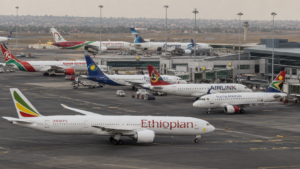
An airline faces a different problem. A traveller searching Kigali to London has not necessarily chosen an airline. They have chosen a journey, and they may be comparing Ethiopian, Qatar Airways, Turkish, Emirates or British Airways, each offering some combination of price, connection and schedule. The airline is not simply competing to capture a booking. It is competing to become the preferred answer to a question that may not have been asked inside its own ecosystem at all.
That difference explains much of the distribution architecture that exists today, and it explains why the industry’s current distribution revolution is not really about eliminating intermediaries. It is about airlines trying to take back control of what happens inside them.
A hotel room is a product. A flight is part of a network.
Both industries face real comparison shopping, and both offer a direct channel once that comparison resolves. A traveller who decides on Kigali Marriott can go straight to the brand’s own site. A traveller who decides on Kenya Airways can do exactly the same thing. The direct channel is not the differentiator.
What differs is how often each decision actually survives long enough to reach that direct channel, and why. A meaningful share of airline trips cannot be completed on one carrier’s own site at all, because the itinerary depends on a connection, a codeshare or an interline agreement that spans more than one airline. A hotel stay is almost never assembled across brands this way. And even when a flight is a simple point to point route where going direct is entirely possible, the comparison tends to re-trigger on nearly every trip. A fare or schedule advantage that sent a traveller straight to one airline’s site last month rarely carries over to the next route they fly, in the way a hotel guest’s preference for one brand tends to travel with them from city to city.
So the honest claim is not that hotels have a direct channel and airlines do not. Both do. It is that a larger share of hotel bookings survive the comparison stage into a direct, brand-owned transaction, because the product is self-contained and the preference is portable across trips. A larger share of airline bookings stay inside a comparison environment, either because the itinerary requires more than one carrier to assemble, or because the reason to skip comparison rarely holds from one trip to the next.
The intermediary is solving a problem airlines cannot wish away
It is tempting to describe OTAs, GDSs and TMCs as an unnecessary layer between airlines and customers. That description misses why they became powerful in the first place. Their value comes from aggregation, and aggregation is especially valuable in aviation because what a passenger is buying is frequently not an airline but an itinerary.
Consider that same Kigali to London search. The relevant question is not which airline has the best flight, but which combination of flights produces the best overall journey. One carrier may have the strongest first sector, another the better connection, another the more attractive baggage terms, another the lowest total fare. Codeshares, interline agreements and alliance connections mean the journey the traveller wants may not belong to a single airline at all. Nobody needs Marriott to aggregate the entire hotel market before deciding whether they want the Marriott they have already chosen. A flight search is fundamentally more comparative, and the intermediary is solving a real problem, not manufacturing one.
Corporate travel deepens this further. Travel management companies sit inside workflows involving policy, approvals, negotiated fares, expense integration and duty of care reporting that airline.com was never designed to replicate. A corporation does not want to buy from one airline. It wants to manage travel across an entire network of carriers, which makes aggregation valuable to the enterprise as well as the traveller. A corporate hotel programme can encourage employees toward one brand’s ecosystem relatively cleanly. Corporate air travel is structurally spread across carriers in a way no single airline website can absorb.
The economics are different, not just the fees
It is easy to say airlines should eliminate distribution costs because intermediaries charge money. But the comparison to hotel commissions understates how different the two businesses are. Hotel inventory is relatively low variable cost once a property exists, and yield management is mostly about filling rooms at the best achievable rate. Airline inventory sits inside a shorter, more volatile booking curve, with fare classes, connecting traffic and dynamic pricing interacting on a single flight in ways one hotel room rarely does.
Ancillary revenue has also transformed what an airline is actually trying to sell. Seats, bags, priority boarding, lounge access and bundled fares now sit at the centre of airline profitability in a way they do not for most hotel groups, and legacy GDS architecture was built primarily to distribute fares and availability, not to carry a richly merchandised, personalised offer. The issue is not simply that the intermediary charges a fee. It is whether the intermediary’s pipe can carry the product the airline actually wants to sell today.
Direct distribution and direct control are not the same thing
Hotels largely fought their distribution battle by making the direct channel more attractive. Airlines are pursuing something more complicated: the reach of indirect distribution without surrendering control of the product. An airline does not need every passenger to book on its own site. It needs to control what is being sold, how it is priced, which ancillaries are attached and how the offer is presented, regardless of where the transaction happens.
That is why NDC matters more than its technical reputation suggests. Framed only as a booking standard, it looks like plumbing. Framed correctly, it is a mechanism for moving offer creation and merchandising back toward the airline even when the customer interaction happens inside a TMC or OTA interface, as carriers like Lufthansa and Emirates have been testing at scale. Direct distribution means the customer books with the airline. Direct control means the airline controls the offer even when the customer books through someone else. Those are not the same thing, and the second may ultimately matter more.
The real battle is not airline versus OTA
The distribution debate is often framed as airlines against intermediaries. That framing is too crude. The more important question is who controls the transaction. An OTA can remain the customer’s interface while the airline controls the underlying offer. A TMC can remain the corporate booking tool while the airline controls the content flowing through it. The airline is no longer necessarily trying to remove the intermediary. It is trying to prevent the intermediary from becoming the place where the commercial proposition itself gets defined.
None of this makes GDSs, OTAs or TMCs obsolete, and it would be a mistake to read the shift that way. GDSs became powerful because they solved real problems of aggregation, settlement and global connectivity that airlines could not solve alone, and TMCs and OTAs still provide reach, comparison and enterprise infrastructure no single carrier replicates. The honest question is not whether intermediaries are useful. They clearly are. It is whether the architecture built for yesterday’s distribution problem, largely fares and availability, remains optimal for a retailing model built around dynamic, personalised offers.
Why airlines cannot simply copy Marriott
This is where the hotel analogy finally breaks. Hotels can tell a customer: you want this property, book it here. Airlines have to answer a harder question: you want to get from here to there, and there are several ways to do it. That is not a technology gap airlines can close with a better app or a more generous loyalty tier. A traveller may still want to see the whole market. A corporation may still need to manage several carriers at once. A passenger may still need a journey assembled from more than one airline. The objective for airlines was never going to be making the intermediary disappear. It is changing what the intermediary is allowed to control.
What happens next
For decades, airlines largely accepted a distribution architecture in which other companies sat between their inventory and the customer. NDC and modern airline retailing represent an attempt to redraw that relationship, not by forcing passengers back to airline.com, but by making sure the airline’s own offer engine, pricing logic and merchandising strategy determine what is actually being sold, no matter which interface the customer is sitting inside.
The airline wants to become the merchant again. Not necessarily the seller.
Hotels fought to move the customer closer to the brand. Airlines are fighting to move the economics closer to the airline. Those may sound like the same battle. They are not, and understanding the difference is the key to understanding where airline distribution actually goes next.