
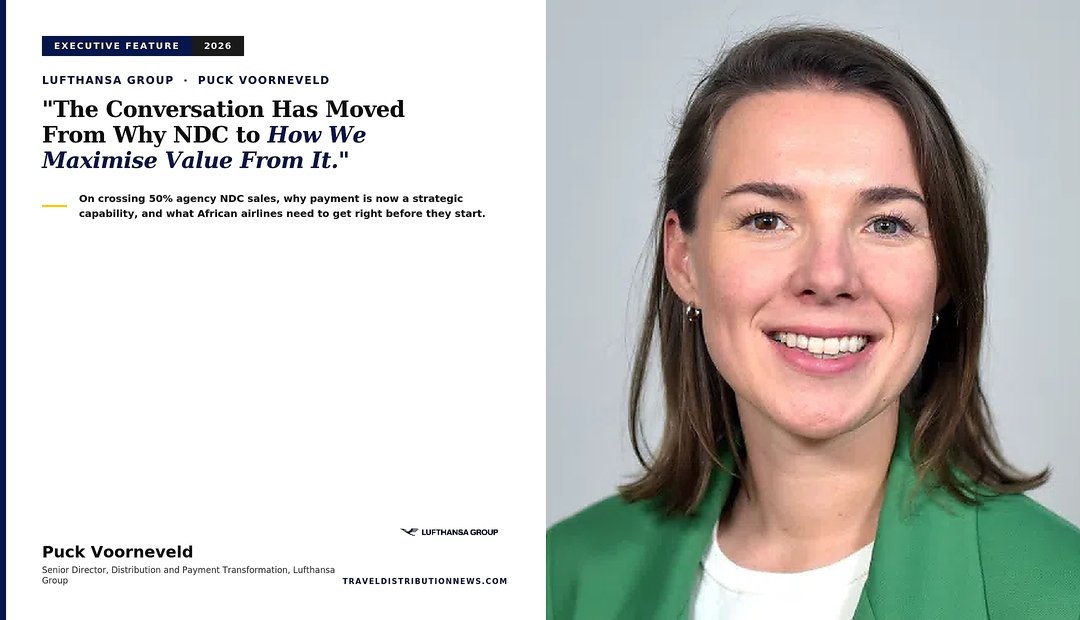
The Senior Director of Distribution and Payment Transformation at Lufthansa Group on how one of the industry’s most advanced NDC programmes crossed 50% agency sales, why payment is now a strategic capability not a back-office function, and what African airlines need to get right before they start.
By Gustave Sugira | Travel Distribution News
There is a version of NDC transformation that exists primarily in press releases. Announcements, roadmaps, go-live dates, and percentage targets that tell the market what an airline intends rather than what it has delivered.
Lufthansa Group is not that version.
When Puck Voorneveld, Senior Director of Distribution and Payment Transformation at Lufthansa Group, discusses NDC, she is discussing a programme that has already crossed 50 percent of Lufthansa Group agency sales generated through NDC, and that sells three times more ancillaries through NDC than through EDIFACT. The numbers are specific and measurable. In a market full of NDC ambition, they offer one of the clearest available pictures of what genuine transformation at scale actually produces, and what it requires to get there.
The Hardest Conversation
Asked what the single most difficult internal conversation was in making Lufthansa Group’s NDC commitment happen, Voorneveld does not reach for a strategic answer. She names the operational one.
“Addressing concerns around servicing capabilities, which traditionally represented one of the biggest barriers to large-scale agency adoption,” she says.
Servicing readiness, the ability to manage changes, cancellations, reissues, and disruption handling reliably through NDC rather than legacy EDIFACT channels, was the point where internal and external resistance was most concentrated. Agencies would not move volume through NDC if servicing was unreliable. Internal teams would not commit to the transformation if the operational infrastructure could not support it. The circle had to be broken from both sides simultaneously.
What broke it was demonstrating that operational challenges could be solved through sustained investment and genuine partner collaboration, not by asserting that the standard was mature enough and expecting confidence to follow. Training 600 servicing agents as part of that effort was a concrete investment in making the operational case real rather than theoretical.
“Today, the results speak for themselves,” Voorneveld says. “More than 50% of Lufthansa Group agency sales are generated via NDC and we sell 3x more ancillaries in NDC vs EDIFACT.”
“Showing that NDC is the new standard for us in B2B sales helps in fostering process changes within our own organisation,” she adds.
Real Traction Versus Checkbox Compliance
The distinction between airlines that have technically gone live with NDC and airlines that are generating meaningful commercial outcomes from it is one of the most important and least discussed gaps in the distribution industry’s progress narrative.
Voorneveld’s answer to how Lufthansa Group distinguishes real traction from checkbox compliance is anchored in content exclusivity.
Lufthansa Group distributes fares through NDC that are simply not available through EDIFACT: Basic and Light fares, carry-on and extra-luggage variations, premium economy and business class light options, sustainable aviation fuel offers, and Continuous Pricing, which delivers an average of 10 percent in savings to customers compared to traditional filed fare structures.
“The conversation has evolved from ‘Why NDC?’ to ‘How do we maximise value from NDC?'” she says.
That shift in the question being asked is the most reliable indicator of whether an NDC programme has moved from compliance into genuine commercial operation. Airlines still answering “why” have not crossed the threshold. Airlines debating “how to maximise” have.
The content exclusivity model is a major part of that shift for Lufthansa Group. When the best fares, the most flexible options, and the richest ancillary catalogue are only accessible through NDC, agencies have a commercial reason to invest in the integration that no amount of industry advocacy can manufacture artificially.
Payment as a Strategic Capability
The argument Voorneveld makes on payment, that it is a strategic capability rather than a back-office function, surfaces in different forms across TDN’s payment coverage. What Lufthansa Group’s experience adds is the specific account of what the internal shift looks like inside a large carrier when it actually happens.
“Modern retailing requires distribution, offer management, order management, and payments to work together,” she says. “The first mindset shift must happen across commercial, distribution, finance, and digital teams, not only within payment departments.”
The nuance in that framing is important. The payment team cannot carry this transition alone, and treating it as a payment department problem is one of the most common ways large carriers stall. Lufthansa Group’s payment and distribution teams triggered the strategic discussion internally, but making it real required pulling commercial, finance, and digital into the same conversation and building a shared understanding that payments are not downstream of the offer. They are part of it.
That internal architecture, payment embedded in the commercial and offer management process rather than appended to it, is what separates carriers that have repositioned payment strategically from those that have rebranded their treasury function and called it transformation.
Global Architecture, Local Execution
Lufthansa Group operates across markets with fundamentally different payment infrastructure, consumer behaviour, and regulatory environments. The approach Voorneveld describes to managing that complexity is one of the clearest articulations of the global-local tension in airline payments TDN has published.
“The strategy should be global in architecture but local in execution,” she says. “Core principles such as NDC versions and modern payment capabilities can be standardised globally. Customer expectations, payment methods, and market maturity differ greatly and require local adaptation.”
The examples she gives are specific. Twint in Switzerland, where the mobile payment platform has achieved deep consumer adoption. Instalment payment options in NDC in Brazil, where consumer purchasing patterns make deferred payment a meaningful conversion lever. And, of particular relevance to TDN’s audience, active exploration of a mobile money solution for Africa and the acceptance of further local currencies across the continent.
“We are not there where we want to be yet with localisation,” she says, “but are investing step by step in targeting our offers to a global customer base.”
That candour about the gap between ambition and current reality is one of the most useful things a carrier of Lufthansa Group’s scale can contribute to the market conversation. The mobile money Africa exploration, still in progress rather than deployed, is a signal worth noting: one of the world’s most distribution-sophisticated airline groups is treating African payment localisation as a strategic priority, not an afterthought. For airlines and payment infrastructure providers working in those markets, that is a meaningful directional indicator of where global carrier strategy is heading.
What African Airlines Need to Get Right First
Asked directly for the single most important piece of advice she would give an African airline CCO beginning the NDC and modern retailing journey, Voorneveld bypasses technology entirely.
“My advice would be to secure executive alignment and funding before focusing on the technology,” she says. “NDC and modern retailing are business transformation programs that require sustained investment, cross-functional resources, and long-term commitment.”
Her prescription is straightforward and deliberately sequenced. Before the technology conversation starts, a CCO needs to align the commercial strategy, defining clearly what offers belong in which channels and what relationships with key providers need to be renegotiated. Before the implementation begins, the CEO and CFO need to understand the strategic value, the expected benefits, the required investment, and the transformation roadmap.
“Our experience has shown that the technology itself is often not the biggest challenge, neither are the customers. They are ready if commercial value is there. The real challenge is mobilising the organisation and the wider ecosystem around it.”
That observation, technology is rarely the bottleneck, organisation and ecosystem are, is one of the most consistent themes across TDN’s interviews with carriers at different stages of this transformation. Airlink’s Katherine Whelan said there should be no expectation of a quick win. NuFlights’ Mohandas Unni said 60 percent of the work begins after the ticket is issued. AFRAA’s Abderahmane Berthé said the deficit of skilled digital talent is the most consequential barrier. Lufthansa Group’s programme, now producing 50 percent NDC agency sales, is the evidence that working through those organisational challenges is what eventually produces the commercial outcome.
Radical Collaboration
The gap Voorneveld identifies between how the industry talks about distribution transformation and what is actually happening on the ground is the sharpest, most consequential point in this interview.
“The biggest gap is that industry transformation is often discussed as an airline-led technology migration, while it is a full ecosystem transformation,” she says. “Airlines can invest in modern retailing, NDC, Offer and Order, and new distribution capabilities, but the benefits will remain limited if sellers, TMCs, aggregators, OBTs, GDSs, and technology providers do not evolve at the same pace.”
Lufthansa Group’s term for the response to that problem is “radical collaboration,” a deliberate and structured approach to pulling the entire ecosystem into the transformation rather than expecting the airline’s own investments to produce results in isolation. The evidence that this approach works: rapid NDC adoption in the corporate segment, with agencies and TMCs now asking “how” rather than “why.”
That shift in the question the ecosystem is asking is, in her framing, the real measure of progress. Not the airline’s internal go-live metrics. Not the percentage of API calls that resolve successfully. The point at which the broader community of sellers, buyers, and technology providers stops debating the destination and starts working on the route.
Five Years From Now
Voorneveld’s vision for what success in airline distribution looks like in five years is one of the most specific forward-looking assessments TDN has published, precisely because it comes from an organisation already more than halfway through its own journey toward it.
Success means NDC reaching maturity as a single standard across the industry, with Lufthansa Group itself moving toward sunsetting EDIFACT within an end-to-end solution where servicing works fully and customers experience real value creation across every interaction.
The thing the industry is most underestimating, in her assessment, is the same lesson Lufthansa Group’s own transformation has reinforced at every stage.
“This transformation cannot be delivered by airlines alone,” she says. “Success depends on early and active involvement of the entire ecosystem, including TMCs, agencies, GDSs, OBTs, payment providers, mid- and back-office vendors, and other third-party technology partners.”
The road from 50 percent to 100 percent is where the hard work begins.
Puck Voorneveld is Senior Director, Distribution and Payment Transformation at Lufthansa Group. Lufthansa Group is one of the world’s leading aviation groups, operating airlines including Lufthansa, SWISS, Austrian Airlines, Brussels Airlines, and Eurowings.
Travel Distribution News covers the business of airline distribution, NDC, GDS dynamics, payments, and emerging markets. Subscribe at traveldistributionnews.com