
Across Africa, airlines are running on distribution infrastructure capable of NDC. Most have chosen not to use it.
Book a flight on a major East African full-service carrier and watch the URL. Then manage your booking. Then check in online. At every step of the passenger journey, reservation, seat selection, check-in, an Amadeus domain is present. The booking engine, the management portal, the check-in flow: all Amadeus-hosted, all Amadeus-powered.
That is not a partial integration. That is a carrier that has handed full control of its retail infrastructure to a third party, then done nothing with the distribution capability that same infrastructure makes available. The gap between where these carriers sit and NDC-active distribution is not a technology problem. It is a decision that has not been made.
And across the continent, it is the same decision, unmade, over and over again.
The infrastructure is ahead of the intention
The standard explanation for Africa’s NDC lag points to agency dependency, legacy GDS contracts, and limited internal technical capacity. That narrative hides the real issue.
PSS modernisation has moved faster than distribution activation across the continent. Amadeus Altéa is the platform of choice for a range of African full-service carriers. Navitaire serves a significant share of the low-cost segment. Both carry NDC capability built in or available as a module. Airlines running on these systems are not starting from scratch. They are already inside the infrastructure, paying for it, and leaving its most commercially valuable layer untouched.
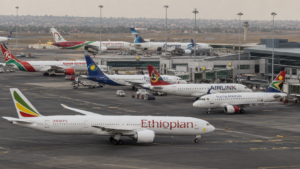
Kenya Airways, Ethiopian Airlines, and FlySafair are the confirmed NDC go-lives on the continent, carriers that have made deliberate moves into modern distribution. Ethiopian signed with Accelya’s FLX Select platform. FlySafair has been consistently cited as among the more progressive African carriers on distribution. Kenya Airways has been active across multiple platforms.
Beyond those three, the picture goes quiet. Not because the infrastructure is absent. Because the will to activate it is.
Silent go-lives and the undercounted record
The public record of African NDC adoption understates reality. Aggregators like TPConnects, Verteil, and Duffel add airlines to their platforms without press releases. A carrier can go live on an aggregator’s NDC feed with no announcement, no industry coverage, and no awareness among agents unless they happen to pull the content.
TPConnects added more airlines, including low-cost carriers, to its aggregator platform in the past year than in any previous period. It has not named them all. Verteil has been expanding its African footprint without fanfare. The go-lives that generate press releases are the minority.
The result is a structural blind spot. Observers, agents, and competing carriers are all working from an incomplete map. The true state of NDC activation across African aviation is unknown, and given the continent’s general reticence on distribution strategy, likely to stay that way.
Why the switch stays off
For carriers with the infrastructure but without activation, the reasons are consistent.
The first is the absence of internal ownership. NDC activation requires someone who understands the commercial case, can coordinate across IT, revenue management, and distribution, and is willing to drive the project through procurement. At many African carriers, that person does not exist in a formal capacity. Distribution strategy is spread across departments with no single champion and no urgency from the top.
The second is market inertia. Where the majority of ticket sales flow through a small number of GDS-connected agencies, there is no pressure from the trade to change. Agents are not asking for NDC content. Airlines see no demand signal and do not create one.
The third is a persistent misreading of complexity. TPConnects has said it can deploy an NDC solution for an airline in twelve weeks. The airlines that have not done it tend to frame it as a multi-year infrastructure overhaul. The perception of difficulty exceeds the actual difficulty, and the project never gets to the top of the list.
The fourth is commercial ambivalence. NDC gives airlines the tools to price dynamically, attach ancillaries at higher rates, and present differentiated product across indirect channels. But using those tools requires revenue management and merchandising capability that many African carriers are still building. The infrastructure is ready. The organisation behind it often is not.
The competitive clock is running
What makes inaction increasingly costly is what is happening everywhere else.
Emirates, Qatar Airways, and Etihad are deep into NDC and offer and order transformation. They are not waiting for African carriers to catch up before competing on the same routes. Turkish Airlines introduced a distribution cost recovery fee on EDIFACT bookings in 2024, a signal that the surcharge era, already felt in Europe and North America, is moving closer to markets where African carriers operate and connect.
Global carriers with mature NDC programmes are able to present richer content, more competitive bundles, and better ancillary offers through indirect channels than African carriers distributing the same itinerary via EDIFACT. That is not a future risk. It is the current state of play on routes where African and non-African carriers sit side by side in a GDS display.
Every month of inaction widens that gap.
What staying still costs
The airlines that have activated NDC are reporting measurable outcomes. Higher ancillary attach rates. Better content parity between direct and indirect channels. Reduced dependency on static fare filing. For carriers operating on thin margins across competitive short and medium-haul routes, the difference between a 5 percent and a 30 percent ancillary attach rate is not marginal. It is structural.
African carriers sitting on Altéa or Navitaire without activating NDC are not holding a neutral position. They are actively ceding retailing ground to carriers that made the decision years ago, while continuing to pay for distribution infrastructure whose most valuable capability they have never switched on.
The URL that surfaces at every stage of a booking on a major East African carrier tells a precise story: full infrastructure dependency, zero distribution leverage. The tools to change that are already installed. What is missing is not technology. It is not budget. It is the decision to act, and the leadership to make it.
That will not hold indefinitely. The carriers that wait for external pressure to force the move, whether from agency surcharges, PSS vendor mandates, or the widening content gap with Gulf competitors, will make the transition on worse terms than those who move now.
The switch is there. The cost of leaving it off is compounding.