

Sabre has announced the first global travel plug-in for Grok, and the pitch is easy to repeat: travellers shop flights and hotels in conversation, then book and manage the whole trip without leaving the chat. That is the least difficult part of the announcement. AI trip search is already crowded, and booking through a chat window is a new front end on plumbing that has existed for decades. The claim worth testing is the one underneath it, that software can spot a disruption and offer the fix before the traveller asks.
Sabre says the Mosaic Travel Connector is an invitation-only beta for travellers and travel managers. It draws on a marketplace that Sabre describes as more than 400 airlines, around 150 of them low-cost carriers and more than 40 live NDC airlines, plus roughly two million lodging options. Garry Wiseman, Sabre’s President of Product and Engineering, told TDN that the connector links directly to Sabre’s marketplace and not to scraped airline or hotel websites. He also said travellers will “ultimately” be able to book and manage a trip through the plug-in, which suggests the full journey is still to come. This is a preview, and those figures describe Sabre’s network, not what a Grok user can buy today.
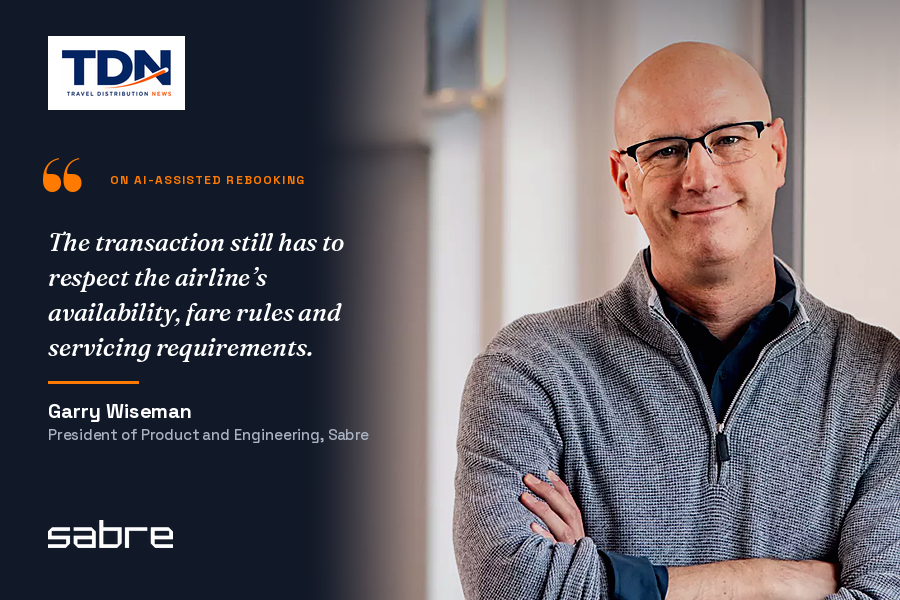
The more consequential part is the event-driven APIs. Sabre says they monitor disruption signals around the clock, identify the travellers affected when a flight is delayed or cancelled, and push that information into agency systems and connected AI tools. From there, a human advisor can step in, a conversational interface can offer options for one-tap approval, or an automated workflow can act within agreed rules. Wiseman stressed that any fix must respect the airline’s availability, fare rules and servicing requirements.
That is where the open questions sit. TDN asked who is the merchant of record when a traveller books through the plug-in. Wiseman said Sabre is not becoming a consumer travel agency, and that fulfilment, ticketing and merchant-of-record responsibilities follow existing structures with the participating travel seller or supplier. Refunds, exchanges and rebooking fare differences, he said, follow supplier rules and authorised servicing processes. Sabre did not name the travel sellers taking part in the beta. Nor did it say who is accountable if an offer shown in chat differs from what the airline’s own systems then allow.
A beta preview is not the place for a full liability framework, so this is not a criticism of Sabre. It does show where the difficulty lies. Rebooking a disrupted passenger can involve the ticketing carrier, the seller, the payment route and sometimes another airline’s inventory. A chat interface that presents an option with confidence is making a promise, and someone has to stand behind it. In Sabre’s account, it supplies the infrastructure, the seller remains the seller, and the airline’s rules decide. The traveller, meanwhile, sees only the bot.
On geography, Wiseman said Sabre sees the opportunity as global, including the Middle East and Africa, but did not announce a market-by-market rollout. He declined to break out commercial terms with Grok or any other platform. He said more than 80 partners are in pilot or production with Sabre’s MCP services, which Sabre has run since 2025, and that the architecture is built to extend to other AI platforms. For airlines and agencies in emerging markets, the practical test is whether live NDC content, local payment methods and servicing rights can all be reached through such a channel.
Sabre cites more than 40 live NDC airlines within a network of more than 400, though the two figures count different kinds of connection and are not a like-for-like measure of coverage. What matters is how much post-booking servicing, such as changes, exchanges and refunds, those NDC connections can support through an AI channel, which agencies have long found difficult.
The booking is the easy part, and Sabre has plenty of rivals able to do it. Whoever controls servicing, meaning airline permission, payment and accountability, controls the channel. Sabre’s event-driven approach is a credible bid for that position. It will be proved when a flight is cancelled and the offer in the chat does not match the airline’s system, not at launch.