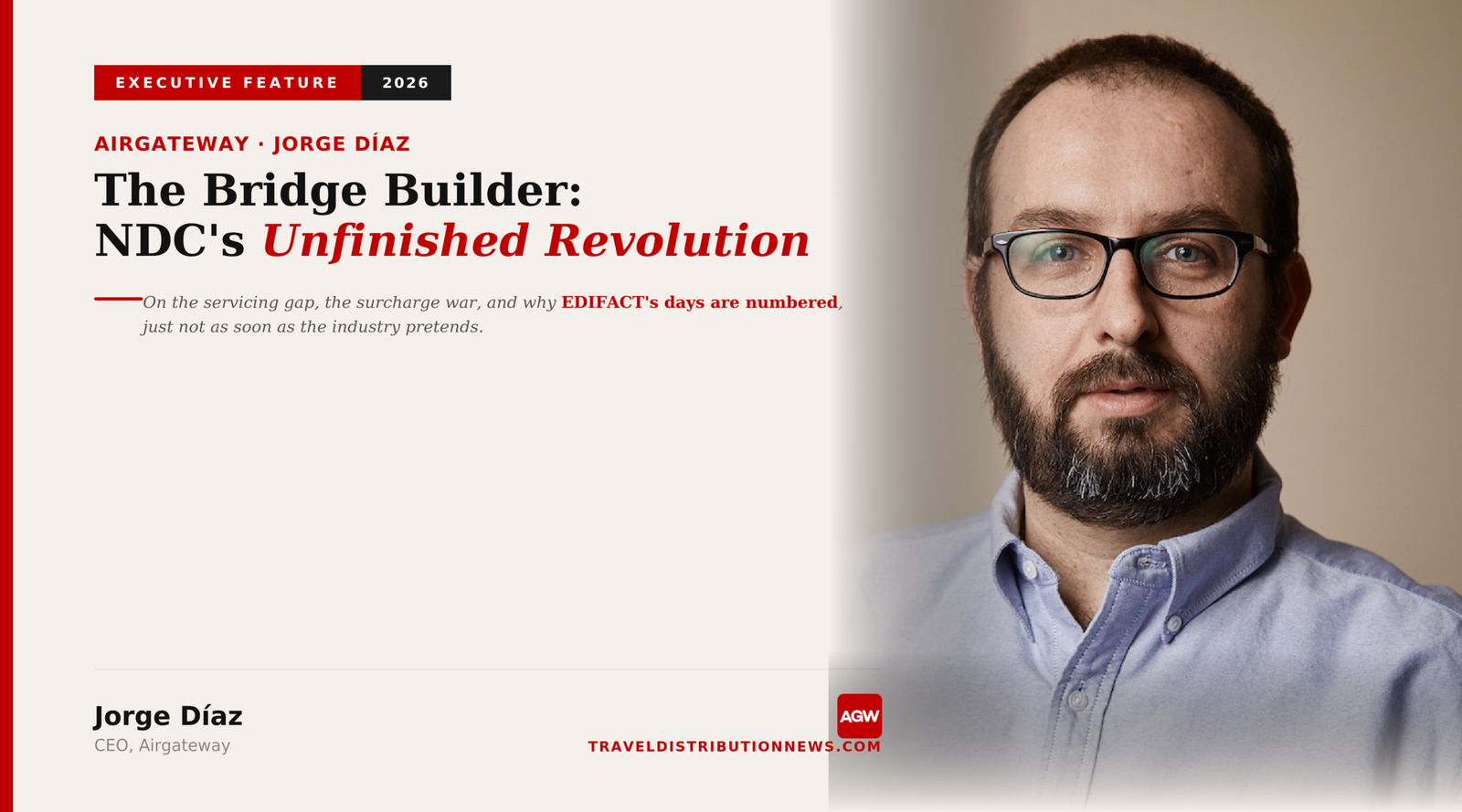
The AirGateway CEO pulls no punches on the servicing gap, the surcharge war, and why EDIFACT’s days are numbered just not as soon as the industry pretends
Travel distribution has a talent for declaring victories prematurely. NDC has been “accelerating” for the better part of a decade. Airlines have been “moving to direct retailing” since before some of today’s distribution startups were founded. The gap between what the industry announces and what it actually delivers has become something of a running joke among the people who have to make it work every day.
Jorge Díaz is not laughing, but he is clear-eyed. As CEO of AirGateway, the Berlin-based NDC aggregator and technology provider, he sits at the intersection of airline ambition and agency reality, building the connective tissue that determines whether the industry’s retailing revolution actually lands. In a written interview with TDN, he offers a frank assessment of where distribution stands, what’s still broken, and why the endpoint of this transition is a multi-source world, not the clean EDIFACT-free future that industry conferences tend to promise.
“Few Can Rebook Without Manual Intervention”
Ask Díaz about NDC progress and he reaches quickly past the headline metrics.
“We see NDC adoption accelerating rapidly as airlines move beyond ‘checkbox’ connectivity to true retailing,” he says. “However, the biggest obstacles remain technical fragmentation and the servicing gap.”
That second phrase deserves attention. The servicing gap is the dirty secret of NDC’s current phase: airlines and aggregators have gotten reasonably good at the front end, shopping, pricing, booking, while the post-booking layer remains largely manual. A disrupted itinerary, a refund request, a schedule change. The moments that define whether a distribution relationship actually works.
“While many can ‘shop and book,'” Díaz observes, “few can seamlessly rebook or refund without manual intervention.”
For corporate travel managers and agency operations teams processing hundreds of transactions daily, that gap is not a technical footnote. It is an operational liability that directly affects decisions about how much NDC volume they’re willing to absorb. Until post-booking servicing achieves parity with what EDIFACT enables today, imperfect as that is, the ceiling on real NDC adoption remains lower than the adoption curves suggest.
AirGateway’s response has been to build a unified workflow that keeps the full transaction lifecycle inside a single environment. The bet is that eliminating handoffs between booking systems and servicing tools will do more for adoption than any number of additional carrier connections.
The Ecosystem Readiness Misunderstanding
The industry has spent years debating whether travel agencies are “ready” for NDC, a framing Díaz finds too narrow.
“Ecosystem readiness is widely misunderstood as simply avoiding fragmentation,” he says. “While aggregation is a critical first step, it is only the beginning of the journey.”
True readiness, in his view, is defined by functional completeness: not just aggregated access to NDC content, but full support for the native capabilities that airline NDC actually offers. Complex servicing. Automated rebooking and cancellations. Fare shopping for corporate, VFR, and special categories. None of that matters, however, if it disrupts the downstream infrastructure that agencies have built over decades.
“Success for agencies and corporate buyers means achieving this high level of functionality while keeping established operational processes intact,” he says. This requires seamless back-office integration for MIR and AIR files, continuity of traveler and corporate profiles, and the ability for OBT and CBT platforms to consume modern NDC content without rebuilding their data models.
It is a more demanding definition of success than the industry typically uses, and a more honest one. An agency that can book NDC fares but cannot reconcile them in their back office, or loses corporate profile data in the process, has not successfully adopted NDC. They have added a fragile parallel workflow that will eventually break under operational pressure.
The Surcharge War
If the servicing gap is the technical obstacle, the commercial structure of traditional distribution is the strategic one. Díaz describes the central tension as a “surcharge vs. incentive tug-of-war.”
The mechanics are familiar to anyone working in the space. Legacy GDSs often apply surcharges to NDC content, effectively taxing agencies that move volume through direct or aggregated channels. Direct connections to airlines can offer better economics in principle, but managing them at scale, across multiple carriers, with consistent servicing, becomes its own cost center.
AirGateway’s commercial response is deliberate: no surcharges, a flat €1 per booking fee that is frequently waived with selected carriers, and no long-term contract lock-ins. The model is designed to remove the commercial friction that gives agencies pause before committing NDC volume, and to make the aggregator layer commercially neutral rather than extractive.
It is a positioning choice as much as a pricing decision. In a distribution landscape where every intermediary is asking airlines and agencies to fund their infrastructure, the no-lock-in approach signals a confidence in product retention that doesn’t require contractual enforcement.
Selling Journeys, Not Seats
On offer and order management, the conceptual framework that has become the industry’s preferred language for the post-PNR future, Díaz is measured rather than evangelical.
“This is shifting the industry from ‘selling seats’ to ‘retailing journeys,'” he says. “It moves the control of the offer back to the airline while simplifying the ‘Order’ for the agency.”
The practical shift he describes is the consolidation of complexity. Instead of managing fragmented PNR records across multiple systems, agencies will work with a single structured order record covering the full scope of the transaction: flight, ancillaries, services. One record, consistent data, clear accountability.
The airline benefits from controlling the offer construction. The agency benefits from operational simplicity. In theory, it is a genuine alignment of incentives, something that has historically been scarce in airline distribution. The question the industry is still working through is how long the transition takes and how much of the legacy PNR infrastructure survives the journey.
AI: Useful Now, Transformative Later (Maybe)
Díaz takes a notably restrained position on AI, unusual in an industry where the technology is currently being applied to everything from pricing optimization to passenger sentiment analysis.
AirGateway is already using AI in production, he says, but in targeted operational areas: first-level support automation, internal processes. The broader question of AI in transaction handling, where the industry’s most ambitious use cases sit, gets a cooler assessment.
“We believe the ultimate key to widespread industry adoption of AI is its capacity for transaction handling,” he says, “and we do not anticipate this function being implemented on a wider scale anytime soon.”
It is a grounded read. The leap from AI-assisted support to AI-executed transactions in a regulated, high-stakes, real-time environment involves a different order of reliability, liability, and regulatory acceptance. The technology may be approaching those thresholds; the industry’s readiness to trust it with transaction execution is probably further behind. Díaz’s framing acknowledges the potential without collapsing the timeline.
The 3-5 Year Picture
Ask Díaz for his 3-to-5 year vision and he offers something more specific than a conference keynote: a healthy ecosystem where EDIFACT is the exception, not the rule.
Getting there requires one thing above all: 100% parity in post-booking servicing across all NDC carriers, delivered at the aggregation layer. Not at the airline level, where implementation quality varies too widely. At the layer where consistency can be enforced by a provider with a commercial interest in making it work.
The endpoint he describes is a multi-source environment, not a pure NDC world. Technology providers like AirGateway act as a bridge, ensuring that whether a fare originates from an NDC connection or an EDIFACT segment, the agent’s experience, reporting, and duty-of-care obligations are handled consistently and automatically.
“A well-functioning system will be a ‘Multi-Source’ environment,” he says, “where technology providers act as a bridge.”
That framing matters. It is not a vision of EDIFACT’s elimination, it is a vision of its irrelevance. Whether an agency books NDC or legacy content becomes an implementation detail, invisible at the workflow level. The distribution layer absorbs the complexity so the agency does not have to.
Why This Moment Is Different
The distribution industry has been promising transformation for long enough that skepticism is warranted. But the combination of forces currently in play, airlines with genuine commercial motivation to move off GDS dependency, aggregators with production-grade servicing capability, and agencies under margin pressure to find better economics, creates a different kind of urgency than the industry has experienced before.
Díaz’s contribution to this conversation is not optimism. It is specificity. The servicing gap is real and named. The surcharge war has a commercial solution. Ecosystem readiness requires more than connection counts. AI’s role is real but bounded.
The companies that will define the next phase of distribution are those building for the full transaction lifecycle, not just the booking moment. AirGateway is making that bet. The industry is watching to see if it pays.
Jorge Díaz is CEO of AirGateway, an NDC aggregator and technology platform serving airlines, agencies, and corporate buyers globally.