
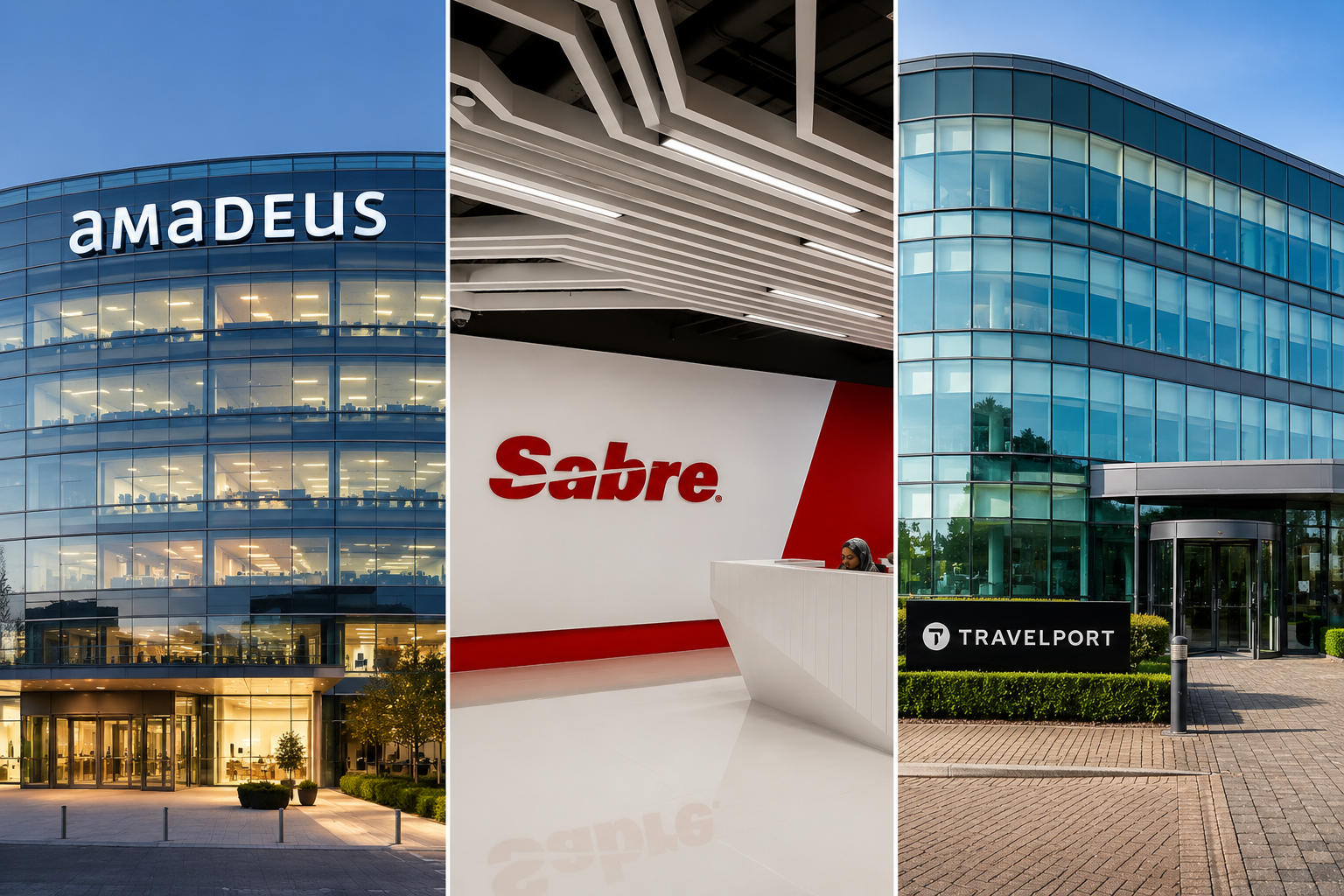
In May, Sabre CEO Kurt Ekert stood in front of investors on the company’s Q1 2026 earnings call and said something GDS executives almost never say about each other on the record. Amadeus, he alleged, holds “a dominant monopoly position” in passenger service systems, and is using that position to make it “very difficult for airlines to choose anybody but Amadeus” for next-generation offer and order solutions. Sabre, he said, is exploring “regulatory and legal approaches.”
TDN covered that escalation as it happened. Two months on, the fight has not gone away. It has widened, and it has clarified something more useful than the monopoly accusation itself: the three GDS majors are no longer running variations of the same playbook. They are placing three structurally different bets on how AI agents will book travel, and the differences say as much about each company’s constraints as about its strategy.
The lock-in bet: Amadeus
Ekert’s allegation centres on Altéa, the passenger service system Amadeus operates for a large share of the world’s full-service carriers, including RwandAir and Ethiopian Airlines, the continent’s largest carrier by capacity. His argument is that Amadeus is using Altéa as leverage to steer PSS customers toward its own offer and order tools rather than letting them shop competing solutions freely.
Since then, Amadeus has not directly rebutted the monopoly claim. Instead it has widened the argument about what it is, expanding its footprint into biometric identity, AI, hospitality and payments, and framing itself as integrated infrastructure rather than a single point of failure. In February, it acquired SkyLink, a Y Combinator-backed startup whose orchestration engine had already completed tens of thousands of conversational bookings through tools like Slack and Microsoft Teams before the deal closed. The acquisition gives Amadeus a working AI booking system, not a roadmap slide, and reinforces a strategy that looks less like a marketplace and more like a tollbooth: be the layer that agentic AI has to pass through, rather than one option among several.
Amadeus holds roughly 40% of global GDS market share to Sabre’s 35%, and it can fund this approach from a position of financial strength that lets it absorb the cost of transition while defending its installed base.
The open-standard bet: Travelport
Travelport, the smallest of the three, is not trying to out-lock Amadeus. On July 1, its TripServices platform expanded to serve more than 400 European travel agencies through an integration with Travelsoft’s Orchestra platform, built on Anthropic’s Model Context Protocol, the open standard that lets AI agents call external systems directly rather than guessing from training data.
The pitch from chief product and technology officer Andrew Jordan is architectural rather than combative: AI agents cannot make deterministic commitments on their own, so booking infrastructure needs a layer that behaves predictably and connects a natural-language request to live inventory. Travelport is backing that bet with capital, not just a partnership announcement. Shareholders committed 50 million dollars to accelerate TripServices, and the company says API-driven transactions have grown from 43% of customer volume in 2022 to 63% in 2026, evidence that AI-native platforms are already routing through it at scale.
Where Amadeus is building a chokepoint, Travelport is betting that being the most open, most reliable connector wins the AI agents that need somewhere to plug in.
The consumer bet: Sabre
Sabre’s public posture is the loudest of the three and, on the evidence so far, the least tested at the level that actually matters commercially. Its flagship agentic showcase is MindTrip, an AI travel planning platform integrated with PayPal for payment, which Ekert has called Sabre’s first agentic AI experience. It is explicitly a consumer product, aimed at individuals planning personal trips, with tourism boards as commercial partners.
That is a legitimate market, but it sidesteps the harder problem entirely. Managed corporate travel requires policy enforcement, duty of care, centralised billing and auditability, none of which a consumer trip-planning tool demonstrates. Sabre says more than 30 partners are piloting or using its agentic APIs, and this week it is co-hosting a Silicon Valley hackathon with DeepLearning.AI, giving outside developers sandbox access to its APIs, MCP server and Vocal Bridge voice AI tools, with Andrew Ng and executives from American Airlines and PayPal judging. It is good developer relations and it keeps Sabre in the AI conversation. It is not, yet, evidence that Sabre has solved the enterprise problem it is accusing Amadeus of foreclosing.
Why this matters beyond the three of them
The GDS market has controlled airline distribution since the 1980s, and NDC was designed in part to let airlines route around that control. What is happening now suggests AI agents may become the GDS layer’s next source of leverage rather than the thing that finally dissolves it, and which of the three strategies wins will decide who holds that leverage.
For African and MENA markets, the stakes are not abstract. Carriers and travel sellers across the region already operate with less negotiating leverage than their counterparts in mature markets, and many still manage fragmented inventory across channels where NDC implementation is inconsistent and expensive to maintain. If regulatory scrutiny does eventually follow Ekert’s allegations, African carriers on Altéa could gain real leverage in future technology negotiations that they do not currently have, particularly on data portability and third-party integration access, issues that tend to sit buried in PSS contract fine print rather than being explicitly negotiated. If instead the market consolidates around whichever GDS becomes the obligatory AI booking layer, that leverage gap widens.
It also matters for the independent vendors that emerged on the premise that the NDC era would decentralise distribution power. Companies like Verteil Technologies, which runs a direct-connect NDC platform with a deliberate focus on Asia, Africa and the Middle East, are building on the assumption that the market for airline retailing solutions stays genuinely open. Whether that assumption holds now depends less on NDC than on which of these three AI infrastructure bets wins.
None of the three companies has settled this yet. Amadeus is betting that scale and acquisition beat openness. Travelport is betting that openness beats scale. Sabre is betting that legal pressure and developer buzz can buy it time to catch up on both. The next twelve months, and whether Ekert’s “regulatory and legal standpoint” produces anything more than a strongly worded earnings call, will tell us which bet the market actually rewards.