

One company, two ways of selling airline tickets
Wakanow is building direct NDC connections to international airlines, while its fintech subsidiary, Kalabash54, helps Nigerian carriers sell tickets in instalments on their own websites. That contrast is the story. In early September, Wakanow became the first travel company in Africa, by its own account, to offer Lufthansa Group’s NDC content through a direct API integration. It adds to the British Airways and Emirates connections that Nigeria CEO Adenike Macaulay discussed in TDN’s May interview.
Those three are the airlines Wakanow has named publicly. Macaulay has separately said Wakanow has completed five direct NDC integrations with five international airlines, and we have not found the other two identified, so this piece speaks of at least three. For a Nigerian online travel agency, that is a real distribution milestone. It is also only half the picture, because the same group sits at the other end of the market, financing fares for passengers of airlines that sell very differently.
This piece draws on published reports and Wakanow’s own statements. It rests on no new interviews, and the firsts and figures cited are company claims unless stated otherwise.
What Wakanow has claimed, and what is missing
The British Airways and Emirates integrations went live in April 2025, according to press reports and Macaulay’s May interview with TDN. Wakanow describes itself as the first online travel agency in Nigeria to connect directly to both through NDC, a claim that is its own and has not been independently confirmed. The integrations run on its Nigeria, Ghana and UAE storefronts, and customers can select seats, add baggage and buy cabin upgrades in the booking flow.
The Lufthansa Group integration follows the same pattern, and TDN has previously reported on the announcement. Wakanow says it gives customers real-time access to the group’s full retail content, including live pricing, availability and enhanced fare options, and that further direct integrations are in development. Lufthansa Group serves Lagos, Abuja and Port Harcourt with connections to Frankfurt, which makes the integration relevant to three of Nigeria’s principal international gateways. A senior Lufthansa Group sales executive for the region took part in the announcement, so the airline side of the arrangement is on the record.
What none of the announcements provides is volume. There are no booking numbers, no share of Wakanow’s air sales that now flows through NDC, and no data on how changes, refunds and disruptions are handled once a ticket is sold direct. Wakanow says direct integration automates ticketing and post-sale service and reduces exposure to GDS disruption. That may be true, but the evidence offered so far shows capability, not performance.
The fintech arm sits on the local carriers’ own websites
In May, Macaulay described Wakanow as as much a fintech company as a travel company, and pointed to instalment payments through its sister company. The public record shows what that means. Kalabash is the group’s fintech subsidiary. It launched a travel card with Mastercard in Nigeria and Ghana in July 2024, and a range of multi-currency cards in October 2025.
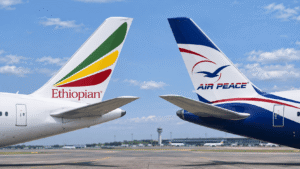
Its best-known travel product, Pay Small Small, lets passengers pay for flights in instalments. It is available on Wakanow’s own site and, under a multi-year agreement announced in October 2022, at checkout on Air Peace’s website, where Air Peace itself publishes instructions for using it. United Nigeria Airlines and ValueJet have offered it as well, and Aero lists it on its site. At the Air Peace launch, Kalabash advertised a minimum down payment of 25 per cent, with the balance payable over 24 hours to six months. Current terms may differ. In August 2025, Kalabash also partnered with Outpayce from Amadeus to bring Pay Small Small into Outpayce’s payment offering.
The detail worth noting is where the product sits. On British Airways, Emirates and Lufthansa Group, Wakanow competes as a travel seller connected through NDC. On the Nigerian carriers, Kalabash sits inside the airline’s own booking flow as a payments provider. The commercial terms are not public, so how much Wakanow Group earns from each side cannot be said.
Macaulay has also said the GDS model is extremely expensive for airlines, even though a few local carriers, including Air Peace, Arik Air and United Nigeria Airlines, still depend on it. That is her account, reported by Nigerian Flight Deck, and it does not independently establish how each airline distributes today. It points to different distribution models rather than a gap between modern and backward carriers. International airlines are opening direct connections to selected agencies, while, in her account, domestic carriers continue to combine their own websites with GDS distribution. Kalabash operates within this second model as a payments provider.
Settlement is the part no announcement covers
In the May interview, Macaulay called for pan-African settlement in local currencies to reduce costs and foreign exchange risk. No timeline was given for the infrastructure that would make that possible.
Nigeria’s own recent history shows why the two problems differ. In July 2022, IATA said $464 million of airline money was blocked from repatriation in Nigeria. Emirates announced it would suspend flights from 1 September 2022 over $85 million it could not repatriate, and the Central Bank of Nigeria said about a week later that it would release $265 million. Blocked funds then climbed to a peak of $850 million in June 2023. By April 2024, IATA said, 98 per cent had been cleared, leaving about $19 million outstanding.
The crisis has largely been resolved, so it belongs in this story as history rather than as a live risk. What it showed is that distribution and settlement are separate problems. A direct NDC connection changes the relationship between airline and seller: who controls the offer, the price and the servicing. It does not change how money moves between countries, currencies and airline accounts. That is our reading, not a Wakanow claim, and it explains why the payments side of the group matters to the distribution story.
Two speeds, one operator
Nigeria’s air distribution runs on different models depending on the airline. International carriers are handing full retail content to the few agencies able to build direct integrations. Domestic carriers, at least as Macaulay describes them, lean on the GDS and their own websites, with payment finance added at checkout to ease affordability. That is a difference in distribution models, not a gap between modern and backward airlines. Wakanow is the one operator present on both sides, which is the real reason its Lufthansa Group announcement deserves attention.
The May headline said the era of modern travel retailing in West Africa had officially arrived. The evidence supports a narrower claim: it has arrived for one agency and at least three international airlines. The harder question is whether direct NDC connectivity can become an industry-wide capability, or whether it stays an advantage held by a handful of large travel companies that can afford the build. That depends on things Wakanow cannot settle alone. Other Nigerian agencies need a route to the same content without building it themselves. Domestic carriers have to decide how far to move beyond the GDS. Settlement has to keep working at scale. Until then, the larger question in Africa’s airline distribution is not only who connects to whom, but who controls the payments, who carries the financial risk and who can move money across borders.