
At UATP’s Airline Distribution 2026 conference this year, United’s managing director of digital sales told the room that the carrier now sells about seventy percent of its tickets direct, with the remainder split roughly between NDC content sold outside the traditional GDS channel and legacy indirect systems. He expects that direct share to keep climbing at about the same pace it has for the last several years.
That number has quietly become a kind of north star for the industry. Direct is treated as the destination, and every airline’s distribution strategy gets measured, implicitly or explicitly, against how close it is to a mix that looks like United’s. Conference panels frame the conversation as a question of pace: how fast can an airline get there, not whether getting there is the right target in the first place.
Nobody has asked that second question about African carriers. Not publicly, not with any rigor. And it is worth asking, because the assumption underneath the seventy percent benchmark does not travel well. The answer matters because copying another airline’s channel mix is far easier than copying the market conditions that produced it.
What direct actually requires
Direct distribution is often presented as a commercial choice. In reality, it is the product of an ecosystem that took decades to build. Trusted electronic payments, widespread card ownership, mature corporate booking tools, consumer confidence in e-commerce, and reliable digital identity all developed long before airlines began aggressively shifting sales toward their own channels.
That ecosystem is not universal, and the gap is not small. Close to half of adults in Sub-Saharan Africa remained unbanked as of the World Bank’s most recent Global Findex data, roughly double the global average. Where banking has taken hold, it has often bypassed cards entirely. Mobile money now runs through more than 700 million registered accounts across the region, and in markets like Uganda and Tanzania it reaches more than sixty percent of the adult population, well ahead of card penetration. Even in South Africa, one of the continent’s most banked markets with roughly eighty five percent of adults holding an account, cash still made up close to two thirds of individual payments as recently as 2022. Kenya’s own distribution pattern reflects this directly, running on high volume, low value mobile money transactions rather than the card rails an airline’s direct booking flow typically assumes.
None of that is a criticism of where African markets stand today. It is a description of what the seventy percent figure is actually measuring, and why it was reached in an environment where card payment, corporate booking integration, and e-commerce trust were already the default before the push toward direct began in earnest. An airline built for a market where mobile money and cash still carry most of the load cannot assume the same default.
This publication has written before about what NDC’s shift to an airline-as-merchant model means for African travel agencies, agencies that operate on thin credit lines and depend on BSP settlement cycles to manage cash flow rather than the direct billing infrastructure NDC assumes. The same underlying mechanism applies here from the other direction. If the agency channel is carrying weight in African markets that it no longer carries in the US or Europe, because it is doing work the payment and booking infrastructure cannot yet do on its own, then treating agency share as pure inefficiency to be designed out is a category error, not a modernization strategy.
The carriers actually building this
Kenya Airways has already become the first Sub-Saharan African airline to distribute NDC content through the Amadeus Travel Platform, and Ethiopian Airlines continues to expand its own NDC programme through global technology partnerships. EgyptAir has gone further still, becoming the first airline in the Middle East and Africa region to deploy IATA’s NDC 24.4 standard, building on its earlier work with TPConnects’ NDC solution. These are real, credible moves, and they matter.
But NDC adoption and a direct-sales target are not the same project, even though industry conversation often collapses them into one. NDC can make an airline’s indirect channel richer and more competitive rather than replacing it. An agency booking NDC content through Amadeus is still an agency booking. The question this raises is not whether African carriers should adopt NDC, most of the credible answers point toward yes, but whether the end state they are building toward should look like a smaller and smaller agency channel, or a stronger one that happens to be running on better technology.
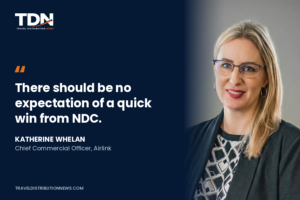
Airlink’s chief commercial officer has spoken about what the airline’s own NDC study found: rising adoption among the agents Airlink works with, not agents being displaced by direct sales growth. That detail deserves more attention than it has gotten. It suggests at least one African carrier’s own data points toward strengthening the indirect channel through better technology, not shrinking it toward a Western direct-sales ratio.
The question worth asking instead
The industry conversation, as currently framed, asks how fast African carriers can get to seventy percent direct. That is the wrong question, or at least a premature one. The better question is what the right balance between direct and indirect actually looks like for a market where payment infrastructure, card penetration, and corporate booking integration are still being built rather than assumed.
Getting that balance wrong in either direction carries real cost. Chase a direct-sales target calibrated for a market with fully built payment and trust infrastructure, and an airline risks starving the channel that is currently doing the heaviest lifting in getting African travelers to book at all. Ignore the shift entirely, and an airline cedes ground on retailing capability, ancillary revenue, and the kind of direct customer relationship that increasingly defines commercial performance in this industry.
Success in African distribution will not be measured by how closely airlines resemble United. It will be measured by whether they build a distribution model that reflects how Africans actually buy travel today, while preparing for how they will buy it tomorrow. Technology should adapt to the market before the market is expected to adapt to the technology.