On February 28, 2026, the travel distribution industry faced a stress test it was never designed for.
Within hours of US and Israeli strikes on Iran, at least eight countries across the Middle East closed their airspace — Iran, Israel, Iraq, Jordan, Qatar, Bahrain, Kuwait, and the United Arab Emirates. The corridor linking Europe, Asia, and Africa, one of the most critical arteries in global aviation, effectively disappeared. More than 3,400 flights were cancelled in a single day across seven major airports in the region. Where one of the world’s busiest aviation crossroads should have been, there was a hole in the sky.
The immediate impact was visible. Flights were cancelled, schedules collapsed, and passengers were stranded across multiple regions.
The deeper impact was not.
Behind the scenes, a more consequential disruption was unfolding inside the infrastructure that powers how travel is sold. Because when airspace closes, the issue is no longer operational. It becomes structural.
Who controls the content?
The Architecture of the Problem
Travel distribution has always been built on a simple assumption: the flight exists. Airlines publish schedules, file fares, and distribute inventory through global systems — primarily GDS infrastructure and, increasingly, NDC-based channels. Under normal conditions, this ecosystem functions with relative stability.
But when routes are suspended overnight, that assumption breaks.
Flights disappear. Connections collapse. Entire itineraries become invalid. Distribution stops being about selling and becomes a question of withdrawing, updating, and rebuilding content at scale and doing it faster than the crisis is moving.
This is where the conflict exposed a fundamental weakness in how the industry is built.
Operational decisions move at conflict speed. Airspace closes in real time. Airlines respond immediately. Distribution does not move at the same speed. Updating content requires coordination across inventory systems, fare filing, GDS messaging, NDC connections, and downstream platforms. Each step introduces delay. In a slow-moving disruption, that delay is manageable. In a geopolitical shock unfolding within hours, it becomes critical and the gap between what is operationally true and what is commercially visible is precisely where risk accumulates.
The Fragmentation Problem NDC Created
The industry’s shift toward modern retailing has added a layer of complexity that the crisis made visible in an uncomfortable way.
NDC has given airlines greater control over pricing and offers. But it has also replaced a centralized content flow with a network of bilateral connections between airlines and aggregators, between aggregators and agencies, between agencies and corporate booking platforms. Under stable conditions, this fragmentation is manageable. Under stress, it becomes a constraint.
There is no single lever to pull. When a Gulf carrier suspends operations, content cannot be switched off universally across NDC channels the way a GDS message can reach the broader agency community simultaneously. Each bilateral connection must be updated independently. Each delay creates a window of inconsistency a period during which a booking tool may still be displaying fares and availability for flights that will not operate.
That window is not just a customer experience problem. It is a liability question, and it lands differently depending on where in the distribution chain you sit.
The Gulf Hubs and the Content Vacuum
The scale of what happened to the Gulf’s hub infrastructure makes the content problem concrete.
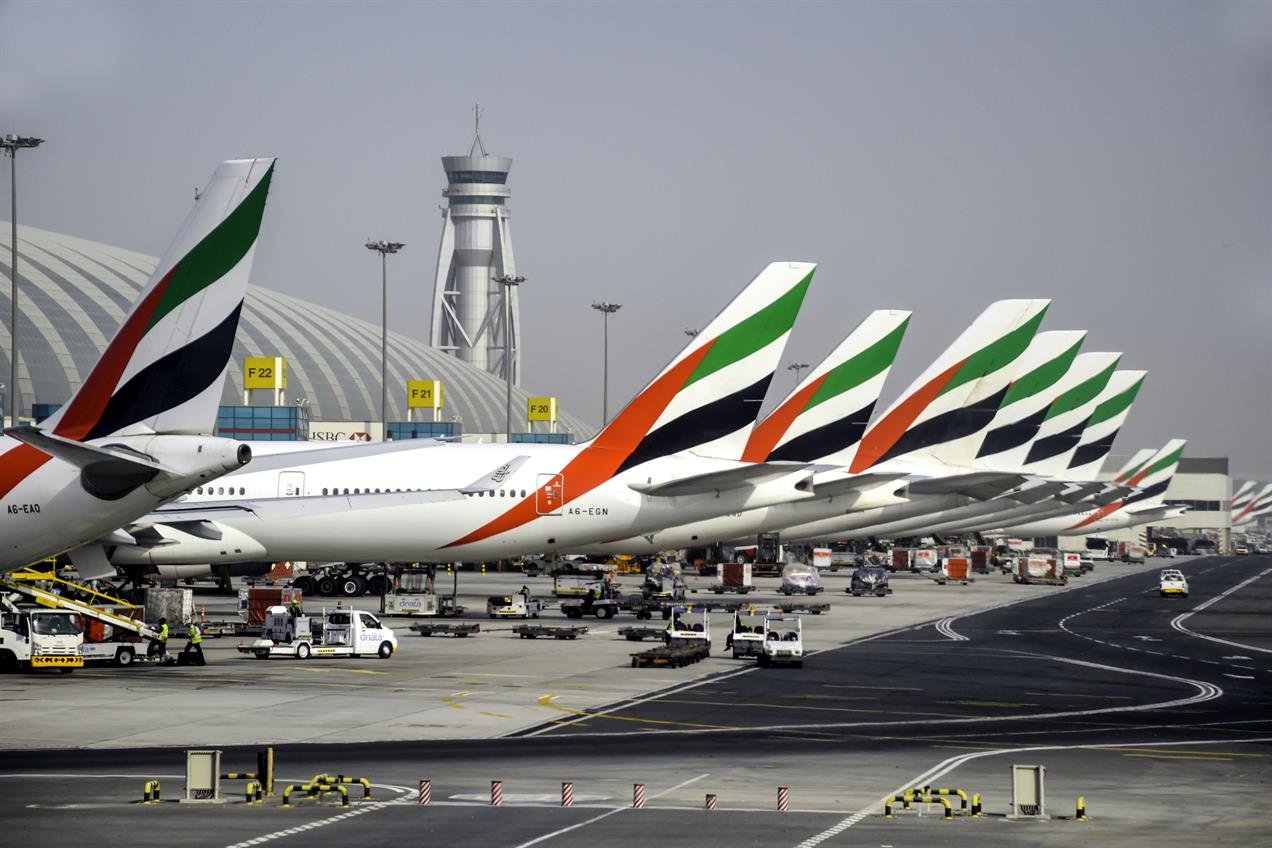
Dubai, Doha, and Abu Dhabi are not just transit points. They are central nodes in global distribution. Emirates, Qatar Airways, and Etihad — three of the world’s largest content contributors to the indirect distribution ecosystem — went from operating at full scale to near-zero within days. The three carriers typically move around 90,000 passengers per day through those hubs. Every one of those passengers had a booking somewhere in a system: a GDS PNR, an OTA reservation, a corporate travel management itinerary.
Those bookings did not resolve themselves. They required action — revalidation, re-accommodation, or refund processing — often under significant time pressure, and across systems that were simultaneously being overwhelmed by inbound disruption signals from across the region.
This is not simply a question of flights not operating. It is a question of how millions of pieces of travel content are managed across a distributed and interconnected system when the underlying product disappears faster than the commercial infrastructure can respond.
Africa’s Structural Exposure
The implications were particularly pronounced in Africa, and for reasons that go beyond geography.
The continent’s international connectivity is heavily dependent on Gulf corridors. Nairobi, Addis Ababa, Lagos, Kigali, Dar es Salaam most of Africa’s major business travel markets connect to Europe, Asia, and North America via Dubai, Doha, or Abu Dhabi. When those hubs shut down, African carriers did not just lose transit options. They lost their primary distribution corridors.
Ethiopian Airlines, the continent’s largest carrier, reported a $137 million loss in a single week and suspended flights to ten destinations across the region. Kenya Airways, Air Tanzania, and RwandAir faced comparable operational setbacks, compounded by surging aviation fuel costs as oil prices spiked in the conflict’s immediate aftermath.
But beneath the operational disruption was a distribution layer problem that the numbers do not capture. African carriers have historically lower NDC adoption rates and more limited direct-connect infrastructure than their European or Gulf counterparts. Their content distribution remains more concentrated in traditional GDS channels. When mass cancellations hit, the manual workload of managing GDS inventory, issuing waivers, processing refunds, and reprotecting passengers across interconnected itineraries fell heavily on airline staff and travel agencies already operating under crisis conditions and with fewer automated tools to absorb the volume.
The Rerouting Economics and the Pricing Gap
For carriers that kept flying, the economics of rerouting created a distribution problem of a different kind.
Extended detours around closed airspace were adding between $6,000 and $7,500 per flight hour in operating costs on wide-body aircraft. Those costs have to go somewhere eventually into ticket prices. Which means new fares need to be filed, existing inventory repriced, and the differential managed across every active distribution channel simultaneously.
This is where the NDC promise and the NDC reality diverge sharply under pressure. Dynamic pricing, in theory, allows an airline to reprice in response to cost changes in near real time through NDC connections. But that capability is only as good as the downstream ecosystem’s ability to receive and display updated offers. Many agencies, particularly across emerging markets, still operate primarily through EDIFACT-based GDS access. When an airline needs to rapidly communicate new cost-reflective pricing across its entire distribution network, the speed asymmetry between NDC and EDIFACT channels does not disappear — it becomes a commercial exposure.
Flights rerouted over Saudi Arabia and Egypt were adding 60 to 90 minutes to total journey times — long enough to break connections systemically and force complete re-accommodation at scale. Every broken connection is a rebooking. Every rebooking is a content transaction. The volume of those transactions during the peak disruption days strained servicing infrastructure across the ecosystem in ways that will take time to fully account for.
What the Crisis Has Made Visible
The Iran conflict has done what market conditions rarely do cleanly: it has made visible the fault lines in global travel distribution that normally stay hidden beneath routine operations.
The first is speed asymmetry. The operational world moves at conflict speed. The content world moves at commercial process speed. That gap is structural, not accidental, and the industry has not resolved it.
The second is channel fragmentation. A decade of NDC investment has created a more capable but more complex distribution environment. Under normal conditions that complexity is manageable. Under crisis conditions it means more channels to update, more bilateral connections to manage, and more points at which inconsistency can enter the market.
The third is geographic concentration risk. The Gulf megahubs have become so central to global aviation connectivity and to global distribution flows that their simultaneous shutdown does not just disrupt travel. It disrupts the content infrastructure that sits on top of it. Airlines whose distribution strategies are built around Gulf hub connectivity carry a category of risk that was largely theoretical until February 2026.
For African aviation, the crisis has underlined a structural vulnerability that predates this conflict and will outlast it: a continent whose aviation market connects to the world primarily through a corridor that just spent weeks under military closure, served by carriers whose distribution infrastructure is less equipped to respond dynamically when that corridor disappears.
The Question That Remains
The airspace is reopening. Routes are stabilizing. Systems are realigning.
But the underlying question the crisis raised has not been answered. When the next disruption hits and the Middle East’s aviation history suggests there will be a next disruption who will pull the content, through which channel, how fast, and under whose authority will once again determine how effectively the industry responds.
The answer today is: it depends. It depends on the airline’s distribution setup, the maturity of its NDC rollout, the responsiveness of its GDS and aggregator partners, and the capacity of its downstream agency network to execute under pressure.
That answer is not good enough.
Travel content is not a commercial afterthought. In a crisis, it is operational infrastructure. The Iran disruption has made that visible at a scale the industry cannot ignore.
The question is whether it will act like it.