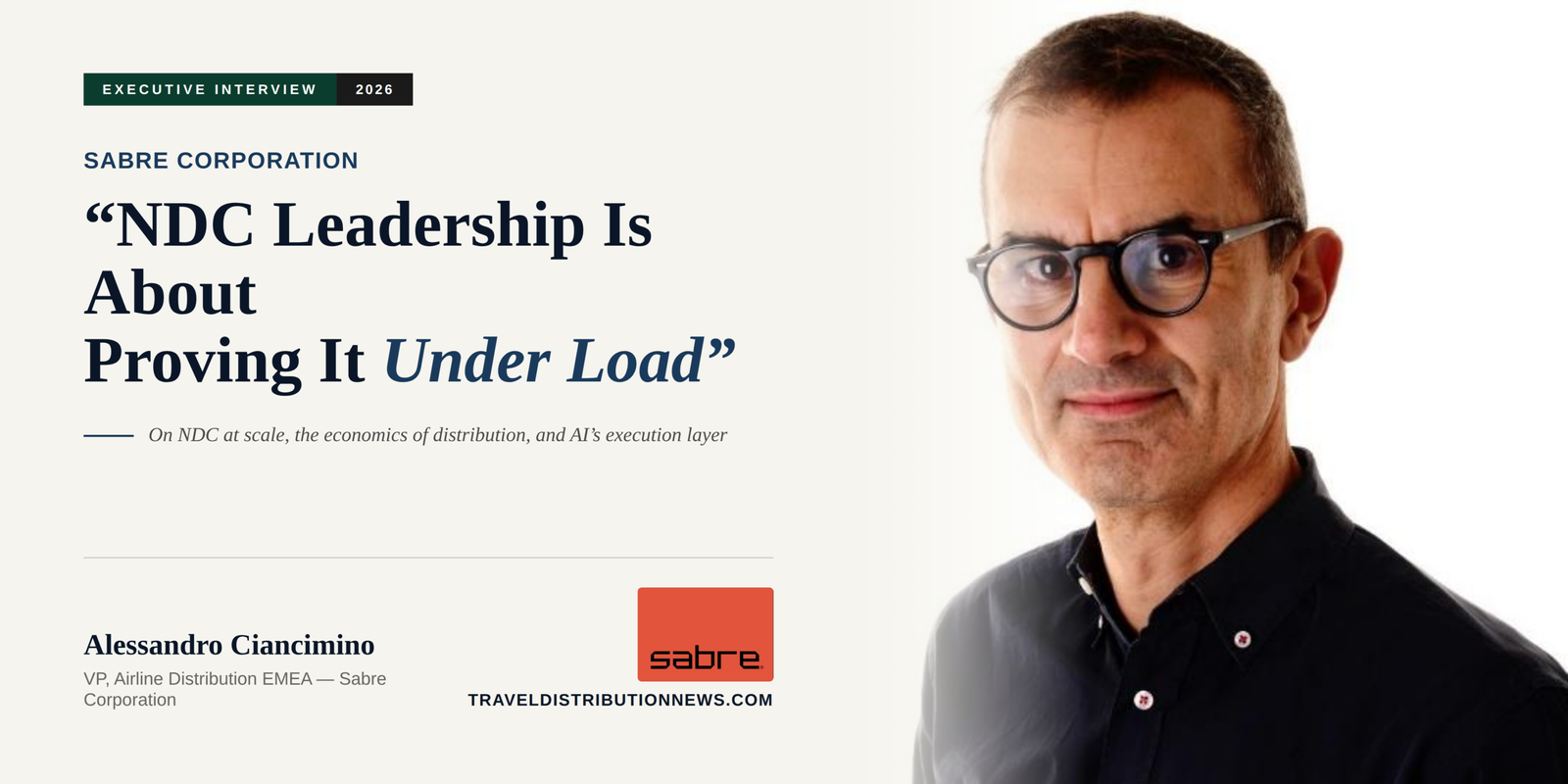
The Vice President of Airline Distribution EMEA at Sabre on why the industry has moved beyond experimentation and what it will take to finish the job.
The rhetoric around NDC has been loud for years. Transformation. Revolution. The death of the GDS. The rise of direct retailing. But rhetoric and production reality are two very different things and few people in the industry have a clearer view of that gap than Alessandro Ciancimino.
As Vice President of Airline Distribution EMEA at Sabre Corporation, Ciancimino oversees GDS distribution commercial relationships for all EMEA-based airlines across NDC, EDIFACT, and bespoke APIs. With 23 years at Sabre behind him, he has watched every phase of this transition from the early IATA working groups to the current scramble to make NDC work at real commercial scale.
His message to TDN is measured but pointed: the experimentation era is over. What comes next is harder, more unglamorous, and will ultimately decide which technology providers survive the decade.
“Scale Exposes Everything”
TDN opened by asking Ciancimino where the industry actually stands in the NDC transition not where the press releases say it stands.
His answer cuts straight to the infrastructure layer. Airlines have made meaningful progress, he says, but the shift that matters now is from connection volume to operational reliability. Sabre currently has more NDC airlines live in production than any other provider and Ciancimino argues that position is precisely what gives Sabre its clearest view of where the model holds and where it still breaks.
“Running a handful of airline connections in isolation is very different from supporting dozens of carriers across regions, schemas, and servicing models, under peak volume and commercial pressure,” he says. “Scale exposes the real challenges of NDC.”
Those challenges cluster around the full booking journey. Comparison shopping across sources, price stability, post-booking changes, disruption handling, downstream integration with back-office and agency systems all of it must work consistently, not just in demos. As offers become more dynamic and generated in real time, infrastructure must absorb higher volumes, tighter latency expectations, and increased automation without inflating cost to serve.
But Ciancimino identifies a second, less-discussed barrier: the content itself. In many markets, the NDC content airlines are making available is not yet compelling enough to shift agency booking behaviour. If NDC content closely mirrors traditional filed fares with limited differentiation or restricted retail flexibility agencies have little commercial reason to abandon workflows that already work.
“Full scale adoption accelerates when NDC is used to deliver genuinely differentiated, dynamic offers that improve conversion and commercial outcomes,” he says, “rather than simply acting as an alternative transport layer for existing content.”
That distinction matters. A lot of the current NDC traffic is airlines replicating what was already available in EDIFACT, dressed up in a new API. The real test and the real commercial opportunity is in dynamic, personalized offer construction that the old model was structurally incapable of delivering.
The Agency Question: Hybrid or Nothing
The second pressure point in any honest NDC conversation is the agency ecosystem. TMCs and OTAs are at dramatically different stages of readiness ranging from full NDC integration to operations still running entirely on EDIFACT with no near-term migration plan.
Ciancimino is direct about how Sabre is approaching this: not by forcing a rip-and-replace transition, but by enabling NDC and EDIFACT to operate side by side within a single workflow.
“Agents should be able to shop, book, change, and service trips without switching systems or sending work to airline portals,” he says. “Good adoption is not about turning NDC on. It is about integrating it into existing operations in a way that feels familiar, scalable, and serviceable.”
The implications for automation are significant. As agencies increasingly deploy AI-assisted booking tools and robotic process automation for servicing, the consistency of the underlying workflow becomes critical. Automation only delivers value when the infrastructure underneath it behaves predictably which is why normalized, hybrid-capable environments are not a compromise position, but a hard commercial requirement for any provider serious about serving TMCs at scale.
Rethinking the Economics of Distribution
Perhaps the most structurally important shift Ciancimino addresses is the evolution of Sabre’s commercial model away from the per-segment transaction fee that has defined GDS economics for four decades.
The per-segment model made sense in an era when distribution was primarily about moving static inventory from airline systems to agency screens. That era is over. Modern airline retailing creates value across the entire customer journey in the initial offer, in ancillary upsell, in disruption recovery, in post-booking servicing not at a single booking moment.
Sabre’s response has been to reposition itself as a technology platform and multi-source marketplace, with a commercial model that increasingly reflects outcomes rather than transactions: higher conversion, faster servicing, lower operational cost at scale.
Underpinning this is a move away from static fare logic entirely. Through Sabre Mosaic, its modular retailing platform, airlines can price based on trip purpose, willingness to pay, and real-time demand signals bypassing fixed fare classes and rigid inventory buckets. Pricing becomes adaptive and responsive, aligning revenue management with how travellers actually shop and book today.
“As retailing becomes more software driven and increasingly automated, the commercial model has to align with the value delivered by the platform, not the mechanics of a legacy booking,” Ciancimino says.
That is not a small shift. It is a fundamental redesign of the financial relationship between GDS providers and airlines and the credibility of that redesign will depend entirely on whether the technology can actually deliver those outcomes in production.
Offer and Order: Staged, Not Revolutionary
On offer and order management, the architecture that underpins the long-term vision of airline retailing as a fully dynamic, retail-grade commerce experience, Ciancimino pushes back against the wholesale transformation narrative.
Real-world implementation, he says, is progressing in a staged and pragmatic way. Airlines are moving at different speeds, hybrid environments will persist for years, and the infrastructure required to create, distribute, service, and settle offers and orders reliably at scale does not materialise overnight.
“Progress is measured in operational outcomes,” Ciancimino says. “Creating, distributing, servicing, and changing offers and orders reliably at scale is the benchmark.”
That framing operational outcomes over architectural ambition runs through everything he says. It is a deliberate positioning against the part of the industry that has spent years announcing the future without building it.
AI and the Execution Layer
The conversation shifts to AI, and Ciancimino’s answer is one of the sharpest in the interview. As AI reshapes how travellers discover and compare options through conversational interfaces, agentic shopping tools, and AI-curated itineraries the critical question is not who wins the top of the funnel. It is who builds the layer that makes AI-generated demand actually executable.
Sabre’s position, he says, is not to compete for consumer attention. It is to build the execution infrastructure that AI-mediated journeys depend on.
“As AI accelerates discovery and decisioning, the ability to fulfil that intent reliably, at scale, becomes more important, not less,” he says. “Sabre is not competing for attention at the top of the funnel. It is building the execution layer that AI mediated journeys depend on.”
That means connecting intent the traveller’s expressed preference, surfaced by an AI assistant to live inventory, dynamic pricing, confirmed booking, and full lifecycle servicing. As AI increases the speed and volume of demand, the complexity at the execution layer does not diminish. It compounds.
“Sabre’s role is to absorb that complexity and make AI driven demand executable, serviceable, and economically sustainable in production,” he says.
What the Next Five Years Actually Require
TDN closed by asking Ciancimino what a well-functioning travel distribution ecosystem looks like in three to five years and what still needs to change to get there.
His answer is both a vision and an implicit critique of where the industry currently fails.
A well-functioning ecosystem is open, interoperable, and operationally predictable. Content is rich but normalised. Servicing works end to end. Economics are sustainable for all three legs of the stool: airlines, agencies, and technology providers. None of that currently exists across the board.
To get there, Ciancimino argues the industry needs less fragmentation at the workflow level and more shared infrastructure that supports scale, automation, and performance under real-world conditions.
“The ecosystems that succeed will be the ones that make complexity manageable and dependable,” he says, “rather than simply pushing more content into an already fragile system.”
That last phrase is pointed. The fragility of the current NDC ecosystem the inconsistent implementations, the servicing gaps, the airline portals that agents are still being forced to use for changes is not a secret within the industry. What Ciancimino is arguing is that the path forward runs through execution discipline, not more standards announcements or content mandates.
The Bottom Line
Ciancimino’s perspective carries weight precisely because Sabre operates where theory collides with reality. More NDC airlines in production than any other provider gives it both the credibility to make these claims and the commercial exposure if the execution fails.
The honest read of this conversation is that NDC has cleared the first hurdle: it is real, it is in production, and the major players are no longer debating whether it works. The debate now is about who can make it work reliably enough, cheaply enough, and consistently enough to actually shift the industry’s centre of gravity.
That is a harder problem than standards adoption. It is an engineering problem, an economics problem, and an operational problem all at once.
Sabre, through Ciancimino’s lens, is betting that solving those problems at scale is the only NDC leadership that ultimately matters.
Alessandro Ciancimino is Vice President, Airline Distribution EMEA at Sabre Corporation. He has held senior roles at Sabre for over 23 years, including VP Strategy for Travel Solutions and VP & Regional General Manager Europe for Travel Solutions.
Travel Distribution News covers the business of airline distribution, NDC, GDS dynamics, payments, and emerging markets. Subscribe at traveldistributionnews.com