
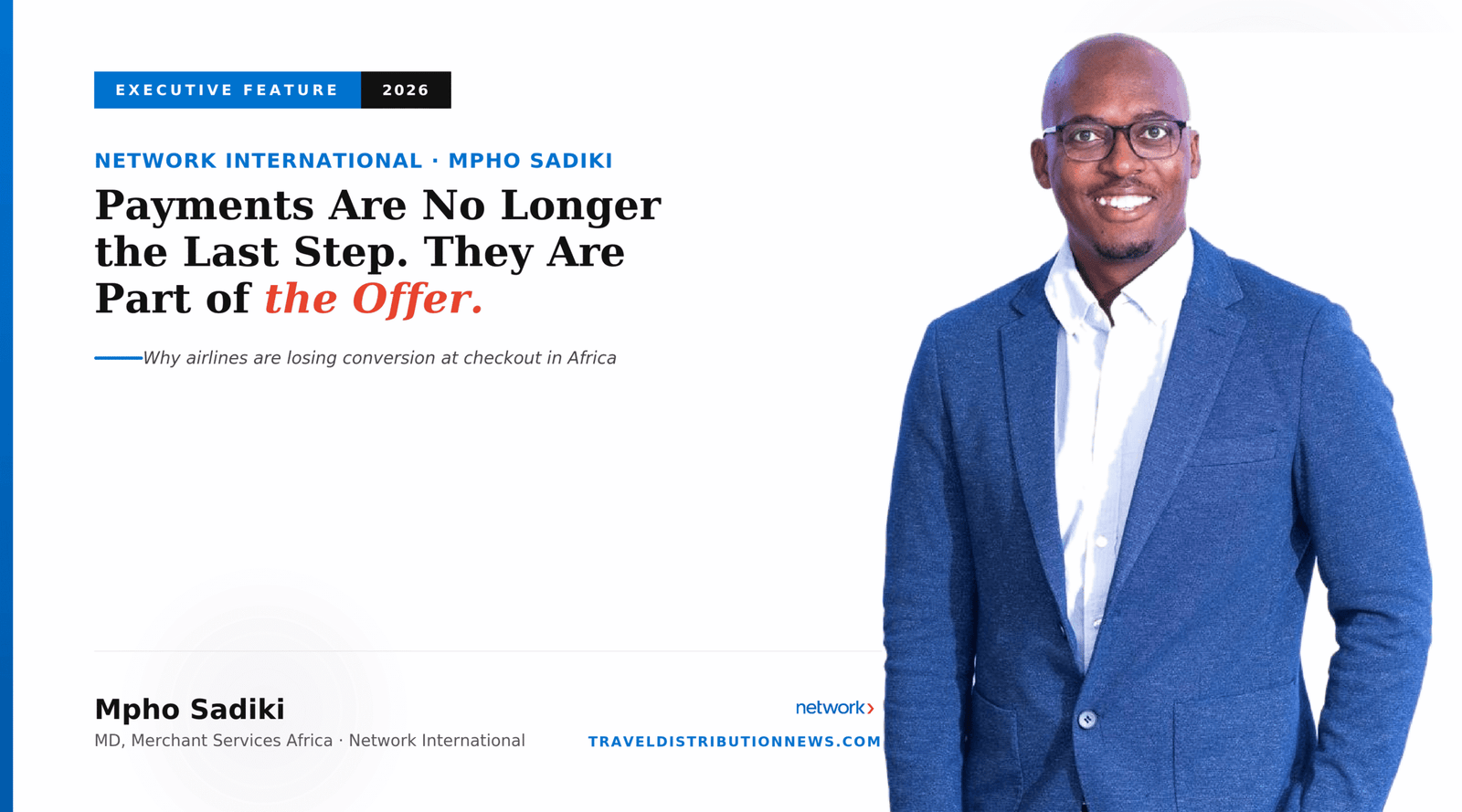
The Managing Director for Merchant Services Africa at Network International on why payments are becoming a key competitive factor in airline retailing, and which players are already paying the price for getting it wrong.
The airline industry has spent the last two decades treating payment as the last step. Something necessary, invisible, and best left to finance and procurement. However, that era is over.
Mpho Sadiki, Managing Director for Merchant Services Africa at Network International, is confident about what has changed and what it means for those still operating on the overdue assumptions.
“Payments now sit inside the offer itself. They are becoming a core part of how airlines convert demand, protect revenue, and deliver a seamless end-to-end customer experience.”
Payment providers that still treat settlement as a back-office function are struggling to keep up with these changes. Meanwhile, airlines that focus only on the lowest-cost payment options are losing conversions, margin and the direct customer relationships they were meant to protect.
THE INFRASTRUCTURE GAP IS NOW A REVENUE GAP
NDC and real-time retailing have changed what payments must do. Airlines that construct personalised offers dynamically, bundling flights with ancillaries and varying pricing by traveller and channel, cannot route those transactions through infrastructure built for static, segment-based distribution.
In the legacy model, funds moved through intermediary chains, settlement stretched for days, and reconciliation was manual. The payment experience reflected back-office logic rather than meeting customer expectations. That architecture made sense when the offer was fixed. But it is incompatible with an airline operating as a digital retailer.
“With NDC-enabled retailing and real-time offer creation, payments must support faster authorisation, clearer attribution of funds across multiple parties, and more automated reconciliation, because pricing, inventory, and fulfilment decisions are increasingly made in real time.”
Payment providers unable to match this speed and attribution clarity create delays and complications in the transaction process. And in a distribution model built to eliminate friction, they become the first thing airlines move away from.
AFRICA: WHERE THE COST OF GETTING IT WRONG IS HIGHEST
When global conversations around payments arise, the default models tend to focus on cards or single-currency systems. In Africa and the Middle East, however, this approach can limit performance in these markets.
Card penetration across Sub-Saharan Africa is structurally uneven. Consumer payment behaviour varies sharply by market. The rails underpinning transactions in Nairobi, Lagos, or Lusaka bear no resemblance to those in London or Dubai. Airlines and travel sellers that deploy a card-first strategy across these markets do not just leave money on the table. They close the door on entire customer segments.
“Enabling familiar local payment methods can make a measurable difference for travel merchants.” Network International supports mobile wallet payments for regional carriers, including Jambojet in Kenya and Skyward in East Africa, as well as flydubai on international routes, allowing customers to pay in the methods and currencies they actually use.
The commercial reality is simple. In markets where mobile money is more common than bank accounts, every missing payment option can lead to lost customers. This is not just a conversion issue alone, as it also signals lost demand that competitors with better payment options will capture.
Moreover, local acquiring compounds the issue. Let’s take the example of a transaction that originates in Nairobi, routes through London or Dubai for processing. It accumulates avoidable cost, latency, and decline risk before it even reaches the airline. Local acquiring eliminates that detour, improving approval rates and protecting the margin that cross-border routing quietly erodes.
The airlines losing in Africa are not losing on price or product. But they are losing at checkout because their payment infrastructure doesn’t perfectly fit the markets they are trying to serve.
SMARTER PAYMENT SYSTEMS IMPROVE PERFORMANCE
Adding payment methods was the first wave. The second is about making every transaction smarter.
Fraud management, approval rate optimisation, and cost reduction are converging around AI, machine learning, and tokenisation. Sadiki describes how Network International has applied these to its risk infrastructure, producing adaptive, real-time fraud prevention that distinguishes genuine high-value bookings from fraudulent ones without inflicting the blanket friction that drives away legitimate customers.
Tokenisation addresses the retention side of the equation. Stored credentials eliminate checkout friction, enable one-click repeat booking, and strengthen transaction security without adding steps for the customer. For airlines building direct booking relationships with frequent travellers, tokenisation is the payment mechanism that makes returning easier than going elsewhere.
BNPL adds another option for customers managing large payments. It has taken hold in travel because high-value bookings create genuine hesitation around upfront payment. As BNPL integrates properly into booking flows rather than appending itself at checkout, it will shift conversion economics materially, particularly for premium and long-haul purchases across MEA markets.
SETTLEMENT: OPERATIONS PROBLEM, PRACTICAL PROGRESS
Cross-border settlement has been a documented cost and operational burden in travel for longer than NDC has been a concept. Yet it remains largely unresolved.
The problem lies in the existing structure: currency conversion across intermediary chains, inconsistent regulatory frameworks, and settlement cycles measured in days rather than hours. This produces costs that airlines absorb without scrutiny and intermediaries pass on without transparency.
But there is a clear path forward as Sadiki points to multi-currency and local collection as practical solutions. By receiving and holding funds in the currency of sale, airlines can cut out unnecessary FX conversions, lower costs, and gain more predictable cash flow.
The longer-horizon shift is the maturation of domestic instant payment rails and their gradual cross-border connectivity. PesaLink in Kenya, PayShap in South Africa, and NIBSS Instant Payment in Nigeria are each building infrastructure that moves funds in seconds within their markets. As these rails connect across borders, settlement cycles for international travel transactions will shorten structurally.
“These rails, alongside improved data and reporting, can support faster, more predictable settlement for international travel transactions.”
PAYMENTS ARE NOW A COMPETITIVE VARIABLE
The travel companies that lead on payment strategy over the next three to five years will share a common characteristic: they treat payments as a revenue and distribution decision.
They will drive higher conversion through locally relevant payment options, protect margins with smarter routing and fewer declines, and reduce operational costs through automated reconciliation and tokenised repeat transactions. Most importantly, they will retain the direct customer relationships that NDC and modern retailing were designed to enable.
Companies that do not adapt may see lower conversion at checkout, lose margin to avoidable intermediary fees, and ultimately lose the customer relationship to airlines and travel sellers that understood earlier what payments have become.
In airline distribution, the product is no longer enough. The offer is no longer enough. How money moves, where it is accepted, how fast it settles, and how cleanly it reconciles now directly affect performance. Airlines that have embraced this will come out ahead, while those still relying on the old playbook are already falling behind.
Mpho Sadiki is Managing Director, Merchant Services Africa at Network International. Network International is the leading fintech enabler of digital commerce across the Middle East and Africa, supporting over 100,000 merchants across the region.
Travel Distribution News covers the business of airline distribution, NDC, GDS dynamics, payments, and emerging markets. Subscribe at traveldistributionnews.com