Africa is not a single NDC story. It is a continent of 54 countries, dozens of national carriers, thousands of travel agencies, and distribution infrastructure that ranges from sophisticated to nonexistent depending on which market you are standing in. Understanding NDC in Africa requires resisting the urge to treat the continent as a uniform bloc. It is not. And that distinction matters more than almost any other framing in this conversation.
What follows is a comprehensive account of what NDC is, why it matters specifically in the African context, where adoption is real, where it is stalled, who the key players are, and what the next phase of this shift will actually look like.
What NDC Is and Why It Was Created
New Distribution Capability is an IATA-developed XML-based data transmission standard designed to modernise how airlines sell their products through indirect channels. It was introduced in 2012 and officially launched in 2015 to address a structural problem that had defined airline distribution for decades: the inability of airlines to control how their products were presented, priced, and sold through travel agencies and global distribution systems.
Legacy distribution runs on EDIFACT, a messaging format built in the 1980s. The system was designed to transmit basic flight information: origin, destination, price, seat count. It was not built to carry rich content, ancillary products, personalised offers, or dynamic pricing. For years, airlines accepted this constraint. The GDS delivered volume. The economics worked.
That changed when airlines began recognising how much margin they were leaving in the indirect channel. A seat is not a commodity. It comes with the potential for a specific seat selection, a meal preference, baggage flexibility, a lounge upgrade, or a bundle with a hotel. None of that richness could travel through EDIFACT at the speed or scale modern retailing requires. NDC was built to change that.
The standard replaces EDIFACT messaging with APIs that can carry the full complexity of an airline’s product. It allows airlines to construct offers dynamically, present content with rich media, include ancillaries natively, and price based on traveller profile, demand signal, or channel. It gives airlines what they never had through GDS: control over how the product looks before it reaches the agent or consumer.
Why Africa Is a Distinct Conversation
The global NDC narrative is largely written from the perspective of European and North American carriers. Lufthansa Group, Air France-KLM, United Airlines, American Airlines, British Airways — these are the airlines that set the distribution agenda globally. Their moves shape how GDS providers respond, how aggregators invest, and how agencies adapt.
Africa does not sit in that narrative comfortably. Its carriers operate with different cost structures, different route economics, and different relationships with intermediaries. African travel agencies are not peripheral. In many markets they control the majority of high-value bookings and carry institutional relationships with corporate clients, NGOs, and government travel programmes that cannot be disintermediated by a direct booking push.
The payments infrastructure question is also different. NDC creates offers. Payments infrastructure determines whether those offers can be completed. In markets where card penetration is low, mobile money is the primary transaction mechanism, and settlement systems are fragmented, even a perfectly constructed NDC offer can fail at the payment layer. Africa’s distribution modernisation cannot be decoupled from its payments modernisation.
Finally, the talent and technology supply chain looks different. Implementing NDC requires API integration capability, ongoing technical maintenance, and commercial teams that understand both the airline side and the agency side of the transition. In most African markets that talent base is thin. The carriers that are moving fastest are those operating in markets where the ecosystem around them has already produced the relevant capability.
Where Adoption Is Real
Three markets have confirmed NDC go-lives, real commercial momentum, and structural conditions that explain why they are moving while the rest of the continent watches.
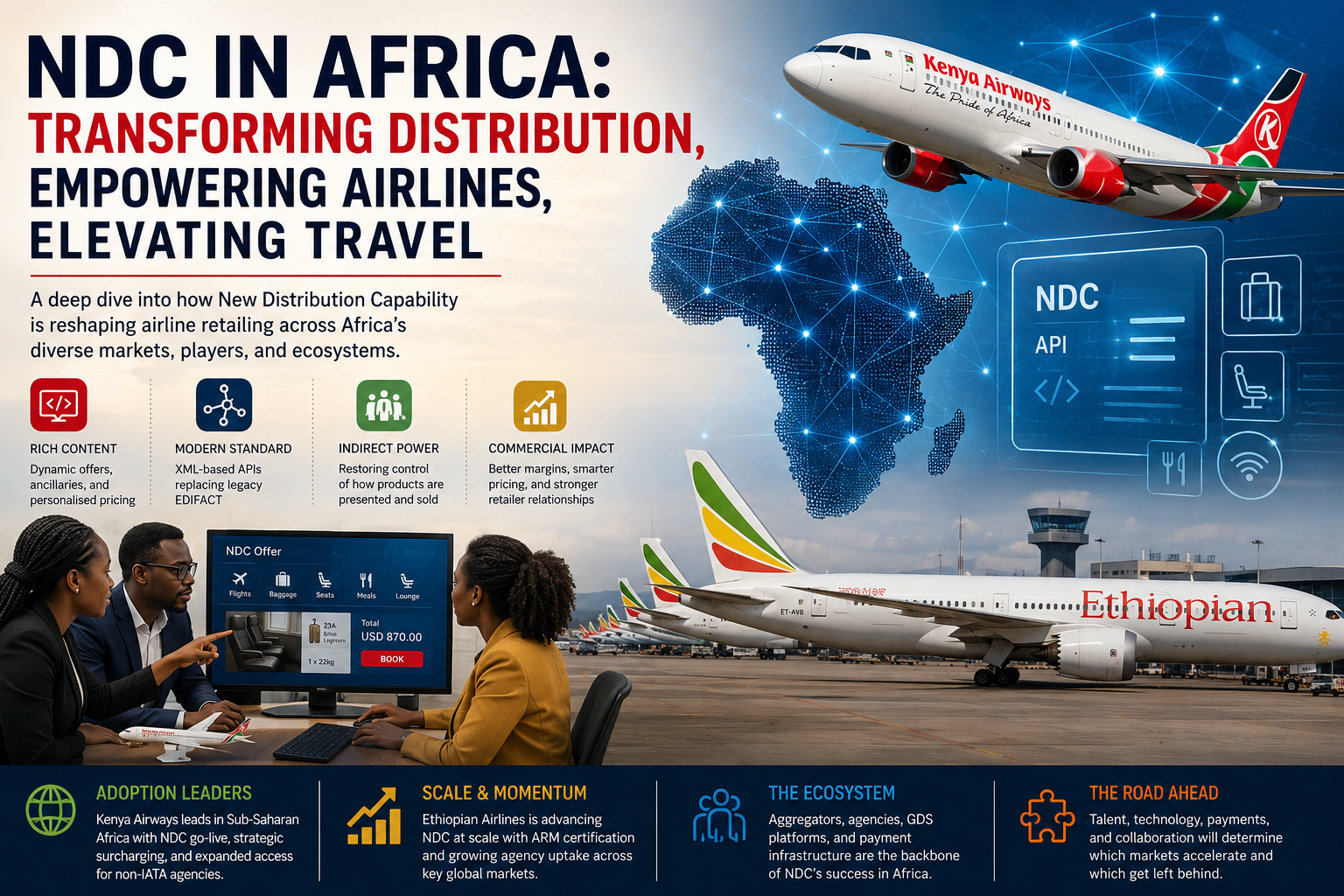
Kenya Airways became the first airline in Sub-Saharan Africa to distribute NDC content through the Amadeus Travel Platform in April 2025. The airline launched with Verteil Technologies as its first aggregator, then added Amadeus to give its NDC content access to the global community of travel sellers simultaneously. KQ also implemented a GDS surcharge of USD 5 per segment for domestic bookings and USD 8 for international, a structural repricing of the indirect channel that creates a commercial incentive for agencies to migrate without requiring them to be told to. That combination of aggregator reach, platform reach, and pricing architecture represents the most complete NDC commercial strategy of any African carrier.
Kenya’s BSP sales reached approximately $567 million in 2025, reflecting how significant the agency channel remains even as the airline pushes toward direct NDC connectivity. The move to extend NDC access to non-IATA agencies through Amadeus in early 2026 widened the addressable market further. Non-IATA agencies can now search, price, and book Kenya Airways NDC offers directly within the Amadeus system, a step that broadens participation without requiring those agencies to build direct API connections.
Ethiopian Airlines is the scale argument the rest of the continent cannot replicate. The airline has signed agreements to advance its digital transformation agenda with a focus on B2B distribution and NDC-enabled content. It holds IATA’s ARM certification covering offer and order management including post-booking servicing. In November 2025 it began processing NDC transactions through ARC Direct Connect, becoming the first airline to integrate using ARC’s new Transaction API. Ethiopian flies to more than 160 destinations across five continents. When it activates NDC content through a settlement platform, it makes that content accessible to a significant slice of the global agency community in a single move, a compression of the market-by-market build that smaller African carriers cannot achieve.
South Africa presents a different kind of progress. The market has developed ecosystem conditions that make NDC commercially viable without requiring airlines to force the issue through surcharges or mandates. FlySafair went live on TPConnects’ Iris platform in early 2025, giving agencies access to its content through a unified interface alongside EDIFACT and other aggregator content. South African Airways has been evaluating NDC options in partnership with technology providers. The technology talent base, agency sophistication, and GDS relationships in South Africa make it structurally more ready than most African markets to absorb NDC at scale.
The Aggregator Layer
Between airlines and agencies sits the aggregator, the technology company that connects NDC content from multiple airlines into a single interface that agencies can access without building individual API connections to each carrier. In Africa, this layer is still forming.
Verteil Technologies was Kenya Airways’ first NDC aggregator and remains the most operationally embedded in the African market. Its relationship with KQ established both the channel architecture and a reference case for what aggregator-led NDC adoption looks like in practice. TPConnects brought FlySafair live in South Africa through its Iris platform. Airgateway is building its aggregation capability across emerging markets including Africa.
The aggregator layer matters enormously for agency adoption. Most African travel agencies do not have the technical capacity to build and maintain direct API connections to individual airlines. The aggregator solves that problem by doing the integration once and distributing access broadly. For NDC to reach agencies at scale in Africa, the aggregator layer has to work. It has to be reliable, commercially accessible, and supported by airlines that are committed to keeping their NDC content competitive.
Airlines that lack an established network of qualified distribution partners find that even the best NDC API can sit idle. The aggregator relationship is not a technical nicety. It is load-bearing infrastructure for the entire distribution shift.
The Agency Readiness Problem
Airline NDC programmes can go live. Aggregators can build the connectivity. None of it moves volume unless travel agencies adopt the new channel. And in Africa, agency adoption is the most significant constraint on NDC scaling.
The barriers are structural, not attitudinal. African travel agencies operate on thin margins with limited technology budgets. Switching from a GDS workflow to an NDC workflow requires investment in training, system integration, and operational change. For a small agency managing corporate travel contracts and government accounts, that investment competes directly with the day-to-day cost of running the business.
The servicing question compounds this. Post-sale changes, refunds, and special requests remain the single biggest pain point in NDC adoption, with no standard servicing logic across airlines leaving agents navigating a fragmented set of support systems. In markets where agency relationships with corporate clients depend on seamless service recovery, this is not a minor inconvenience. It is a commercial risk that agencies rationally choose to avoid.
In the United States, OTAs accounted for 77% of settled NDC transactions in 2025, while leisure agencies accounted for 16% and corporate agencies just 7%. The pattern in Africa mirrors this globally. The agencies most dependent on NDC content for commercial survival are also the ones least equipped to adopt it quickly.
The GDS Response
Global distribution systems are not passive participants in this transition. Amadeus, Sabre, and Travelport each have significant commercial interests in how NDC adoption plays out, and each has invested in NDC connectivity as part of its own platform evolution.
Amadeus processed Kenya Airways’ NDC go-live and is the platform through which KQ’s content reaches the broadest agency community. That is not a concession by Amadeus. It is a strategic positioning. By becoming the preferred NDC distribution layer for African airlines, Amadeus maintains its centrality in the market even as the underlying standard shifts.
The GDS providers are not being replaced by NDC. They are being transformed by it. The question is not whether they survive the transition but how much of the commercial architecture around pricing, settlement, and agency relationships they retain as the standard evolves. In Africa, where GDS penetration is deep and agency dependency on GDS tooling is high, that transition will be slower and more negotiated than in markets where airlines have more direct leverage over agency behaviour.
What Comes Next
According to IATA’s 2025 Annual Review, even the leading NDC airlines are still in the setup phase, while many others will only begin their transition in 2028 to 2029. Full Offer and Order adoption is unlikely to become mainstream before 2030. Africa sits within that global timeline, not outside it.
The markets that are moving will continue to pull ahead. The gap between Kenya, Ethiopia, and South Africa and the rest of the continent will widen before it closes. Aggregators will concentrate their investment in markets with confirmed airline programmes and sufficient agency density to generate volume. Technology vendors will follow. The distribution infrastructure of African aviation will not modernise uniformly. It will modernise in clusters, led by the markets that have already built the conditions for NDC to work.
For airlines across the continent that have not yet moved, the window to shape the transition on their own terms is narrowing. The longer they remain on legacy distribution, the more the commercial terms of the shift will be set by carriers and aggregators that moved earlier. NDC is not a technology upgrade. It is a renegotiation of commercial power in the distribution chain. The airlines that understand that distinction early are the ones building the leverage that will define how African aviation is sold for the next decade.