
Sabre has spent the better part of a year telling the travel industry that agentic AI is its future. On 6 May, it stopped talking and started showing.
The launch of Mindtrip Flights, a conversation-led flight booking experience built on Sabre’s Mosaic platform and integrated with PayPal’s agentic commerce services, marks the first time a major GDS infrastructure provider has powered a live, end-to-end agentic booking product available to consumers. From search to checkout, entirely within a chat interface.
The product itself is straightforward. Travelers visit mindtrip.ai/flights, describe what they need in plain language, and receive structured flight recommendations. When they are ready to book, they pay through PayPal without leaving the conversation. No tab-switching, no redirect to an airline website, no separate checkout flow.
But the product is not the story. The positioning is.
“Out of the Lab and Onto the Ledger”
Garry Wiseman, President of Product and Engineering at Sabre, chose his words carefully at launch. “We’ve moved agentic AI out of the lab and onto the ledger,” he said. “It’s no longer theoretical. It’s a live production blueprint.”
That phrase, live production blueprint, is the signal worth paying attention to. Sabre is not presenting Mindtrip Flights as a one-off consumer product. It is presenting it as a reference architecture for what comes next, an open invitation, in Wiseman’s words, to any company in the industry building AI-native travel experiences.
Sabre’s underlying message to airlines, OTAs, and travel tech builders is clear: you do not need to build the infrastructure. We have already built it. Plug into Sabre Mosaic, and your agentic experience has live inventory, real-time pricing, and enterprise-grade fulfilment behind it from day one.
This is a meaningful strategic pivot for a company whose core business has historically been defined by the GDS model, a centralised intermediary layer between airlines and agencies. TDN spoke with Alessandro Ciancimino, Sabre’s Vice President of Airline Distribution for EMEA, earlier this year on how Sabre is approaching this transition.
What It Means for Airline Distribution
The implications for how airlines distribute their content are significant.
Traditional GDS economics have always depended on the agency channel. Airlines pay booking fees, agencies receive incentives, and the GDS sits in the middle as a necessary infrastructure provider. That model has been under pressure for years, first from direct booking, then from NDC, and now from AI.
Agentic booking changes the question. If travelers increasingly search, evaluate, and purchase through conversational AI interfaces rather than search engines or OTA listing pages, the question for airlines is no longer just which GDS they are connected to. It is which AI interfaces have access to their content, at what fidelity, and under what commercial terms.
Mindtrip Flights, powered by Sabre Mosaic, currently reaches inventory across more than 420 airlines including 150 low-cost carriers. Airlines whose content sits within that ecosystem are, in principle, reachable through agentic interfaces without any additional integration work. Airlines outside it are not.
The NDC Dimension
There is a layer to this story that the press release does not address directly but that distribution professionals will notice.
Sabre Mosaic is built on a modular, API-first architecture. Agentic systems depend on rich, structured content to generate meaningful recommendations. A conversational AI that can only access availability and price, without ancillaries, fare conditions, or branded fare context, will deliver worse recommendations than one with full offer content.
The agentic layer does not care about protocol ideology. It cares about content richness.
This creates a quiet but real incentive structure. Airlines that have invested in NDC content distribution stand to benefit more from agentic interfaces than those still distributing legacy EDIFACT content.
The Africa Question
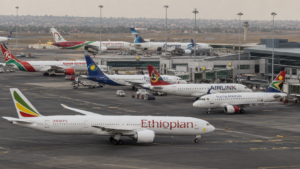
For African carriers already on Sabre’s platform, this development is largely invisible in the near term. Mindtrip’s consumer rollout is focused on the US and European markets at launch. But the infrastructure question is the same everywhere: as agentic interfaces become the dominant consumer discovery layer, where your content sits and how it is structured will determine whether AI systems can find it, present it, and sell it.
For many African airlines still early in their NDC and retailing transition, the risk is not simply falling behind on distribution technology. It is becoming invisible inside AI-driven discovery environments.
A Blueprint, Not Just a Product
Wiseman said at launch that Sabre has created “a blueprint for how the travel industry can come together to scale in the agentic era.” That framing matters.
Sabre is positioning itself not as the destination but as the foundation. The consumer experience belongs to Mindtrip. The payments layer belongs to PayPal. Sabre provides the infrastructure that makes both of them work at scale. This is a deliberate repositioning away from the GDS model, where Sabre controlled the interface and the economics, toward a platform model, where Sabre controls the infrastructure and others build the experiences on top.
Whether that repositioning succeeds will depend on adoption. Airlines, OTAs, and AI builders have to choose to build on Sabre Mosaic for the blueprint to matter. The Mindtrip partnership is designed to demonstrate that it works. The harder commercial work, convincing the rest of the industry to follow, is still ahead.
What is no longer in question is the direction. The GDS era, defined by centralised interfaces and long-term agency contracts, is giving way to something more distributed, more API-driven, and increasingly mediated by AI. Sabre, whatever else can be said about its recent years, has placed its bet clearly.