
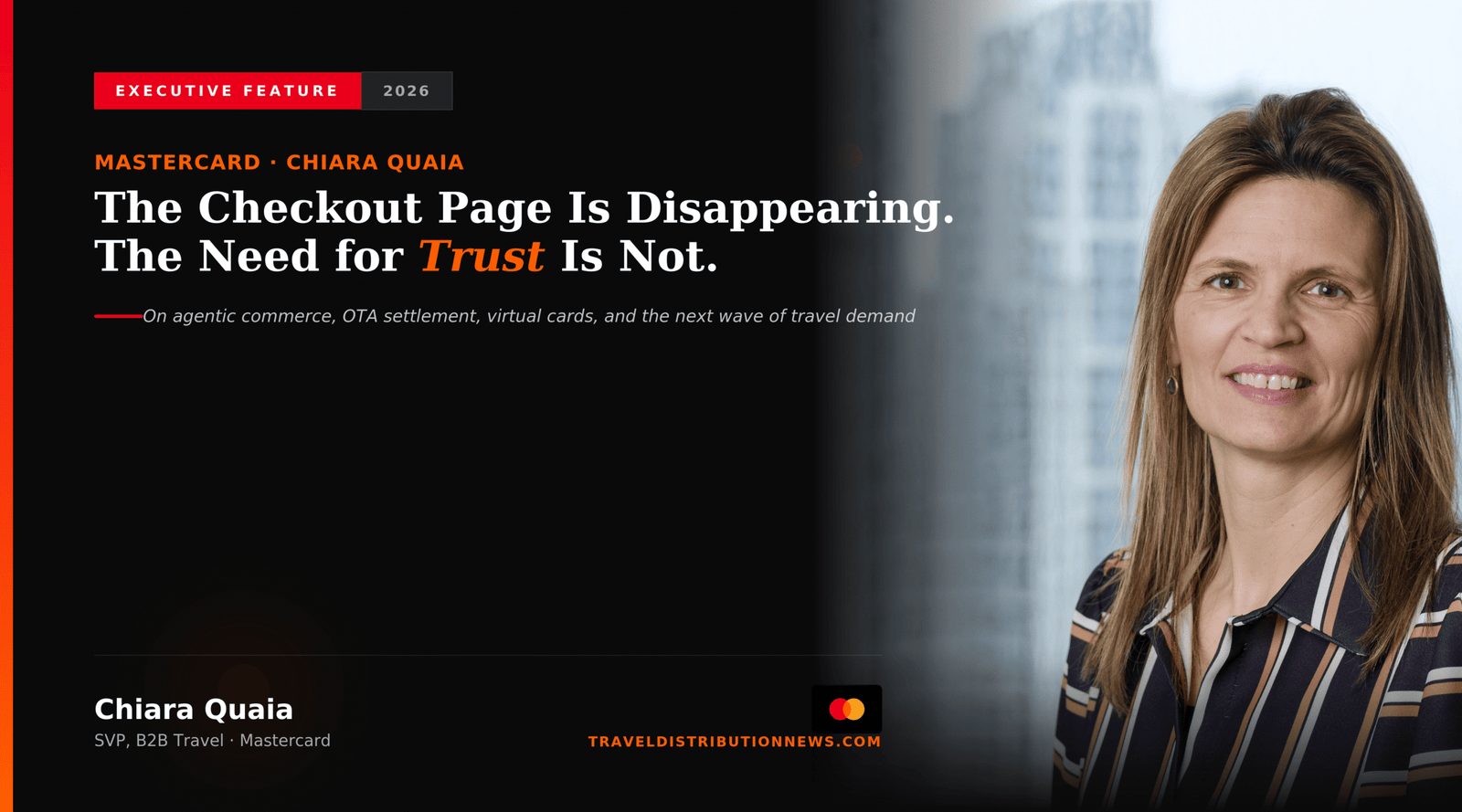
The Senior Vice President of B2B Travel at Mastercard on agentic commerce, the OTA settlement problem, why virtual cards are reshaping airline distribution, and what financial inclusion in travel actually requires.
There is a version of the airline payments conversation that stays close to the surface. Settlement cycles. FX spreads. Decline rates. The plumbing of moving money from one party to another across an increasingly fragmented distribution chain.
Chiara Quaia is not interested in that version.
As Senior Vice President of B2B Travel at Mastercard, Quaia sits at the intersection of two of the most consequential shifts in travel commerce: the structural transition from EDIFACT-based settlement to dynamic offer and order architecture, and the emergence of AI-mediated booking that is set to dissolve the checkout page entirely. Her view of where the industry is heading is sharp, specific, and grounded in what Mastercard is already building.
The picture she draws is one where the payments infrastructure question is no longer a back-office concern. It is a strategic one.
The EDIFACT-to-Orders Gap Is Not a Technology Problem
The shift from EDIFACT-based settlement to a true offers-and-orders environment is the foundational change running beneath every other conversation in airline distribution. It is also the one most frequently mischaracterised as a technology upgrade.
Quaia pushes back on that framing immediately.
“Moving from EDIFACT-based settlement to a true offers-and-orders environment is not a simple technology upgrade,” she says. “It requires careful end-to-end planning and coordinated execution across the industry.”
The distinction matters because it relocates responsibility. If the transition is a technology problem, it belongs to engineering teams. If it is an end-to-end orchestration problem requiring alignment between airlines, payment service providers, acquirers, and networks, it belongs to the C-suite. Her argument is that the industry has been treating it as the former when it is clearly the latter.
The most acute gaps cluster around data flow. The rich contextual data attached to modern travel transactions is still constrained by legacy processes and intermediary chains. Each handoff introduces risk of data loss, delay, or misattribution.
Optimising individual steps, faster authorisation here, cleaner reporting there, is insufficient. The whole transaction lifecycle, from authentication through to revenue reconciliation, needs to be redesigned with offers-and-orders complexity in mind. Piecemeal fixes will not get the industry where it needs to go.
The Cross-Border Opportunity Is Larger Than Anyone Is Pricing In
The data on cross-border travel payments in markets like Africa and Southeast Asia is well known within the industry. High failure rates. Wide FX spreads. Conservative issuer decline strategies that reject transactions that should clear. The combined effect is significant and measurable suppression of demand from markets growing faster than anywhere else in the world.
What is less discussed is the commercial upside when those frictions are reduced.
Mastercard’s view is direct about the scale. As barriers come down, the benefit is not marginal improvement in existing flows. It is access to millions of new travellers currently underserved or excluded from global travel commerce entirely.
“For travel suppliers, that translates directly into greater demand,” she says.
Virtual Card Numbers are central to how that opportunity gets captured, particularly for travel intermediaries and corporate buyers, where they improve approval rates, reduce fraud, and simplify settlement in complex cross-border flows. Issuers, equipped with richer data, tokenisation, and VCN controls, can shift from conservative decline strategies to growth-oriented approval models.
The competitive logic is clear. The issuers, platforms, and networks that can orchestrate trust at scale in cross-border transactions will capture the growth. Those that cannot will cede it.
In Africa specifically, this is not a distant prospect. Mobile-first consumer behaviour, rapidly expanding digital wallet penetration, and growing appetite for international travel create conditions where the right payment infrastructure can open markets that have been structurally closed for years.
When the AI Books the Flight
The agentic commerce question is the one most of the payments industry is still treating as a future scenario. From Mastercard’s perspective, it is a present design problem.
As AI agents, chatbots, and embedded commerce surfaces take on more of the travel booking function, the traditional checkout page starts to disappear. The transaction happens inside the agent’s workflow. The human is at one remove from the moment of payment.
This creates a problem that is both technical and commercial. Who authorised the transaction? What exactly was purchased? If something goes wrong, where does accountability sit?
Mastercard’s answer is Agent Pay, a solution that requires AI agents to be verified and registered before they can transact on the network, in the same way that merchants are verified today. Beyond authentication, the system captures and records the customer’s original instructions and links them directly to the transaction, creating a complete chain of accountability from intent to execution.
“Nothing is purchased without the customer’s explicit approval and every step is fully traceable,” Quaia says.
Mastercard is not positioning itself as a gatekeeper that slows down agentic commerce. It is positioning itself as the infrastructure that makes agentic commerce trustworthy enough to scale. The distinction is the difference between friction and foundation.
For airlines and travel companies building towards AI-mediated distribution, the consumer confidence that a booking made on their behalf is accurate, secure, and reversible cannot be assumed. It has to be engineered into the infrastructure.
The OTA Settlement Problem Has a Solution
When a traveller books a multi-airline itinerary through an OTA using NDC content from different carriers, the traditional settlement architecture breaks. It was designed for single-supplier transactions. It was not designed for a scenario where one booking involves multiple airlines, each with its own NDC implementation, its own servicing logic, and its own payment expectations.
The result, in practice, is fragmentation that the traveller absorbs through split transactions, inconsistent servicing, and confusion around changes or refunds.
The implication, she argues, is straightforward. Allow the OTA to act as Merchant of Record, managing the payment directly with the customer while settling with each airline in the background.
“This shields the traveller from fragmentation and creates a single point of accountability for servicing,” Quaia says.
Virtual cards are the enabling technology. They give the OTA a flexible, secure mechanism to pay multiple suppliers while maintaining a single, clean customer-facing experience. The traveller sees one transaction. The OTA manages the complexity behind it.
This is not a theoretical arrangement. It is how the most sophisticated OTA payment operations already work. What Mastercard is describing is the standardisation and scaling of that model as NDC-sourced multi-airline bookings become the norm.
Airlines as Financial Ecosystems
Perhaps the most structurally significant shift in the conversation concerns what is happening inside airlines themselves. Airlines are increasingly functioning as financial services providers, storing value in loyalty programmes, issuing virtual cards, managing currencies that sit outside the traditional monetary system.
Mastercard’s strategic alliance with Riyadh Air illustrates where this is heading. The partnership introduced Riyadh Air-branded, digital-first Mastercard cards allowing cardholders to earn flights, upgrades, lifestyle rewards, and exclusive experiences embedded within the airline’s ecosystem, with application, activation, and reward tracking through a single touchpoint in the app.
More significant for the distribution industry is what Quaia describes as the first airline-branded virtual card programme for travel intermediaries globally, giving Riyadh Air’s travel partners improved efficiency, security, and reconciliation through a streamlined payment solution.
The significance is not the co-branded card itself. It is the emergence of airlines as embedded financial ecosystems rather than purely transportation providers. The carriers that move earliest to embed these capabilities within their customer relationships will build compounding advantages in loyalty, distribution economics, and data that are difficult to replicate once established.
Inclusion Is a Growth Thesis
The final dimension of the argument carries the longest time horizon and arguably the largest commercial stakes.
A significant and fast-growing share of global travel demand is coming from markets where access to traditional card rails remains limited. Mobile-first consumers in Sub-Saharan Africa, Southeast Asia, and parts of Latin America are increasingly willing and able to pay for travel, but excluded by infrastructure built around assumptions that do not hold in their markets.
Mastercard’s response is to expand access through digitally native and account-based payment options, including mobile wallets, tokenised credentials, and real-time account-to-account and prepaid solutions. The goal is to enable consumers who are underbanked or unbanked to transact securely for travel using tools they already trust, while connecting those transactions to the global acceptance network that travel suppliers depend on.
“Our objective is to democratise access to travel,” Quaia says, “enabling the next wave of travellers to participate fully in global commerce while helping travel providers safely capture new growth.”
The commercial thesis is that inclusion and growth are the same thing, not trade-offs. The travellers currently excluded from formal travel commerce represent real demand. The platforms and networks that bring them in will capture a share of travel growth that their competitors will miss entirely. In a market where established travel economies are growing modestly, that is where the next decade of expansion is going to come from.
The Bottom Line
Chiara Quaia’s perspective on travel payments refuses to stay at the operational level. The settlement gaps, decline rates, and VCN mechanics are real and important. But the argument she is making is ultimately about what kind of infrastructure the travel industry needs to build to serve the next generation of commerce.
Agentic booking requires verified, traceable, accountable transactions. Multi-airline NDC itineraries require a single point of accountability that shields travellers from backend complexity. Cross-border inclusion requires the connection of local rails to global acceptance. Airlines evolving into financial ecosystems require strategic partners with the scale and capability to build alongside them.
The checkout page may be disappearing. The need for trust, accountability, and seamless execution is not going anywhere.
Chiara Quaia is Senior Vice President, B2B Travel at Mastercard. Mastercard is a global technology company in the payments industry, connecting consumers, financial institutions, merchants, governments, and businesses worldwide.
Travel Distribution News covers the business of airline distribution, NDC, GDS dynamics, payments, and emerging markets. Subscribe at traveldistributionnews.com