

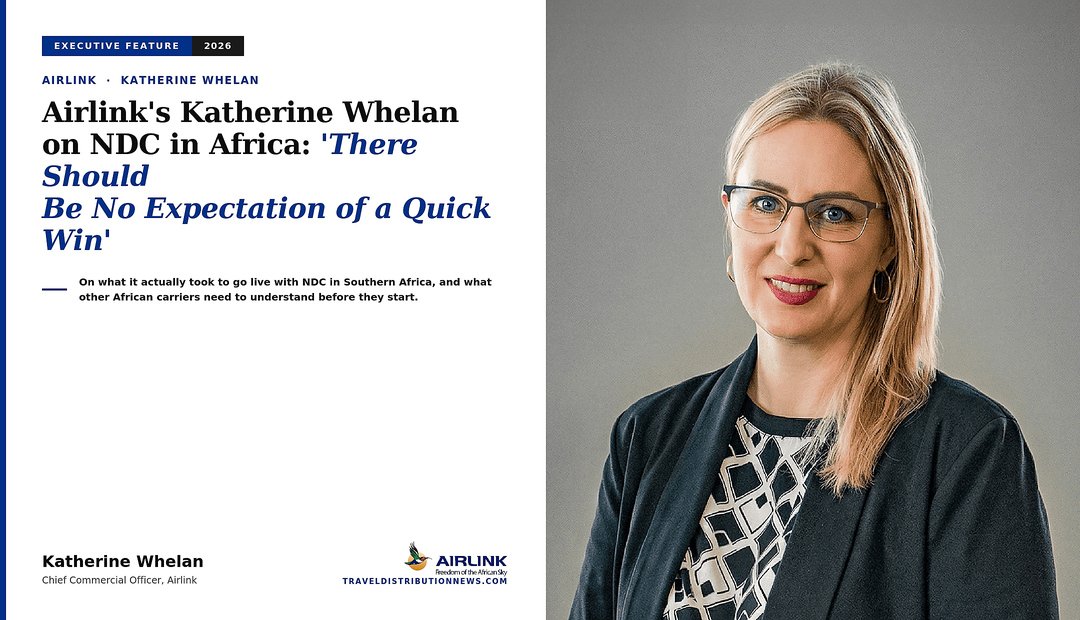
Airlink’s Chief Commercial Officer on what it actually took to go live with NDC in Southern Africa, why the hybrid model is here to stay, and what African carriers considering the transition need to understand before they start.
Airlink went live with NDC in July 2024. In the context of African aviation, where NDC adoption has been slow, fragmented, and frequently more announced than implemented, that makes the South African carrier one of the earliest movers on the continent.
Katherine Whelan, Chief Commercial Officer of Airlink, is not interested in presenting the journey as a success story in the promotional sense. Her account of what the transition actually involved is more useful than that: honest about the technical difficulty, clear-eyed about the commercial reality, and specific about what other African carriers need to understand before they commit to the same path.
The central message is one the industry rarely hears stated plainly. There are no shortcuts. There is no version of NDC adoption that is fast, smooth, or easy. And anyone who approaches it expecting otherwise will spend a long time being surprised.
Why Airlink Moved Early
The decision to begin NDC integration ahead of most African carriers was not driven by a conviction that the timing was perfect. It was driven by a more pragmatic calculation.
“Airlink was aware that the integration of NDC into the business would not be a quick process,” Whelan says. “Since it had to be done, it made sense to get going early.”
That logic is worth unpacking. Airlink was not moving early because it had solved the agent readiness problem, or because the Southern African market was clamouring for NDC content. It was moving early because it understood that the transition would take longer than anyone expected, and that delaying the start would simply delay the outcome.
There was also a signalling dimension. By committing to NDC publicly, Airlink was communicating to the trade that modern distribution was arriving in Southern Africa and that the conversation was worth having. Many agencies in the market had already integrated NDC capability to accommodate requirements from international carriers, so the concept was not new. Airlink’s move added a local carrier to the landscape.
The Hardest Parts
Whelan’s description of what the transition actually required is one of the most candid accounts of NDC implementation that TDN has encountered.
The technical side was the most frustrating dimension. Limited NDC experience within the company meant learning under pressure, working through problems that could not be anticipated in advance because the knowledge to anticipate them did not yet exist internally.
“We realised that there were fewer standardised features amongst airlines than we had originally thought,” she says. “This meant several enhancements needed to be made, which prolonged the project even further.”
That observation carries a specific lesson for carriers considering the same path. NDC is a standard in name. In practice, each airline’s implementation is different, each aggregator’s integration has its own characteristics, and the assumption that the standard will produce consistent behaviour across different connections is regularly disproven in production.
The biggest surprise was simpler than any of that: the time it took.
“The amount of time it took to get NDC up and running was probably the biggest surprise.”
In an environment where airlines face commercial pressure to deliver results quickly and where technology projects are routinely underestimated, that admission is important. NDC is not a technology project with a fixed delivery date. It is an ongoing capability build that requires sustained investment in people, systems, and relationships over an extended period.
The Economics: Real But Not Yet Transformative
On the financial case for NDC, Whelan is measured. The savings are real. They are not yet large enough to dominate the commercial picture.
“The volumes are not big enough yet to see a marked improvement, but based on the numbers we do have, the savings are evident. This will improve over time as more NDC adoption occurs.”
That is an honest assessment of where most early-stage NDC implementations sit commercially. The cost differential between NDC and EDIFACT bookings is genuine: the GDS distribution fee that applies to traditional bookings is a real expense that NDC routes around. But realising material savings requires volume, and volume requires agent adoption, and agent adoption takes time.
The implication for how airlines should frame the NDC business case is important. The cost reduction argument is valid but long-cycle. It does not deliver in the quarter of implementation. It builds as adoption grows. Airlines that present NDC to their boards as a near-term cost play will find themselves explaining disappointing numbers. Those that present it as a medium-term infrastructure investment will be in a better position.
Hybrid Is Not a Transitional Phase
On the question of whether the current hybrid NDC and GDS model in Southern Africa represents a transitional phase or a permanent state of the market, Whelan’s answer is nuanced and practically important.
“At this stage, within the Southern African market, it certainly seems like the most viable option. It gives agencies the time they need to familiarise themselves with this new form of distribution.”
She stops short of predicting the permanent coexistence of the two models. Her view is that traditional GDS will eventually give way to next-generation distribution practices. But the timeline is long, and the pressure to force a faster transition is counterproductive.
“Having the option to switch between traditional GDS and NDC is advantageous and is likely to offer agencies a level of comfort whilst navigating this transition.”
That comfort matters commercially. Agencies forced into a model they are not ready for make more errors, generate more support costs, and ultimately book less. The hybrid model is not a compromise on ambition. It is a recognition that distribution transformation works better when it is pulled by agent readiness than pushed by airline policy.
Who Is Adopting and Who Is Not
Airlink’s agent base today reflects the pattern visible across most markets where NDC has been introduced. A cohort of early adopters is moving quickly and capitalising on the opportunities NDC creates. The broader market is moving at its own pace.
“There are currently several agencies within Southern Africa that are very focused and driven to embrace the changes and who are utilising the opportunities NDC brings to increase sales,” Whelan says. “For the most part, the industry as a whole realises that the move is necessary, but as each business is different, they will need to move at a pace that makes sense for them.”
That segmentation is likely to persist. The agencies leading adoption are typically those with stronger technology capability, larger corporate client bases, and commercial incentives to differentiate on content. The laggards are typically smaller, less technically resourced, and more dependent on established workflows that NDC disrupts.
The practical consequence for Airlink is a distribution strategy that must serve both groups simultaneously, maintaining EDIFACT access for agents who are not yet ready while investing in the NDC capability that will serve the leading segment and increasingly define the commercial future.
The African Carrier Question
One of the most direct questions TDN put to Whelan was whether Airlink’s experience constitutes a model other African carriers can realistically follow. Her answer refuses the framing.
“This is not a one size fits all scenario. It will very much depend on individual airline aspirations as well as the markets they are working in.”
She goes further. Some carriers in certain geographies will find NDC integration more tractable than others. The regulatory environment, the sophistication of the local agency market, the airline’s internal technology capability, and the level of NDC knowledge within the organisation all shape how difficult and how long the transition will be.
The one observation she is willing to make universally is the most important one.
“There should be no expectation of a quick win. This is especially true if there is a general lack of knowledge on the subject.”
For African carriers evaluating NDC, this is the sentence that should anchor the internal conversation. The business case is real. The path is long. The airlines that go in expecting a rapid transformation will be poorly equipped to manage the reality. Those that go in with a realistic multi-year timeline, adequate internal capability, and a genuine understanding of what the technology requires will be better positioned to reach the outcomes they are building toward.
What Comes Next
Airlink’s distribution agenda beyond the current NDC implementation centres on Offer and Order architecture, with a focus on not falling too far behind global norms.
“Since we started our NDC project earlier than most airlines in Africa, we have created the time to assess how best to move forward based on what would work within our business as well as within our markets,” Whelan says.
On the aggregator side, Airlink currently has live connections through Accelya to AirGateway, Verteil, Thomalex, TravelIT, and Nucore, with seven more aggregators in various phases of onboarding and several more under discussion. That roster represents meaningful momentum in building the connectivity layer that NDC content requires to reach agents at scale.
The direction is clear. Airlink is not treating NDC as a destination. It is treating it as a foundation from which the next phase of distribution capability, more dynamic pricing, richer ancillary merchandising, and eventually full Offer and Order architecture, will be built.
The work is not finished. In some respects, it is only beginning. But the foundation is being laid by a carrier that understood early that this transition rewards those who start, not those who wait for perfect conditions that will never arrive.
Katherine Whelan is Chief Commercial Officer of Airlink. Airlink is a South African regional carrier operating scheduled services across Southern Africa and beyond.
Travel Distribution News covers the business of airline distribution, NDC, GDS dynamics, payments, and emerging markets. Subscribe at traveldistributionnews.com