
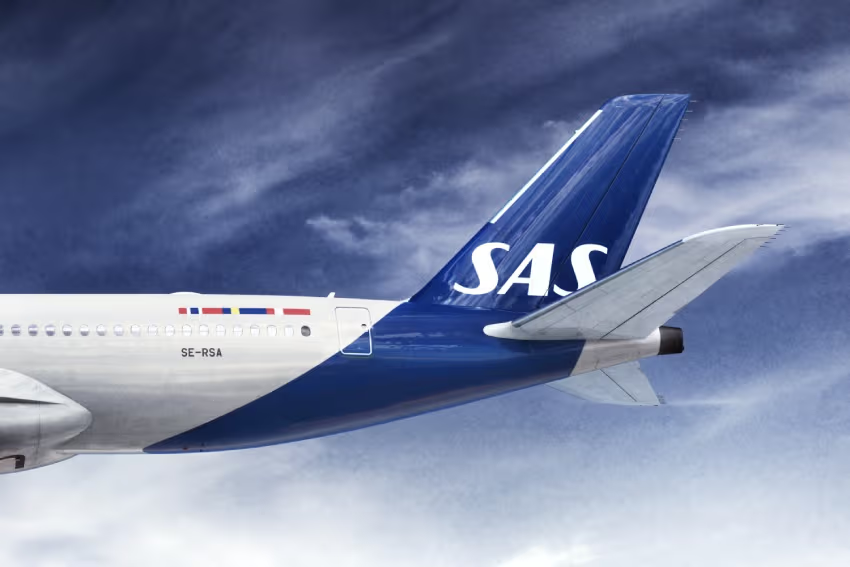
Amadeus has deployed its Air Pricing Optimization tool, AAPO, across the full network of Scandinavian Airlines. The rollout is one of the clearest signals yet that continuous, AI-driven pricing is moving out of pilot territory and into standard commercial operation at a major full-service carrier.
According to Amadeus, the initial markets where SAS activated AAPO on its website and NDC-enabled channels have already produced an average revenue increase of more than three percent. That figure comes from the vendor’s own announcement rather than an independent audit, and Amadeus has not disclosed which markets, how many, or over what time period the gain was measured. It is a real result worth noting, but it should be read as a vendor-reported number until SAS or a third party confirms the detail.
The mechanics matter more than the headline number. AAPO replaces the traditional model of fixed booking classes, where a fare jumps from one price bucket to the next as seats sell, with pricing that adjusts continuously in response to demand. Amadeus frames this as a smoother, more predictable experience for shoppers and less manual price management for SAS’s revenue teams, who retain control through pricing strategies and guardrails rather than needing to refile fares by hand.
SAS Chief Revenue Officer Erik Westman tied the deployment to the airline’s broader retail transformation, describing it as part of an effort to make the shopping and booking journey feel more consistent. Maher Koubaa, who leads Amadeus’s Travel Unit and EMEA business, positioned the deal as proof of the vendor’s ability to run AI at production scale with governance behind it, a message aimed as much at the market as at SAS itself.
For distribution watchers, this is a data point in a larger contest. Amadeus, Sabre and Travelport have each staked out a different bet on where the next phase of airline retailing gets won, and Amadeus’s bet has centred on retail infrastructure and now, visibly, on pricing intelligence layered on top of NDC content. A quantified, named-customer result is rare in this space and gives Amadeus something concrete to point to as competitors make similar claims with less specificity.
The deeper story sits underneath the pricing algorithm itself. Traditional airline pricing has run on a fairly linear sequence: revenue management sets strategy, fares get filed in advance, seats are sold through fixed booking classes, and those classes are pushed out through distribution. Continuous pricing breaks that sequence. Revenue management still sets the strategy, but the price itself is no longer filed ahead of time; it is generated at the moment a customer shops, using real-time demand data, and delivered through NDC or API channels as a personalised offer rather than a pre-set fare bucket. That is not a pricing feature. It is a shift in what an airline is actually selling at the point of sale, from a filed fare to a generated offer, and it depends on infrastructure most carriers do not yet have: modern offer management, clean and accessible customer data, NDC distribution, and the ability to price in real time rather than in batch.
That dependency is why SAS’s deployment matters more as a signal than as a revenue number. Most African and Middle Eastern carriers are still working through earlier stages of that same infrastructure build, and for them, the foundational question is not whether to adopt a pricing algorithm like AAPO but whether the offer management and NDC groundwork underneath it exists yet. The significance of this deployment is therefore less about a reported three percent revenue gain than about what it signals. Airlines are gradually shifting from managing inventory through predefined booking classes to generating prices dynamically at the moment of shopping. If that model proves commercially sustainable at scale, continuous pricing may become as fundamental to airline retailing as NDC itself. The next question is no longer whether the technology works, but how quickly airlines outside the industry’s largest retail innovators can build the infrastructure needed to support it.