
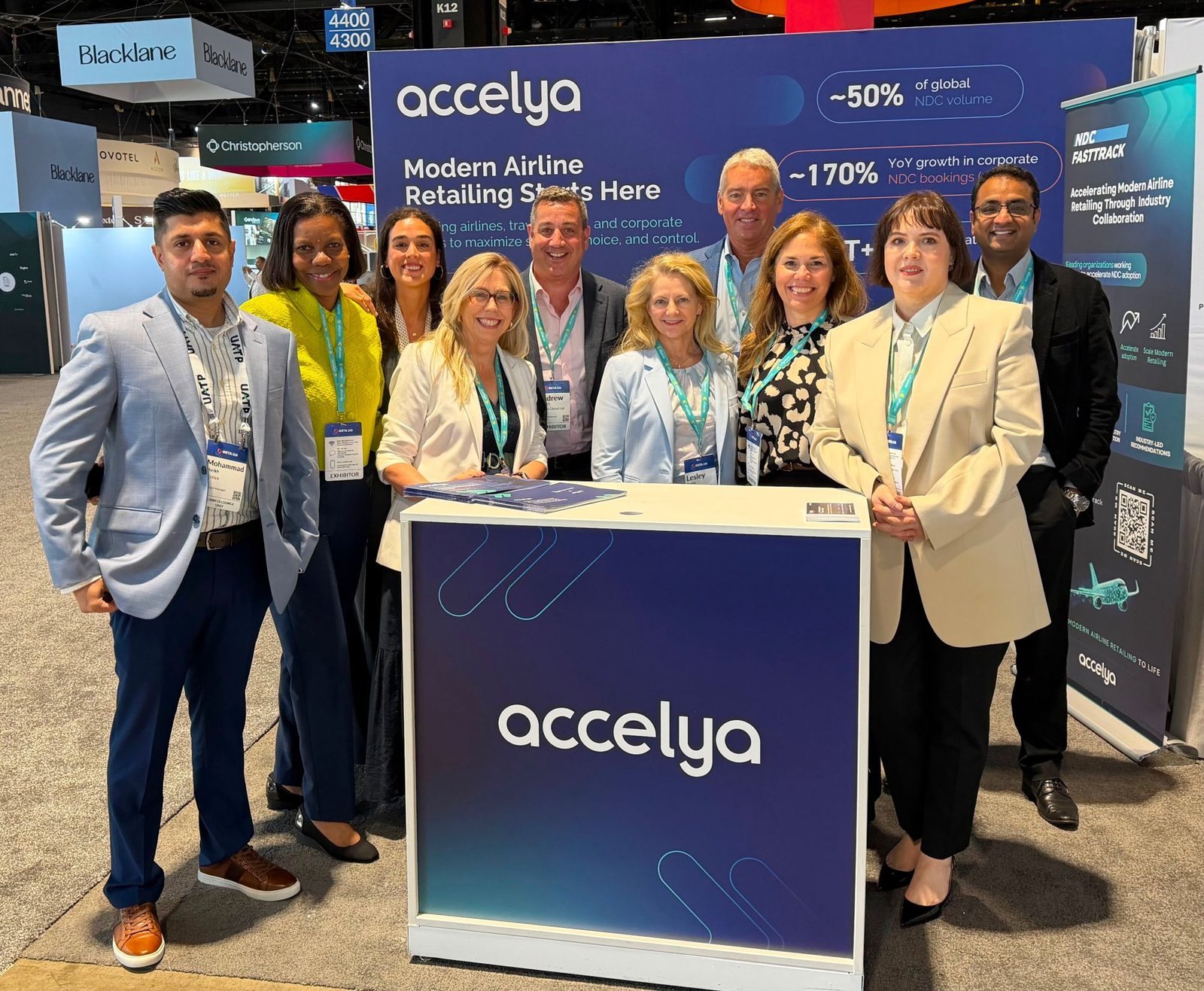
NDC FastTrack marked its first anniversary in July with 18 member organizations, up from two founding members at its GBTA Denver launch in July 2025. The current roster, per Accelya’s own one-year update, is Amadeus, Amex GBT, ARC, ATPCO, BCD Travel, CTM, Direct Travel, Emburse, Farenexus, FCM Travel, Fox World Travel, Navan, Sabre, SAP Concur, Spotnana, Travelfusion and Travelport, alongside Accelya itself. The roster is overwhelmingly concentrated in North America and Europe, with no African or MENA-headquartered organization among the 18 members.
That growth changes the shape of the question. A year ago this was a small, founding-member club, and its geography was easy to explain as early-adopter timing. Eighteen organizations in, spanning GDSs, TMCs, corporate travel platforms, settlement bodies and industry standards groups, FastTrack looks less like a startup cohort and more like an emerging industry forum for NDC servicing. The question is no longer why there were only twelve. It’s why, after a year of deliberate geographic and functional expansion, that expansion still hasn’t reached Africa or MENA.
Read against the rest of Accelya’s African footprint, that absence doesn’t look like neglect. Africa isn’t missing from Accelya’s NDC story. It is appearing at a different layer of that story.
Accelya’s relationship with the continent is not shallow. IATA’s most recent financial services fact sheet names currency liquidity and repatriation as active, unresolved problems in specific African markets: the Central and West Africa CFA franc zones, and Malawi, Nigeria, Egypt and Lebanon. Accelya operates BSPlink, the system underpinning much of that settlement layer, under a long-term agreement it renewed with IATA in February 2025. Sam Gilliland, Accelya’s CEO, said at the time that the company processed more than $100 billion in airline revenue globally in the prior financial year. Accelya does not publicly break that figure down by African market, but the scale puts its settlement infrastructure in a very different category from its newer NDC footprint.
The NDC side is newer, and it’s arriving with real weight where it’s arriving. Airlink, the Johannesburg-based regional carrier, became Accelya’s global launch customer for FLX Select in September 2024, the first airline anywhere to adopt the product. Ethiopian Airlines adopted the same platform fourteen months later, in November 2025, giving Africa’s largest carrier a live NDC deployment of its own. Two of the continent’s more significant airlines on the same platform, over a year apart, is a real signal, not proof of a broader trend.
What hasn’t shown up yet, at least publicly, is the same depth of participation in the servicing, workflow and collaboration layer that FastTrack is designed to address. That’s what Tye Radcliffe, Accelya’s Chief Customer Success Officer, described to TDN in June when asked how the company approaches airlines in Africa and other emerging markets running constrained IT and smaller teams. He rejected a uniform playbook outright, saying a big bang transformation often isn’t realistic and can introduce more risk than value in the short term. The approach he described is sequential by design: airlines start with NDC distribution capability itself, then build toward Offer and Order over time, with Accelya’s systems connecting to what’s already running rather than requiring anything to be ripped out.
Whether FastTrack itself represents a later stage of that same sequence is an inference TDN is making, not something Accelya’s public materials state outright. But it’s a plausible one. Ethiopian and Airlink sit at the distribution stage Radcliffe described. FastTrack is designed around the harder, multi-party coordination problems that become more important as NDC distribution scales, and its own July update describes exactly that, workstreams on deferred payment, order change notifications and ticketing automation, built by and for organizations already managing high-volume NDC servicing. A roster concentrated this heavily in mature markets may therefore tell us less about Accelya’s willingness to engage the region than about where the industry’s NDC ecosystem has so far developed the scale and complexity that FastTrack is designed to address. ARC’s December 2025 data, showing NDC transactions at 21.2% of settled bookings overall, is a reminder that even globally, the industry remains somewhere in the middle of that transition.
Radcliffe’s comments on GDS fit the same picture. He was explicit that GDSs aren’t being displaced but are becoming NDC enablers themselves, with airlines distributing through a mix of direct channels, aggregators, and NDC-enabled GDS environments simultaneously. That’s consistent with what WestJet’s May 2026 NDC launch showed in practice, listing Direct Connect with Accelya as a distinct channel alongside GDS access through Sabre, Travelport and Amadeus, rather than routed through them. Amadeus and Travelport are already FastTrack members. The forum isn’t drawing a line between GDS and NDC. It’s drawing a line, for now, between markets where NDC has matured enough to need this kind of structured collaboration and markets that haven’t gotten there yet.
None of this settles into a tidy verdict, and it shouldn’t. Accelya’s African story is not one of absence. It is a story of layers. Its deepest presence is in settlement infrastructure. Its newer presence is in airline NDC deployments. Its ecosystem-building initiatives have yet to develop the same regional depth. That progression offers a useful window into where Africa’s NDC market is today, and what the next phase will require.
The question for Africa isn’t whether NDC is arriving. It is whether the ecosystem around it can mature quickly enough to support what comes after distribution: the servicing, workflow, settlement and commercial infrastructure required to turn NDC content into a genuinely scalable retailing model.