

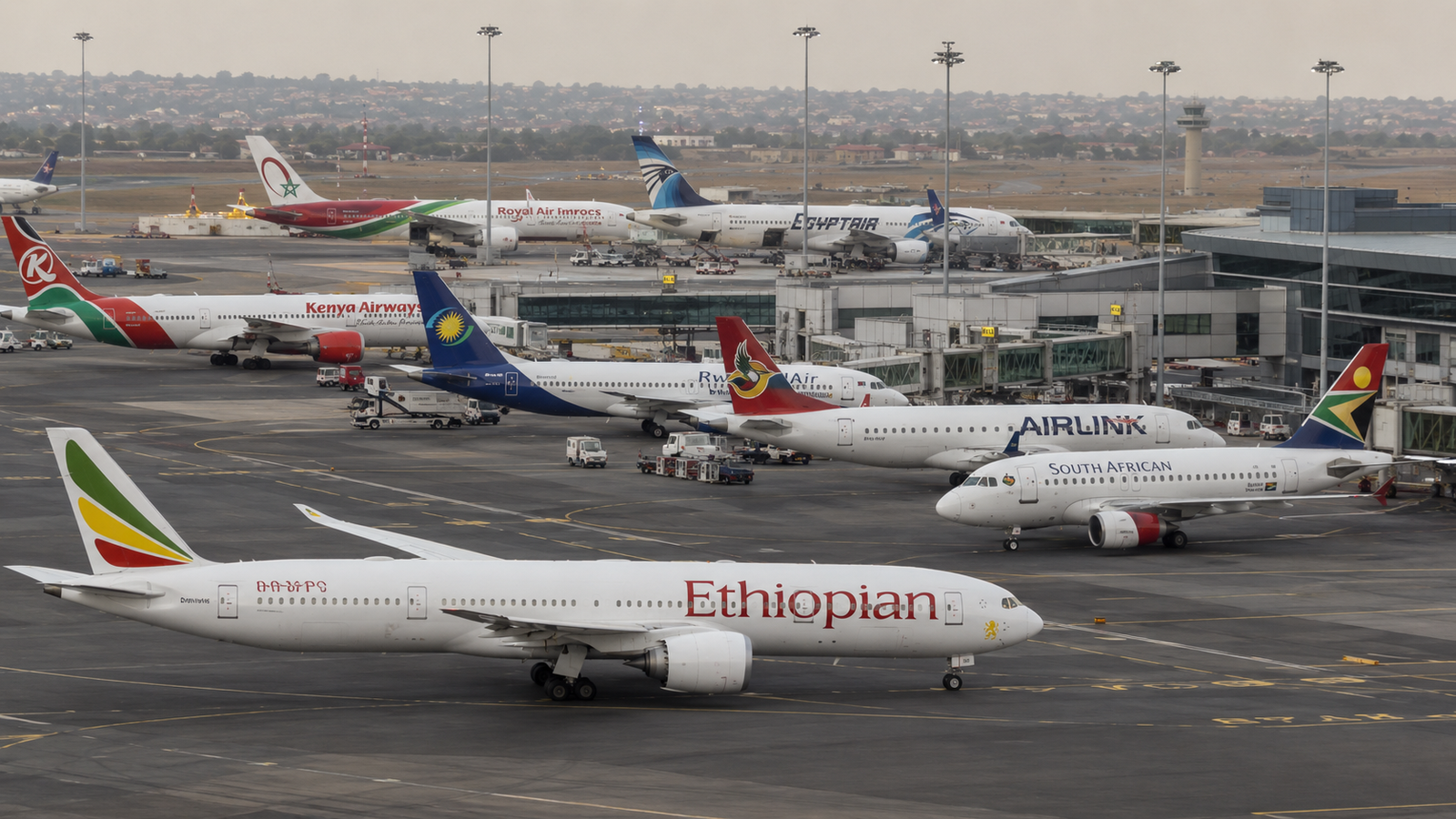
Uganda Airlines has committed roughly $985 million to a ten-aircraft Boeing order. Air Peace, Ethiopian Airlines, and TAAG Angola are all expanding routes and fleets. Etihad, Qatar Airways, and Emirates are simultaneously deepening their own African networks. At the same time, Air Botswana has cut routes after sustained losses, Kenya Airways has now posted back-to-back half-year losses, with the most recent widening 32 percent, South African Airways has had three CEOs in four months after its latest acting chief was suspended in August amid a governance investigation, and Johannesburg and Nairobi together recorded 168 flight disruptions during July.
Some carriers are racing to expand. Others are retrenching or wobbling. Both are happening in the same year, across the same continent, and the trade press has largely covered them as separate stories: a growth story, a liberalisation story, occasionally a distress story. What hasn’t been asked clearly enough is a distribution question: does this multi-front race actually fragment African airline distribution, or is fragmentation a separate problem running on its own track?
Growth creates new systems to integrate. Contraction creates churn in the systems that already exist. Both are distribution events, and that is the core of the argument here.
The race is not one race
It’s worth being precise about what’s actually racing, because it isn’t a single competitive dynamic. Uganda Airlines’ fleet order and Air Peace’s new West and Central Africa routes are a capacity play: more aircraft, more city pairs, more frequencies. Separately, Entebbe, Kigali, Nairobi, and Addis Ababa are each positioning their national carrier as the connecting hub for a region’s passenger flow, which is a different kind of competition altogether, about who becomes the switching point rather than who simply flies where. And layered on top of both, Etihad, Qatar Airways, Emirates, and Turkish Airlines are expanding their own African networks, adding foreign capacity and connections to an already busy picture.
Each of these is a legitimate story on its own. The distribution question is what happens when all three run at once.
Retrenchment adds complexity too
It would be a mistake to treat the contraction side of the ledger as a counterweight that balances out the expansion story. It doesn’t reduce complexity; it adds a different kind. A route withdrawal can mean an interline arrangement unwound, a GDS listing pulled, or an agent relationship that has to be rerouted, though not every dropped route carries all of these. Financial and leadership strain does something similar from a different angle: a carrier absorbing repeated losses, as Kenya Airways is, or cycling through its third CEO in four months, as South African Airways is, is not a carrier positioned to invest in distribution modernisation, whatever its route map looks like on paper. Disruptions at major hubs force connecting carriers and agents to recalculate routings in real time. None of this is distribution-neutral, even though little of it looks, on its surface, like a distribution story.
Why more hubs could mean more systems, not more connectivity
If Entebbe, Kigali, Nairobi, and Addis Ababa all succeed in building genuine hub-and-spoke networks, the result may not be one better-connected Africa. It could produce four parallel hub systems, each anchored by a different national carrier, each with its own interline agreements, its own GDS content quality, and its own pace of NDC adoption. For a travel agent or aggregator trying to sell across the continent, that would mean maintaining separate commercial relationships and technical integrations with each hub-building carrier, rather than working through a smaller number of consolidated distribution channels.
This is an argument about mechanism, not yet a documented fact. No published data currently shows agents managing more distinct booking relationships today than two years ago. The capacity race is well documented; the distribution consequence, for now, is a hypothesis that follows from how airline distribution works, not a reported finding.
What would confirm or kill this thesis
A few things would move this from plausible to demonstrated. First, whether the carriers expanding fastest, Uganda Airlines, Air Peace, and Ethiopian among them, are modernising their distribution stack at the same pace as their fleets and route maps, or adding capacity onto largely unchanged commercial plumbing. Second, whether agents and aggregators serving multiple African markets report managing more distinct integrations than in prior years, or whether consolidation among a handful of major aggregators is absorbing the added complexity. Third, whether the hub-building carriers are pursuing shared distribution standards or aggregator partnerships with each other, which would blunt the multiplication effect, or whether each is building in isolation.
The honest answer, for now
The capacity race is real. The retrenchment happening alongside it is also real. What’s not yet established is whether the combination is fragmenting distribution in practice, or whether it’s simply adding volume to a system that was already uneven for other reasons, including payments infrastructure and NDC readiness gaps that predate this wave of expansion.
Africa’s airlines are racing on multiple fronts at once, and that race has the potential to create more distinct commercial relationships for the distribution side of the business to manage, at a moment when some of those relationships are also being disrupted by carrier distress. Whether that adds up to structural fragmentation or simply more short-term noise in a market that was already fragmented is the question the next round of reporting needs to answer: carrier by carrier, aggregator by aggregator, and with data rather than inference from route announcements alone.