
Etihad Airways has spent the past four years building a distribution strategy that looks less like a single initiative and more like three separate campaigns run in parallel: an early and aggressive NDC rollout, a fast-moving network expansion built on interline and codeshare paper rather than metal, and a domestic payments push tied directly to UAE monetary policy. Individually, each is a reasonable commercial move. Together, they describe an airline trying to control every layer of the sale, from how the fare reaches an agent’s screen to how the passenger’s card gets charged.
The NDC foundation: earliest mover among the Gulf three
Etihad’s NDC story starts earlier than most of its peers. The airline relaunched its programme, branded Etihad Connect, alongside its move to the Amadeus Altéa passenger service system, a transition completed in an overnight switchover on March 6, 2023, after a 2021 technology agreement that also brought in Amadeus’s Digital Experience suite and machine-learning-driven merchandising tools. That PSS migration mattered for distribution because it gave Etihad a single, modern platform to run both traditional and NDC content through, rather than bolting NDC onto a legacy Passenger Service System as an afterthought.
The credential that matters most to distribution partners came shortly after: IATA Level 4 NDC certification, one of the highest grades the programme awards. Level 4 means an agent or aggregator can shop, order, and service a booking, including post-sale changes, entirely within the NDC connection, without falling back to EDIFACT messaging. That fallback requirement is where many airlines that claim NDC capability actually still sit, and it is a genuine operational gap for agencies. Etihad closing it early gave the airline a credibility advantage with technology partners at a moment when NDC servicing was still widely seen as unreliable.
What Etihad did with that certification is arguably more instructive than the certification itself. Rather than picking one aggregator and calling the job done, Etihad built a deliberately multi-partner distribution stack:
Verteil Technologies became a partner specifically to deepen reach into India, a market Etihad has historically treated as strategically important. Before the pandemic, the airline was running 150 weekly return flights between Abu Dhabi and ten Indian gateways, and the Verteil partnership was framed explicitly around that market rather than as a generic global rollout.
Travelport has renewed and expanded its content agreement with Etihad multiple times, most recently in a multi-year deal announced in January 2024 that folded NDC content and servicing into the existing Travelport+ relationship, alongside participation in Travelport’s rich content, branding, and sponsored-flight advertising products. Etihad’s Chief Commercial and Revenue Officer, Arik De, described the goal as bringing “more offers to travel agencies and more choice to travelers,” language that reads as standard press-release positioning but reflects a real commercial choice: Etihad kept legacy GDS relationships alive and layered NDC on top, rather than treating the GDS channel as something to be phased out.
Sabre added Etihad’s NDC content to its global marketplace in mid-2024, rolling out first to agencies in Oman and Bahrain before a broader release, giving agencies access through Sabre Red 360 and the GetThere booking tool alongside Etihad’s traditional fares.
APG, the airline representation network, and AirGateway, a Berlin-based NDC aggregator connected to more than 30 airlines and 430-plus IATA-accredited agencies, both added Etihad content through 2024 and 2025, extending reach to smaller and regional agencies that would not otherwise carry direct technical connections to the airline. TPConnects lists Etihad among the airline integrations available through its Iris aggregator platform, on the same supplier roster as Emirates, Qatar Airways, Lufthansa, and Air France-KLM, giving Etihad a fifth active aggregator relationship alongside its GDS-native NDC deals.
The pattern across all five is the same: Etihad is not mandating a single channel and is not, as of this writing, using GDS surcharges to force agency migration onto NDC. That is a meaningful point of contrast within the Gulf. Lufthansa Group has spent roughly two years pushing European agencies toward NDC using GDS distribution surcharges, effectively pricing agents for staying on legacy channels. Etihad, like Emirates, has not applied that pressure. The bet both carriers are making is that better content and richer merchandising will pull agencies toward NDC on its own, rather than pushing them there with a financial penalty. Whether that bet outperforms Lufthansa’s more coercive approach over the medium term is one of the more interesting open questions in Gulf distribution right now, and it is not yet settled by public data.
Network expansion as a distribution strategy, not just a route map
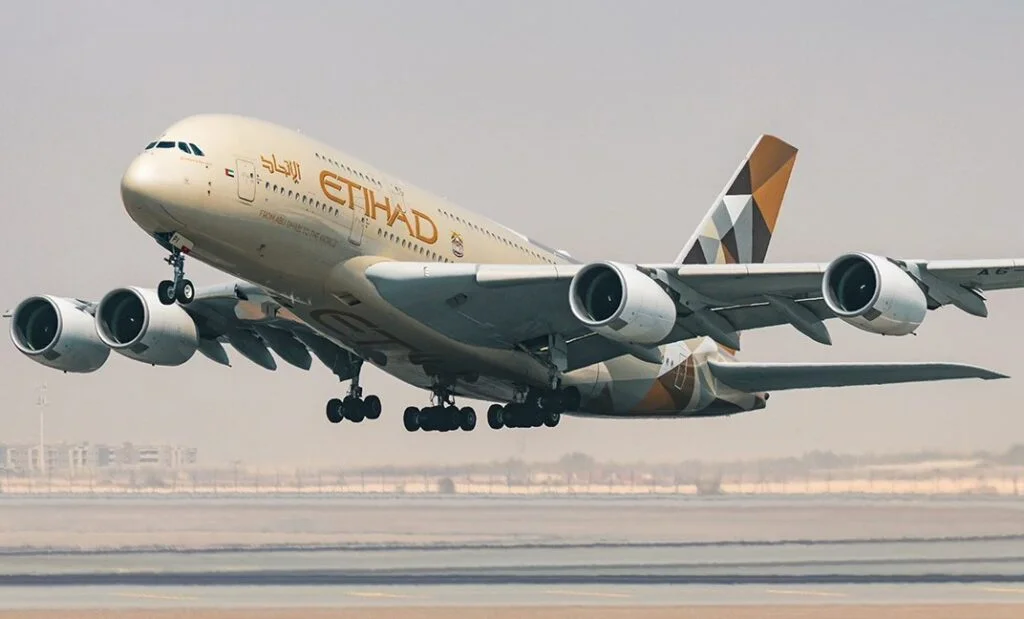
Etihad’s distribution ambitions cannot be separated from what has been an unusually aggressive period of network growth. The airline carried a record 22.4 million passengers in 2025, up 21% year over year, added 29 aircraft to lift its operating fleet to 127, and expanded its served destinations from 94 to 110. CEO Antonoaldo Neves has said the airline’s fleet order book supports a target of 200 aircraft and 37 million passengers by 2030, up from an earlier 30 million target.
What is more relevant to a distribution audience is how Etihad has chosen to extend its network beyond the routes it flies itself. In a compressed window during July 2026, the airline signed three African partnership agreements in quick succession: an interline deal with Zimbabwe’s Fastjet, an interline agreement with Nigeria’s Air Peace opening access to around 20 destinations across Nigeria and West and Central Africa, and a memorandum of understanding with Ghana’s Africa World Airlines covering codeshare, interline, cargo, and loyalty cooperation. Arik De framed the three deals as deliberately differentiated by market: “the reach of Fastjet in Southern Africa, the breadth of Air Peace’s network and the depth of a strategic framework with Africa World Airlines.”
These partnerships are explicitly sequenced ahead of Etihad’s own route launches. The airline announced six new African destinations in April 2026, with services beginning from November 2026, and the interline paper was signed months in advance so that connecting itineraries would be bookable from day one rather than built retroactively. That is a distribution decision as much as a network one: it means Etihad’s African expansion arrives with a functioning connecting network already live, rather than asking agents and OTAs to sell point-to-point routes into a hub with no onward options.
The timing also tracks UAE trade policy. The Comprehensive Economic Partnership Agreement signed between the UAE and Nigeria in January 2026 sits behind the Air Peace deal, and Etihad’s public statements have leaned into that alignment directly, positioning Abu Dhabi as a connecting corridor between Africa, India, and Asia at a moment when cargo demand out of Africa is outpacing available capacity. This also builds on Etihad’s existing strategic joint venture with Ethiopian Airlines, giving the airline a second layer of African connectivity beneath the new interline paper.
For TDN’s audience specifically, the relevant comparison is with Emirates, which activated its own Air Peace interline agreement in January 2026, extending Africa-UAE-London connectivity. Both Gulf carriers are now running parallel interline strategies through the same Nigerian partner, which says less about Air Peace’s individual value and more about how central Nigerian traffic has become to Gulf carriers’ Africa strategy generally.
Payments: the newest and most UAE-specific layer
The most recent addition to Etihad’s distribution stack is payments, and it is worth separating into two distinct moves.
First, Etihad became the first airline to accept Jaywan, the UAE’s domestic card scheme, for flight bookings on etihad.com, with the integration going live in August 2026. Jaywan is operated by Al Etihad Payments, a subsidiary of the Central Bank of the UAE, and launched in July 2026 with banks rolling out cards in phases. The airline’s involvement follows a memorandum of understanding signed with Al Etihad Payments in October 2025, and Etihad has committed to further benefits for Jaywan Royal cardholders, including fare discounts on Comfort and Deluxe fares and priority check-in and boarding. Etihad Guest Managing Director Mark Potter described it as “the first step in our partnership with Al Etihad Payments,” language that signals more integration is coming rather than a one-off feature launch.
This is a domestic-only play for now, relevant to UAE-resident travelers rather than the broader agency or corporate channel. But it fits a pattern of Etihad tying its retail experience to UAE national infrastructure, echoed in its relationship with Etihad Rail, a separate entity under common government ownership, whose first passenger service launched in June 2026.
Second, a development worth flagging with a clear caveat. In August 2026, UATP, the airline-owned corporate payment network on which Etihad is a long-standing account issuer, named dLocal as a new payment processing partner for its UATP One merchant platform, adding local acquiring across more than 60 countries in Latin America, Africa, the Middle East, and Asia. To be precise about what this is: it is a UATP-level infrastructure announcement, not an Etihad-specific partnership, and there is no public statement from Etihad describing how or whether it will use the new dLocal processing option. The connection to Etihad’s own strategy is TDN’s inference, not a reported fact: an airline that is actively signing interline paper into West and Central Africa has an obvious use case for better local-acquiring capacity behind whichever payment rails it already runs on, and UATP is one of those rails. Readers should treat that as a plausible implication to watch for, not as something Etihad has confirmed.
Revenue management: the layer behind the offer
Etihad’s distribution stack is also underpinned by a revenue management build-out that gets less attention than the NDC certification but is arguably doing more work day to day. The airline’s revenue management team, using PROS technology, won an industry award recognized for contributing to Etihad’s 2023 profit turnaround, according to comments from Chief Revenue and Commercial Officer Arik De and VP of Revenue Management Wei Jin. PROS’s own positioning around Etihad centers on continuous pricing and dynamic, class-free fare structures, the technical foundation that makes NDC’s promise of personalized offers actually deliverable rather than a certification checkbox with static fares sitting behind it. Emirates and Lufthansa Group have both spoken publicly about similar continuous pricing journeys, and it is reasonable to read Etihad’s investment here as table stakes for any Gulf carrier serious about NDC-era retailing rather than a unique differentiator, but it is a piece too often left out of NDC coverage that focuses only on the front-end certification story.
What this adds up to
Taken together, Etihad’s distribution strategy is not a single announcement or a single technology decision. It is an early NDC certification used as leverage to build a genuinely multi-partner aggregator and GDS ecosystem, a network expansion strategy that treats interline paper as distribution infrastructure to be signed ahead of route launches rather than after, and a payments strategy split between UAE-specific domestic integration and emerging-market acquiring capacity through its existing UATP relationship. The open question, and one worth revisiting as 2026 closes, is whether the no-surcharge, content-led approach to NDC adoption that Etihad and Emirates share will move agency behavior as effectively as Lufthansa Group’s more punitive model, or whether the absence of a stick means NDC volumes stay concentrated among the largest, most technically capable agencies while the long tail stays on legacy rails by default.