
For most airlines, a successful payment is one that gets approved. Kevin Murphy, Group CEO of CellPoint, thinks that definition is costing them millions. He argues airlines have spent years optimising individual pieces of the payment chain, from approval rates and fraud controls to provider costs and routing, without adequately measuring what those decisions ultimately do to revenue, margin and resilience. That is the gap CellPoint is trying to close with Zenith, its new payment intelligence layer.
Zenith is not positioned as another orchestration product. It is designed to sit above an airline’s existing payment environment, whether that environment is powered by CellPoint, a competing orchestrator, a PSS, or infrastructure the airline built and manages itself. “Airlines rarely operate a single, clean payment environment,” Murphy told TDN. “They may use an orchestrator, have payments embedded within their PSS, or maintain infrastructure they have built themselves. Requiring them to replace that environment before they can improve its commercial performance would create additional cost, delay and unnecessary risk.” The logic follows from the diagnosis: if the problem is fragmented payment decision-making, another replacement project won’t solve it. Murphy argues the intelligence layer should sit above the complexity instead, helping airlines understand what their existing decisions are actually producing. CellPoint’s differentiation, he said, comes from combining payment data and advanced AI with airline payments expertise, transparent reasoning, and accountable human oversight.
That philosophy runs through how Murphy describes the industry’s core problem. He has previously called payments “one of the least well managed” lines on an airline or hotel P&L, and he’s careful about what he means. “That is not a criticism of payment teams,” he said. “The problem is that responsibility and information are often fragmented.” One team may manage approval rates, another leads on fraud prevention, procurement negotiates provider cost, and finance sees the eventual impact on the P&L. Each team can be making a rational decision within its own remit while the airline as a whole makes a commercially suboptimal one: routing through the provider with the highest approval rate while paying more for it, tightening fraud controls in a way that rejects valuable customers, or picking the cheapest provider and quietly taking on a resilience risk. “Approval only tells an airline that a transaction went through,” Murphy said. “It does not say what that decision cost, whether a better route was available, how much margin was retained, or whether the decision introduced unnecessary risk.” Zenith is built to bring those consequences together, showing where value is being lost and simulating the effect of different decisions rather than optimising a single metric in isolation.
Working above existing infrastructure, including competitors’ technology, is a deliberate commercial choice as much as a technical one. “Our existing airline relationships give us deep data, practical experience and an immediate group of customers with which to develop Zenith,” Murphy said. “But we deliberately designed it so that an airline does not need to use CellPoint’s orchestration platform. It can work above third-party or airline-built infrastructure, which opens the opportunity well beyond our current customer base.” That matters because payment infrastructure is rarely replaced in isolation. It’s connected to distribution, passenger servicing, finance, fraud and acquiring relationships, which makes replacing it a large transformation programme. Improving the decisions made on top of it is a different, smaller proposition, and one CellPoint sees as its opening beyond its traditional customer base.
Murphy sees particular potential in Africa and MENA, but rejects the idea that either can be approached with a single payment strategy. “We see clear potential in Africa and MENA, but neither is a single market,” he said. “The priorities, rails, regulations and customer behaviours vary significantly, so expansion has to be grounded in data, expertise and partnerships rather than a standard regional template.” That caution extends to how Zenith’s AI decisioning is being built for those markets specifically. FX exposure, settlement arrangements, payment-method adoption, regulation and provider performance can vary dramatically between countries, and even between airlines operating in the same region. “The architecture is being designed for complexity, but that does not mean pretending every market behaves in the same way,” Murphy said. The underlying model is designed to accommodate that fragmentation, he said, but responsible deployment still requires market-by-market adaptation and validation.
CellPoint’s roughly fifty-role build-out across product, data, AI, sales and partnerships signals the scale of the bet, but Murphy described the rollout as staged rather than a single launch moment. Airlines can already engage CellPoint to diagnose where value is being lost using their own transaction data, and the company is working with what Murphy calls lighthouse customers on live payment traffic while building out broader decisioning and governance capabilities. He is explicit that success won’t be measured by feature count. “It will be measured by airlines using Zenith to make better decisions and being able to show the effect on approval rates, cost, recovered revenue, margin and resilience,” he said.
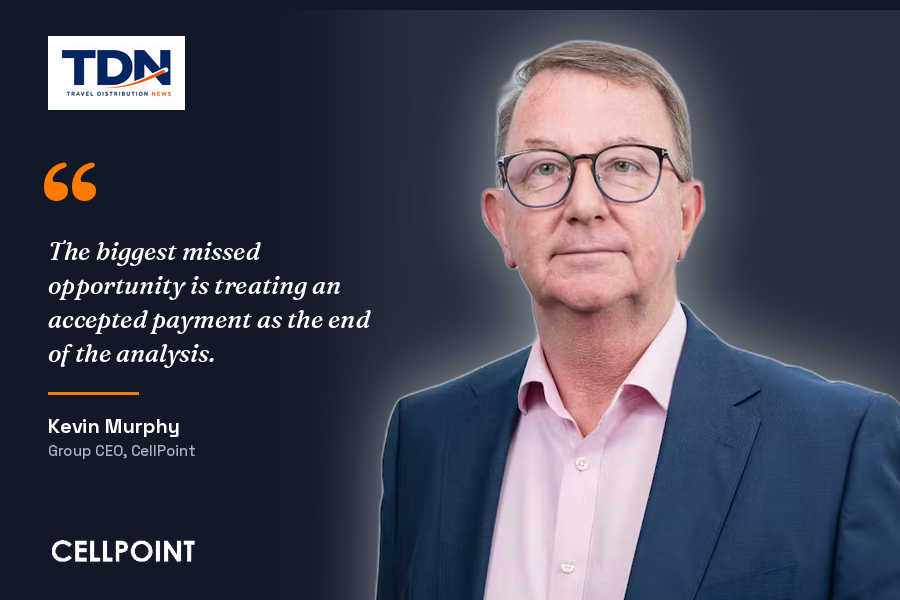
Pressed on the single biggest missed opportunity airlines are still leaving on the table, Murphy returned to the same point. “The biggest missed opportunity is treating an accepted payment as the end of the analysis,” he said. He cited one carrier CellPoint works with where analysing twelve months of transactions surfaced more than $40 million in potential annual revenue and margin recovery, close to a full point of operating margin. That figure is worth reading for what it is: one CellPoint customer analysis of potential value, not an industry-wide estimate of what every airline can expect to recover. The broader point, though, doesn’t depend on that number holding everywhere. Airlines already hold enormous amounts of payment data; the question Murphy is raising is whether that data is connected across the decisions that determine commercial performance, or left siloed inside each team’s own metric.
Asked what CellPoint hoped to take away from T2RLEngage 2026, Murphy didn’t frame it as a customer-acquisition target. “We want airlines to leave questioning whether their current definition of payment success is good enough, and we want to be asked the difficult questions,” he said. “If a CFO has asked where margin is leaking, why a provider is underperforming or what smarter routing would have meant for the last 12 months of revenue, we want to understand that problem.” It’s a bet that the more consequential shift in airline payments isn’t about keeping transactions moving, but about being able to say which transactions, routes and providers actually created the most value, and proving it.