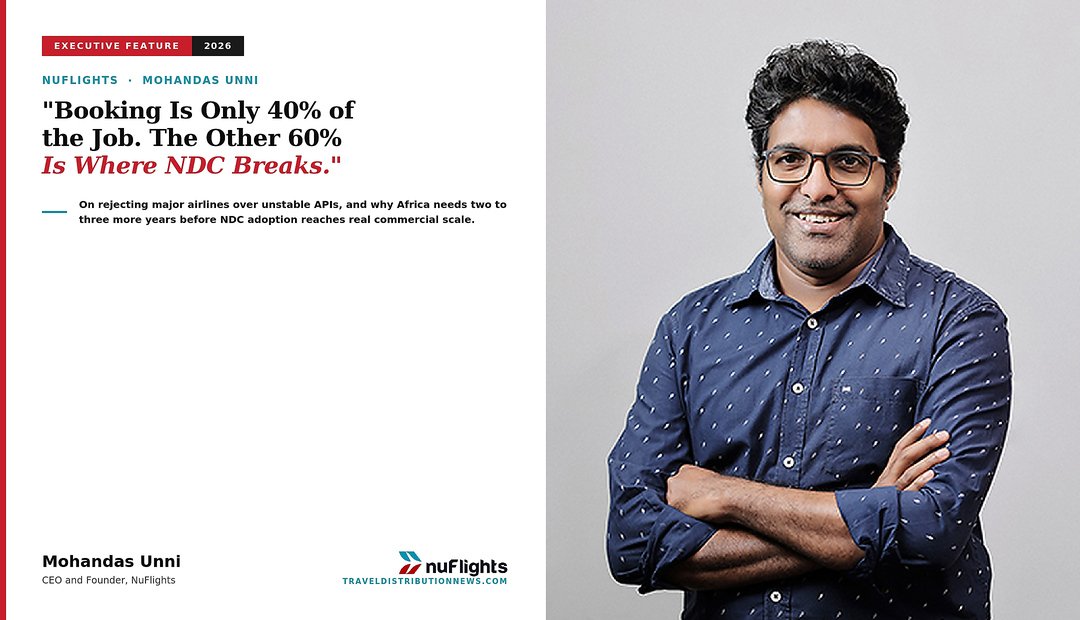
The CEO and Founder of NuFlights on why his company has rejected major airlines over unstable APIs, what Riyadh Air’s greenfield architecture reveals about NDC’s future, and why Africa needs two to three more years before NDC adoption reaches real commercial scale.
Most NDC aggregators compete on how many airlines they can connect. Mohandas Unni, CEO and Founder of NuFlights, has built his company’s reputation partly on which airlines he has refused to connect.
“Over the last three years, we have made the difficult decision to reject five airlines,” he says. “While I cannot disclose their names, three of them are major carriers with high demand among our client base. However, their APIs simply were not technically mature or stable enough to meet our production standards.”
That willingness to turn away major airline business is unusual in an industry where aggregators typically compete to maximise the breadth of their airline content. It reflects a deeper argument Unni makes throughout this interview: that the real test of NDC readiness has almost nothing to do with booking, and almost everything to do with what happens after the ticket is issued.
The 40/60 Problem
NuFlights operates with a deliberately narrow geographic focus, the Middle East, Africa, the Indian subcontinent, and an expanding Southeast Asia footprint, rather than positioning itself as a volume-driven global distributor.
“We do not position ourselves as a generic, volume-driven global distributor like the traditional GDS giants,” Unni says. “Instead, we hyper-focus on delivering flawless execution across our primary strongholds.”
That focus is what allows the company to hold a non-negotiable technical threshold. An airline’s API must be stable not only for shopping and booking, but specifically for complex post-ticketing servicing, automated reissues, refunds, and involuntary disruption handling.
“If an API cannot support an agent end-to-end, it does not get onboarded,” he says.
The reasoning behind that standard is rooted in NuFlights’ twenty-plus year history as a mid- and back-office ERP provider through its TRAACS platform, serving travel agencies long before NDC existed as a category.
“We refuse to jeopardise a two-decade legacy of hard-earned trust by exposing our agency network to fragmented, unstable airline tech,” he says.
That back-office heritage is also where Unni locates the industry’s most persistent misconception about NDC. Most aggregators, in his assessment, build their platforms on the assumption that booking, issuing, and basic servicing represent the whole challenge.
“In reality, for a commercial travel agency, booking a complex itinerary is only about 40% of the operational lifecycle,” he says. “The remaining 60% of the work begins after the ticket is issued, revolving around automated corporate policy validation, credit management, complex financial reporting, and seamless back-office reconciliation.”
NuFlights’ platform, he says, was engineered specifically to ensure that when an agency migrates from GDS to NDC, there is zero disruption to that downstream financial and operational workflow, the part of the lifecycle most platforms were never built to handle.
Why the Middle East and Africa Are Not the Same as Anywhere Else
Unni is direct about why NuFlights’ regional depth in the Middle East, Africa, and the GCC matters more than global breadth would.
“In Western markets, corporate travel compliance, credit structures, and booking workflows are relatively standardised and linear,” he says. “In contrast, the MEA and GCC regions feature some of the most intricate, highly customised, and demanding business scenarios in the global travel industry.”
Multi-layered credit structures, complex sub-agent networks, corporate rebate models, and localised multi-currency settlement processes are, in his words, scenarios that would leave Western-centric aggregators utterly baffled. NuFlights’ twenty-year history automating mid- and back-office workflows for agencies through TRAACS gives the company a structural advantage that platforms built without that heritage simply do not have.
“We didn’t just build a pretty front-end booking engine,” he says. “We built an enterprise-grade NDC infrastructure capable of handling the heavy-duty, highly intricate back-office realities of the MEA market from day one.”
Where Servicing Actually Breaks
Asked where post-booking servicing fails most often in production, Unni is careful to separate the standard itself from how individual airlines implement it.
“This persistent friction is not a limitation of the NDC standard itself,” he says. “The IATA NDC schemas define post-ticketing servicing exceptionally well. The breakdown occurs entirely in the variation of individual airline implementations.”
He cites Turkish Airlines as an industry benchmark, with API handling of involuntary changes, automated reissues and refunds with zero penalties during schedule changes or cancellations, that other carriers have not matched. The two areas where servicing breaks down most consistently across the wider industry are interline and multi-carrier segment processing, and involuntary disruption handling when an airline itself cancels or delays a flight.
The underlying bottleneck, in his assessment, is structural rather than a failure of will. Most airlines do not build their own NDC technology. They depend on core technology providers including Amadeus, Sabre, and Accelya, which means individual airlines are bound to those vendors’ development roadmaps and release cycles, creating deployment delays that have nothing to do with the airline’s own commitment to NDC.
The payoff once that gap closes is significant. In the traditional GDS world, processing an involuntary refund requires an agent to manually source a waiver code from the airline and enter it, with human error risking a costly Agency Debit Memo. In a mature NDC ecosystem, that process is automated, rules-driven, and guaranteed directly by the airline’s system.
“Once the industry bridges this temporary implementation gap, automated servicing will shift from being NDC’s biggest headache to its most loved feature,” he says.
What Building From Zero Actually Looks Like
NuFlights’ work as a launch partner for Riyadh Air gives Unni a direct comparison between an airline building its distribution architecture from nothing and the much larger population of carriers retrofitting NDC onto decades of legacy infrastructure.
“Working with a greenfield carrier like Riyadh Air offers a firsthand look at what the future of true airline retailing is supposed to look like when unburdened by legacy technology,” he says.
The contrast shows up in specific, technical ways. Established airlines retrofitting NDC frequently pull legacy data structures directly into new XML or JSON payloads without sanitisation. Fare rules, the conditions governing changes and cancellations, illustrate the problem clearly: most legacy carriers dump long, unstructured paragraphs of plain text into API responses exactly as they have for decades on GDS, making the data extremely difficult for an aggregator’s software to parse programmatically.
“Riyadh Air, by contrast, delivers fare rules that are short, crystal clear, and completely structured into machine-readable data fields,” Unni says.
Multi-passenger order handling is the second sharp contrast. In the traditional GDS world and most legacy NDC implementations, changing one passenger’s flight within a multi-passenger booking requires a “PNR Split,” dividing the booking and isolating the passenger into a new record, fragmenting the data. Riyadh Air’s data model allows agents to modify individual passengers directly within the original order structure without splitting it.
“I am confident that over the next year, their distribution architecture will become the global benchmark that the aviation industry talks about,” he says.
The Aggregator Field Is About to Shrink
The NDC aggregator market has grown crowded, with established players like Verteil, TPConnects, and AirGateway operating alongside newer entrants. Unni’s view of where NuFlights sits in that field is grounded in the company’s twenty-two year operating history rather than its NDC-specific tenure.
“Since 2004, we have provided mid- and back-office solutions to over 1,450 agencies across 51 countries,” he says. “Because NDC is purely a B2B play, our inside-out understanding of agency workflows, revenue constraints, and fraud prevention makes us the ideal bridge between airlines and retailers.”
He identifies poor data quality as the defining technical weakness across current airline NDC APIs, one that NuFlights’ back-office expertise allows it to clean and normalise in ways other aggregators cannot easily replicate. Commercially, the company’s positioning is built around protecting the agent’s existing productivity and margin structure during the transition out of GDS, rather than simply providing connectivity and leaving agencies to adapt on their own.
“We are deliberately building for established, volume-driven travel agencies that require a sophisticated aggregator, one that respects their operational workflows and safeguards their margins,” he says.
His forecast for where that field consolidates over the next three to five years is specific. The independent aggregator market shrinks to roughly 10 to 12 serious global and regional players, with the rest exiting or facing what he calls a natural operational death. The economics explain why: NDC aggregator revenues will only be a fraction of what GDS giants historically commanded through EDIFACT distribution, making scale without efficiency unsustainable.
“Survival belongs to lean, technology-driven organisations,” he says, pointing to extreme operational efficiency and regional depth over global breadth as the two strategies that will separate survivors from the rest. He also expects airlines themselves to actively reinforce that consolidation, having spent decades trying to break free of GDS control, with no appetite to let a new generation of aggregators grow large enough to recreate that same leverage.
“Airlines will intentionally support lean, cooperative regional partners rather than fuelling the rise of a new tech monopoly,” he says.
Africa’s Honest Timeline
On how long meaningful NDC adoption will take to reach African carriers, Unni does not soften the assessment.
“There is a widening distribution divide in our region,” he says. “The Middle East is moving aggressively, with carriers like Emirates, Oman Air, Saudia, Riyadh Air, and Turkish Airlines hyper-focused on NDC adoption. Africa, despite being one of the world’s fastest-growing aviation markets, lags behind structurally.”
His estimate is specific: two to three years before NDC adoption captures a significant percentage of African market volume, with carriers like Ethiopian Airlines and Airlink making genuine, active progress while others have announced intentions without generating commercial momentum behind them.
What would accelerate that timeline, in his view, is not more technology but a change in how airlines treat their agency partners financially. GDS surcharges are an effective tool for pushing migration, but airlines cannot ignore what agencies lose when they step out of the GDS environment, the segment incentives that have historically been part of their revenue.
“Airlines must look at this revenue loss and actively compensate agents through better NDC commercial structures to make the transition viable,” he says.
The second lever is more behavioural than financial: airlines treating agencies as partners rather than competitors, avoiding undercutting them with direct-channel discounts that erode the case for staying in the relationship at all.
“When airlines actively protect agency revenue workflows rather than disrupting them, African NDC adoption will scale rapidly,” he says.
That assessment lines up closely with positions TDN has heard independently from AFRAA’s Secretary General and from ASKY’s Commercial Director, both of whom identified agency channel activation, not airline technology readiness alone, as the binding constraint on faster African NDC adoption.
Backward Compatibility as a Design Principle
NuFlights’ agency network spans operators with sophisticated mid-office systems and others running on minimal infrastructure. Unni’s approach to that range is built on a single principle: agencies should never have to overhaul their operations to access NDC content.
For agencies already on NuFlights’ own TRAACS back-office system, the integration is direct. For agencies on third-party legacy systems, NuFlights delivers NDC data translated into standard GDS handoff file formats, the format every major back-office system on the market already knows how to read.
“To their back office, a NuFlights booking looks and acts exactly like a traditional GDS booking,” he says.
That translation layer solves what Unni identifies as a structural, industry-wide problem: airline NDC APIs frequently output cluttered, fragmented data that most aggregators struggle to clean. NuFlights’ decades of back-office expertise allow it to normalise that data into GDS-grade quality regardless of how sophisticated or minimal the receiving agency’s own technology stack happens to be.
Mohandas Unni is CEO and Founder of NuFlights, an NDC aggregator and travel technology provider with deep operating roots across the Middle East, Africa, the Indian subcontinent, and Southeast Asia.
Travel Distribution News covers the business of airline distribution, NDC, GDS dynamics, payments, and emerging markets. Subscribe at traveldistributionnews.com