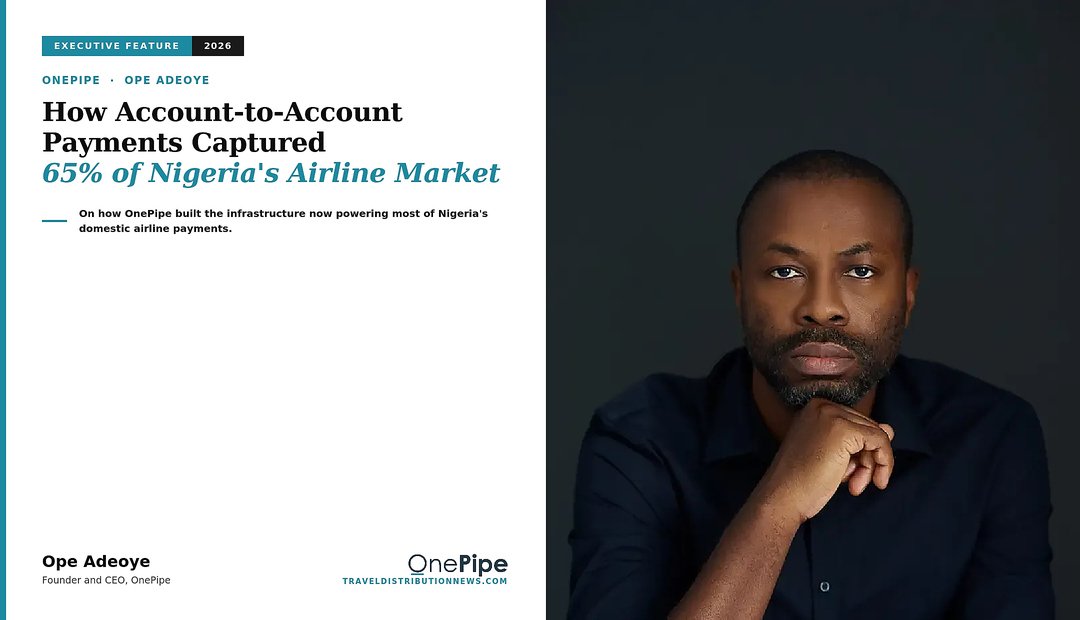
“The 8x shift wasn’t changing consumer behaviour. It was removing friction.” OnePipe’s Ope Adeoye on how his company built the infrastructure now powering most of Nigeria’s domestic airline payments, and why new carriers are choosing the model before they even launch.
There is a number in Nigerian aviation payments that deserves more attention than it has received. One airline, after activating OnePipe’s account-to-account infrastructure, saw customers choose bank transfer over card at eight times the previous rate within three hours.
Ope Adeoye, Founder and CEO of OnePipe, does not read that number as evidence that Nigerian consumers changed their behaviour. He reads it as evidence that the infrastructure had been getting in their way all along.
“The 8x shift wasn’t changing consumer behaviour,” he says. “It was simply removing the friction and finally allowing consumers to pay the way they already preferred.”
That distinction, between shifting behaviour and removing obstruction, is the foundation of how OnePipe, by its own measurement, came to power 65 percent of Nigeria’s domestic airline payments market in four years, a figure the company tracks internally across its airline partners and has not been independently audited by a third party.
The scale of the underlying shift toward account-to-account payments in Nigeria is corroborated independently. The Central Bank of Nigeria’s first Fintech Report found that nearly 11 billion transactions were processed through the NIBSS Instant Payments platform in 2024, more than double the 5 billion recorded in 2022, placing Nigeria among the world’s leading adopters of real-time payments.
The Insight Everyone Else Missed
OnePipe’s founding bet on airline payments specifically was, in Adeoye’s account, less a leap of intuition than a readable market signal that most providers chose not to read.
“Nigeria became an account-based payments market,” he says. “With consumers growing comfortable with bank transfers as their primary mode of exchange, we believed businesses would eventually need to tap into this consumer behaviour, and also prefer the same speed, reliability, and simplicity for payment collections.”
Airlines were a natural proving ground because the stakes around payment failure are higher than almost any other transaction type. A failed payment is not a minor inconvenience. It is a missed flight, a customer escalation, and in many cases a lost sale entirely.
“While many providers remained focused on card rails, we invested early in transfer-based infrastructure, and airlines became a natural fit because payment success and instant confirmation are critical to their business,” he says.
The wider industry’s slowness to act on the same data point reflects a deeper assumption that Adeoye identifies as the real failure. Global payment infrastructure was designed with cards at the centre, and as that infrastructure expanded into African markets, the working assumption was that consumer behaviour would eventually converge toward Western patterns.
“What they missed was that Nigeria was developing its own payment habits, driven by a strong bank transfer infrastructure and widespread adoption,” he says.
Why Bank Transfer Won
The preference for bank transfer over card in Nigeria is not a matter of marginal convenience. Adeoye describes it as a trust relationship built on the specific failure modes of card payments in the market.
“Nigerian consumers are not emotionally attached to cards, and the experience is generally fraught with fraud, chargeback, and high failure rates,” he says. “When people are buying a flight ticket, they want the payment method that is most likely to work the first time, without failures, retries, or concerns about limits and declines.”
The complaint resolution experience compounds the problem. Card disputes in Nigeria typically route through multiple intermediaries, a process Adeoye describes as customers being tossed around between parties when something goes wrong. Bank transfers avoid that structure entirely.
“Bank transfers have earned that trust because they are familiar, immediate, and increasingly reliable,” he says.
Account-to-account payments via Nigeria’s NIBSS instant payment rail account for an estimated 76 percent of high-ticket Nigerian e-commerce transactions, according to OnePipe. Airline ticketing, as one of the highest-value consumer transaction categories in the market, sits squarely inside that pattern. The gap, in Adeoye’s view, persisted because airline technology stacks were built for global markets where card dominance was never questioned, and were transplanted into Africa largely unmodified.
“As aviation expanded into developing markets, airlines largely adopted the same systems, often without adapting them to local payment behaviour, making it an afterthought rather than a design principle,” he says.
The commercial cost of that oversight is direct. Every failed card transaction, abandoned booking, or payment retry represents revenue an airline never collects, not because the customer did not want to fly, but because the payment method offered did not match how the customer actually wanted to pay.
No Airline Builds From Scratch, But Some Are Starting Right
OnePipe now serves 9 of Nigeria’s 14 licensed domestic carriers, including new entrants Binani Air, NG Eagle, and Rano Air, all of which launched directly on OnePipe’s infrastructure rather than migrating to it later.
Adeoye is careful to correct a common misconception about what that pattern represents. No airline, he points out, actually builds its payment stack from scratch.
“Typically, they onboard with a global booking engine who already have several default payment options,” he says. “As a result, historically, the default choice was almost always the card-focused provider, because that was the established industry norm.”
What has changed is not the starting point but the decision that follows it. Airlines are increasingly returning to their booking engine providers after onboarding to request localised payment flows, having been educated on the mismatch between default card infrastructure and actual Nigerian consumer behaviour.
The mechanism driving new entrants to skip that detour entirely is a function of how small the airline industry actually is. Commercial, finance, and distribution professionals move frequently between carriers, carrying direct experience with what worked at their previous airline into their next role.
“Increasingly, we’re finding that teams who have experienced OnePipe before are advocating for its inclusion from day one because they have seen the impact on payment success rates, customer experience, and revenue conversion,” Adeoye says.
That pattern, industry veterans insisting on a specific payment infrastructure before an airline has even taken its first booking, is the clearest signal available that the market has moved past experimentation.
“It is a sign that the market has moved from experimentation to adoption,” he says.
Beyond Chargebacks
The headline operational benefit of account-to-account payments, the elimination of chargeback risk entirely, is real but represents only the most visible part of a deeper operational shift.
Card transactions in African markets typically pass through a chain of intermediaries: issuing banks, acquiring banks, card schemes, processors, and gateways. Each additional party in that chain is another point where a transaction can fail, stall, or require manual intervention.
“Every additional participant introduces another potential point of failure,” Adeoye says.
Refunds illustrate the gap most starkly. A card refund in many African markets requires coordination across several of those intermediaries and can take days or weeks to reach a customer’s account, generating repeated customer service inquiries in the meantime. Account-to-account refunds move through a single, simpler flow.
“Airlines spend less time resolving payment problems and more time serving customers and growing revenue,” Adeoye says.
A Model Built to Travel
Nigeria is OnePipe’s home market, but Adeoye is explicit that the underlying problem the company solves is not Nigeria-specific. Card-first payment infrastructure mismatched to local consumer preference is a pattern that recurs, with different specifics, across most of the continent.
“The preferred payment method may differ by market, but the common theme is that consumers prefer payment methods that are local, familiar, and reliable,” he says.
The clearest evidence that the model travels with the airline rather than staying fixed to a single geography came directly from a customer. When Air Peace began operating routes to the UK, it asked OnePipe to extend the same account-based payment experience to that market, so its customers could continue paying the way they were used to even on an international route.
“Expansion is less about reinventing the product and more about building the right local banking and payment partnerships, market by market,” Adeoye says. “Once those rails are in place, the value proposition remains the same: helping airlines collect payments in the way customers actually prefer to pay.”
Where Real Infrastructure Value Gets Created
OnePipe’s own path, from an open banking API gateway to embedded finance to airline-specific payments infrastructure, gives Adeoye a view on where value actually accumulates in African fintech.
“Infrastructure alone is not where the greatest value is created,” he says. “It helps to set a foundation that can be built on in multiple subsequent iterations.”
The shift to embedded finance came from recognising that the larger opportunity was bringing financial services directly into the workflows of businesses that already had trusted, recurring customer relationships. Airlines fit that pattern precisely: the customer acquisition problem is already solved by the fact that people need to travel. What remained unsolved was making the financial mechanics around that travel work properly.
Looking past aviation, Adeoye sees the largest unrealised opportunity in African fintech sitting inside the informal and underserved sectors of the economy, segments he describes as representing a multi-trillion-dollar opportunity with strong consumer demand but limited access to modern financial tools.
“If we were starting again today, I think we would arrive at that conclusion much faster,” he says. “We would spend more time identifying industries with large transaction volumes, recurring customer behaviour, and clear financial friction points.”
The Default, Not the Exception
Adeoye’s outlook for airline payments in Africa over the next three to five years is built around a single reordering of priorities: optimising for how customers actually want to pay, rather than which payment model is easiest to import from elsewhere.
“Rather than forcing customers onto a single payment approach, airlines will increasingly support the payment rails that consumers already trust, whether that’s bank transfers in Nigeria, mobile money in East Africa, or other account-based payment methods across the continent,” he says.
The industry-level shift required is conceptual before it is technical. North American payment ecosystems were built around card usage and consumer credit. Many African markets evolved around bank transfers and mobile money as the default, not the alternative. Until airlines, booking engine providers, GDS platforms, and payment providers design for that difference rather than assuming card-first infrastructure travels universally, the gap Adeoye has spent four years closing will keep reappearing in new markets and with new carriers.
What gives him confidence the shift is already underway is a change in how airlines are starting to evaluate payment providers in the first place.
“Established carriers are beginning to measure payment providers not just on processing capability, but on conversion, reliability, reconciliation, and customer experience,” he says. “Once airlines start evaluating payments through that lens, the right infrastructure tends to become an obvious choice.”
Ope Adeoye is Founder and CEO of OnePipe, a financial infrastructure company powering account-to-account payments for Nigeria’s domestic airline industry and beyond.
Travel Distribution News covers the business of airline distribution, NDC, GDS dynamics, payments, and emerging markets. Subscribe at traveldistributionnews.com