This is not primarily a diplomacy story. It is a distribution story. Africa’s regional and national airlines operate roughly 19 percent of flights within their own continent, according to figures the African Development Bank presented at its June 2026 Annual Meetings in Brazzaville. Africa holds close to 18 percent of the world’s population and commands less than 3 percent of global air traffic. That imbalance is not just about which airline’s metal is in the sky. It is about who controls the booking systems, the fare filing, and the commercial terms that decide how an African traveller actually buys a ticket between two African cities, and it is the fact sitting underneath every codeshare announcement coming out of the continent this year.
A wave of partnerships, mostly pointed outward
Line up the deals from the past six months and the pattern is hard to miss. Turkish Airlines and South African Airways began a reciprocal codeshare on March 1, placing Turkish’s code on SAA routes across Johannesburg, Cape Town, Durban and other gateways, with SAA returning the favour on Turkish’s routes into Istanbul, Frankfurt, Paris and London. Emirates and SAA deepened their own reciprocal codeshare, building on a partnership close to three decades old. Etihad and Ethiopian Airlines activated the first phase of a full joint venture, a deeper commercial structure than a standard codeshare, giving Etihad passengers access to more than fifty destinations across thirty-three African countries through Addis Ababa, while Ethiopian travellers gain improved connections into Asia, the Middle East and Australia through Abu Dhabi. Qatar Airways signed a codeshare with Air Algérie. Emirates and Air Peace activated a bilateral interline agreement, marking one of the first times a foreign carrier has signed such an agreement with a Nigerian domestic carrier in years. Kenya Airways struck a unilateral codeshare with JetBlue, explicitly framed by KQ as a way to diversify beyond its existing Delta relationship and turn Nairobi into a one-stop gateway to dozens of secondary American cities.
What intra-African connectivity actually looks like
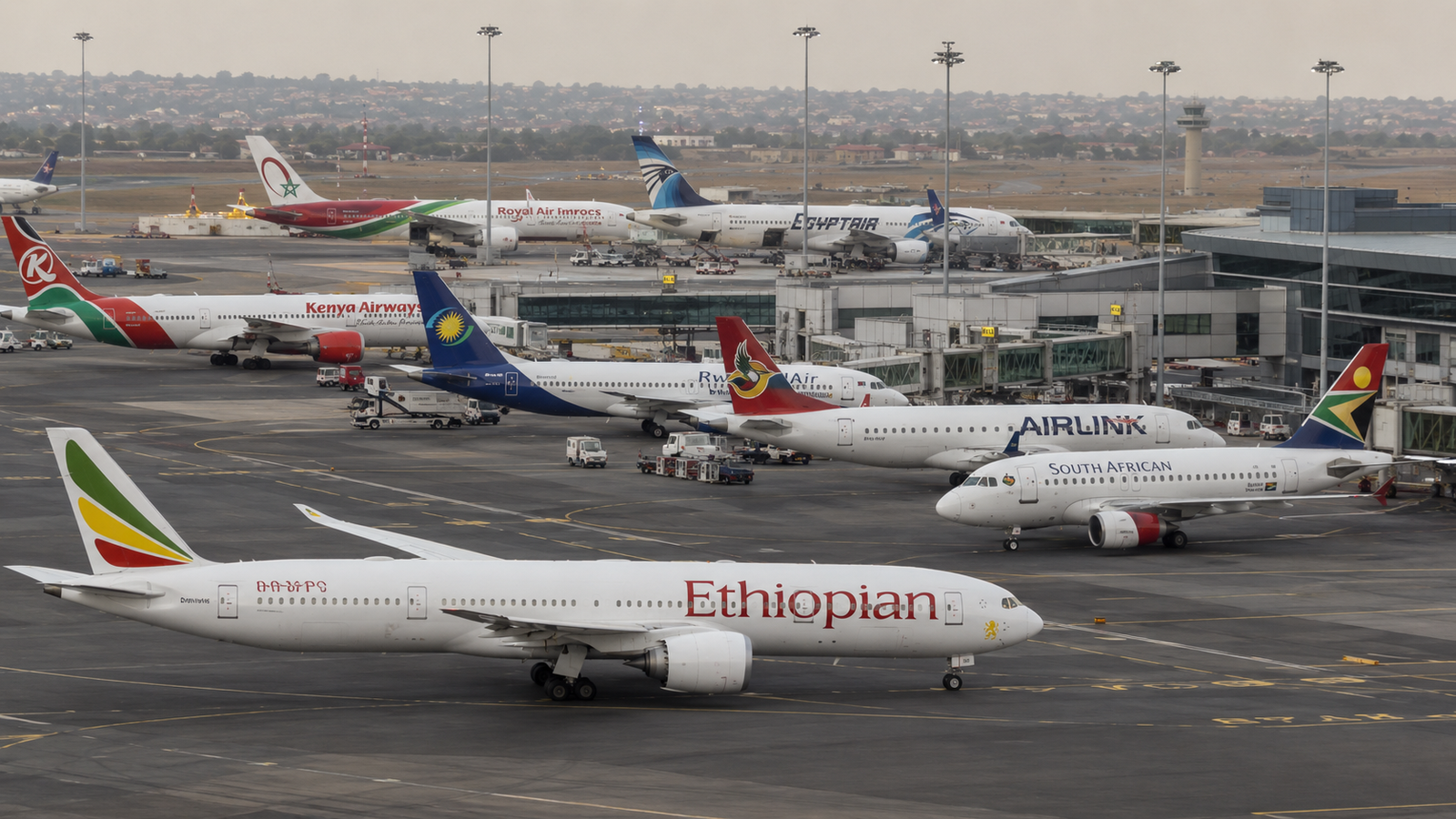
While Kenya Airways and South African Airways spent four years trying to build something larger through what both airlines called the Pan-African Airline Group, or PAAG, a separate and much smaller layer of intra-African cooperation kept moving on its own track, narrow and bilateral rather than networked, and mostly unconnected to PAAG’s rise or fall. RwandAir and EgyptAir signed a codeshare and interline partnership on June 10, connecting Kigali to Cairo, Rome and Amman through a single itinerary. Kenya Airways and Royal Air Maroc have a codeshare that links Nairobi and Casablanca, though it has a rocky history of its own: the original 2018 agreement collapsed within a year and was only revived in 2022 and 2023. TAAG Angola and South African Airways signed in December 2025, built around Luanda, Johannesburg and Cape Town as shared hubs. SAA also has a domestic tie-up with CemAir, which its CEO called a game changer precisely because it reaches regional routes SAA could never justify flying on its own. None of these deals exists because PAAG failed. They simply never depended on it succeeding.
The alliance that aimed higher, and didn’t make it
The most ambitious attempt at something larger than a bilateral codeshare did not survive. PAAG was signed in 2021, when Kenya Airways and South African Airways agreed a Strategic Partnership Framework explicitly modelled on the IAG holding structure behind British Airways and Iberia, with coordinated networks, combined pricing, and shared procurement to compete with Ethiopian Airlines and the Gulf carriers on more equal footing. At its peak in 2022, the codeshare component covered thirteen routes between the two carriers. By 2023, only five remained active. In early 2025, SAA formally withdrew as co-champion of the project, citing the need to focus on its own financial recovery under a new five-year corporate plan. Kenya Airways is still searching for new partners to revive the broader ambition.
The underlying bilateral codeshare between KQ and SAA reportedly remains in place even after the larger alliance fell apart. That single fact is close to the theory of the whole market: the narrow, low-commitment version of intra-African cooperation survives. The deeper, structurally binding version does not.
Ethiopian Airlines has taken a different and arguably more durable route. Rather than negotiate codeshares as standalone commercial deals, it has taken equity stakes in ASKY Airlines, Zambia Airways and Malawi Airlines, tying those carriers into its own network through ownership rather than contract. Put plainly, the model substitutes capital control for contractual trust, which is a more durable bet in a region where partner airlines’ financial footing can shift fast enough to sink an agreement, as it did for SAA. That approach is harder to unwind than a codeshare and gives Ethiopian more control over the connecting carrier’s schedule, fleet and service standards. It is also widely cited as one reason Ethiopian has pulled further ahead of SAA and Kenya Airways regionally even as both of the latter were negotiating their own alliance.
What ministers signed in Lomé, and why this round might be different
That fragility is the backdrop against which African aviation ministers gathered this week. On June 16, at the first African Air Transport Convention and Expo in Lomé, Togo, ministers adopted the Lomé Declaration and Implementation Matrix, the latest formal recommitment to the Yamoussoukro Decision and the Single African Air Transport Market, eight years after SAATM’s launch.
What was signed: a renewed political commitment to liberalise market access, plus two operational mechanisms attached to it. The AFCAC Solidarity Commitment 2026 to 2028 is meant to fund AFCAC’s own capacity, on the theory that the commission has lacked the staff and budget to enforce what governments already agreed to in 2018. A new Continental Harmonized Policy Framework on Aviation Taxes, Charges and Fees targets the layer of government fees that inflate ticket prices before an airline even competes on schedule or service.
What changes operationally, if it works: fewer bilateral air service agreements standing between two African cities, lower government charges baked into every fare, and an AFCAC with enough resourcing to actually monitor compliance rather than just collect signatures.
Why it has failed to stick before: SAATM has existed since 2018 and thirty-five countries have nominally joined, representing more than four-fifths of the continent’s aviation market on paper. The KQ-SAA collapse is a useful case study in why policy commitment alone has not been enough. Even with two willing state-owned carriers and an explicit political mandate, the deeper version of cooperation still failed on commercial and financial grounds. AFCAC’s Secretary-General, Adefunke Adeyemi, framed this round as the difference between policy on paper and an actual flight plan, and Togo’s president, Faure Gnassingbé, was blunt that integration only becomes real when it produces better-connected cities, more routes, lower costs and smoother exchanges, not another round of commitments.
The number that makes the declaration credible
7 billion dollars against 50 to 100 billion dollars a year.
On June 2, at the AfDB’s Annual Meetings in Brazzaville, the bank unveiled the Integrated Aviation Transformation Program, a 7 billion dollar, five-year commitment to fleet modernisation, airport upgrades and logistics integration across the continent. AfDB’s Mike Salawou, who also supplied the 19 percent flight-share figure, put the annual cost of African aviation’s inefficiencies at 50 to 100 billion dollars. Measured against a loss of that size, a 7 billion dollar program over five years reads less like generosity and more like the bank doing the arithmetic on what it would take to stop the bleeding. Japan pledged 10 million dollars to the program’s risk-sharing facility, aimed at helping African airlines manage the financing risk of acquiring or leasing modern aircraft, the same kind of financial fragility that arguably contributed to SAA pulling out of its own alliance with Kenya Airways. Nigeria’s aviation minister, Festus Keyamo, signed the first National Compact under the new framework while still in the room in Brazzaville.
Why this belongs in a distribution publication
Every codeshare, interline or joint venture requires shared inventory systems and, increasingly, NDC or aggregator connectivity between two carriers’ commercial platforms. The KQ-SAA story shows what happens when two carriers want that integration but lack the financial footing to sustain it: the codeshare survives at a fraction of its original scope, and the harder structural commitment quietly dies. An airline that operates a sliver of its own continent’s flying, and that cannot finance modern aircraft without external risk-sharing support, is not well positioned to build or maintain deep distribution infrastructure on equal terms with a Gulf or Turkish partner that already has it, or with a continental rival like Ethiopian that is buying its way into smaller carriers outright. The 19 percent figure is the diagnostic. The Lomé Declaration and the AfDB’s 7 billion dollars are both bets that the diagnosis can change over the next five years.
Whether it does will show up less in ministerial statements than in a simple, checkable fact: whether African carriers begin to control intra-African distribution flows themselves, or continue routing them through external networks, the way the codeshares that outlasted PAAG still mostly do.