

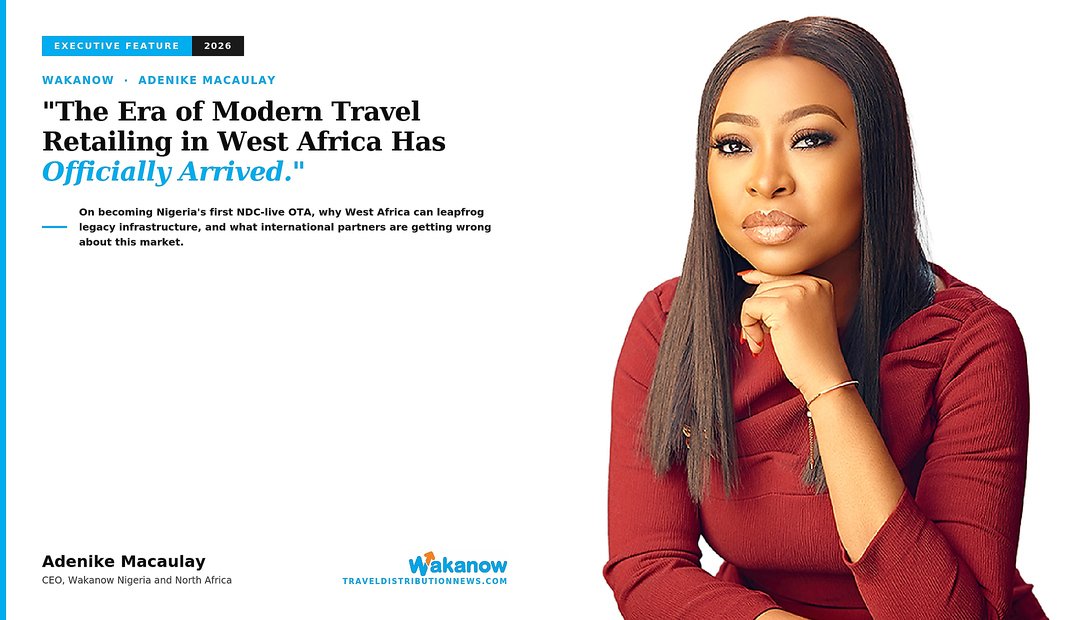
The CEO of Wakanow Nigeria and North Africa on becoming the first OTA in Nigeria to go live with NDC, why West Africa can leapfrog legacy infrastructure, and what international partners are getting wrong about this market.
There is a version of the African travel market story that international airlines, technology providers, and investors tell themselves. It is a story about risk, about infrastructure gaps, about markets that are not yet ready, about waiting for the right conditions to invest seriously.
Adenike Macaulay, CEO of Wakanow Nigeria and North Africa, is not interested in that version.
“Do not look at this region through a legacy lens,” she says. “This is not a market that requires outdated solutions or a cautious, wait-and-see approach.”
Macaulay runs one of Africa’s most commercially significant OTAs at a moment when the distribution architecture underneath the entire industry is being restructured. Her account of where Wakanow sits in that restructuring, what it has already built, and where it is going next, is one of the most operationally grounded perspectives on African travel commerce currently available.
A Market-First Moment
In April 2025, Wakanow became the first OTA in Nigeria to go live with direct NDC integrations with both British Airways and Emirates, across its Nigeria, Ghana, and UAE storefronts.
That milestone deserves more attention than it has received. NDC in the Nigerian market has, for years, been discussed in the future tense. Macaulay’s team moved it into the present tense, and in doing so demonstrated something the broader industry needed to see: that the infrastructure is ready, that the commercial case is real, and that West African OTAs are capable of leading distribution transformation rather than waiting for it to arrive from elsewhere.
The commercial consequences of that move are specific and material.
Before direct NDC integration, OTAs in West Africa faced a structural disadvantage: GDS distribution surcharges added to the cost of every booking, while the cheapest promotional fares were reserved for airline direct websites. Customers had a financial incentive to bypass the agency entirely.
Direct NDC pipelines change that equation. Wakanow’s customers can now access the same fares on Wakanow platforms as on the airlines’ own websites. Price parity, which sounds like a baseline expectation, was not the reality before. It is now.
The ancillary dimension is equally significant. Seat selection, extra baggage, cabin upgrades; services that were previously cumbersome or unavailable through traditional GDS channels are now integrated directly into the booking flow. The booking experience Wakanow can offer has materially improved. And operationally, direct integration creates automation that speeds up ticketing, changes, and post-sales servicing while insulating the platform from external GDS disruptions.
“Before direct NDC integration, OTAs in West Africa were frequently squeezed by GDS distribution surcharges and locked out of the cheapest promotional fares that airlines reserved for their direct websites,” Macaulay says.
That is no longer Wakanow’s position. The question is when the rest of the market follows.
The Multi-Speed Reality
Macaulay’s description of the current distribution landscape in Nigeria and West Africa as a “multi-speed reality” is one of the most accurate framings TDN has encountered of what is actually happening across African markets.
Traditional GDS systems still form the backbone of many agencies. NDC connections are expanding. Direct API integrations are being built by the more technically capable players. All of this is happening simultaneously, in a market where consumer behaviour is already mobile-first and where the expectation of real-time, personalised service is being set not by aviation but by the fintech and e-commerce platforms African consumers use every day.
The gap between those consumer expectations and the infrastructure serving them is the central challenge. It is also, in Macaulay’s view, the central opportunity.
“Unlike more mature markets that are heavily invested in decades-old legacy infrastructure, West Africa has the distinct advantage of being able to leapfrog directly into modern retailing,” she says.
That leapfrog argument is not rhetorical. It reflects a structural reality. Markets that built distribution infrastructure in the 1980s and 1990s carry the technical debt of those decisions. West Africa, where that infrastructure was never built at scale, enters the modern retailing era without the same drag. The transition from where the market is to where it needs to go is shorter, not longer, than in more established aviation economies.
The GDS Relationship Is Changing
On the evolution of GDS over the next three to five years, Macaulay’s framing is precise. The GDS is not disappearing. Its role is changing.
“I foresee the GDS evolving from its traditional role as a gatekeeper of content to becoming more of an aggregator within a broader, more diversified distribution ecosystem.”
Wakanow’s strategic response is a hybrid infrastructure that treats GDS as one pipe among several rather than the primary conduit. The GDS retains value for its global reach and its reliability for certain booking types, particularly content from airlines that are not yet NDC-enabled. But the investment is increasingly in direct connections, proprietary technology, and the translation layers that allow different content sources to be integrated into a single, coherent customer experience.
The competitive logic she describes is one of selective co-operation and selective competition with GDS providers, using GDS where it serves the strategy and building around it where it does not. That is a more sophisticated position than either wholesale GDS dependency or aggressive migration rhetoric, and it reflects the genuine complexity of managing a large-scale OTA operation across multiple markets with varying levels of distribution maturity.
Payments as a Fintech Problem
Macaulay’s framing of Wakanow as “as much a fintech company as a travel company” is one of the most commercially revealing things she says, and it points to something the travel industry often underestimates about what it takes to operate at scale in African markets.
The payments layer in African travel is not a minor operational consideration. It is a fundamental commercial challenge. FX volatility, fragmented payment methods, the absence of pan-African settlement infrastructure, the cost of dollarised transactions, these are not edge cases. They are the daily operating environment.
Wakanow’s response has been to build deeply into that layer. Over 15 local payment methods integrated. Mobile money platforms. Instalment payment capability through its KALABASH sister company. The consumer experience is designed around how African customers actually pay, not around how a Western-designed payment stack assumes they pay.
On the infrastructure side, Macaulay’s assessment of what would make the most difference is specific: a more integrated, efficient pan-African settlement system that reduces reliance on dollarised cross-border transactions and enables settlement in local currencies.
“If we could move towards settling more trades in local currencies through robust regional platforms, it would significantly reduce the cost of travel for the end consumer, empower local economies, and provide much-needed stability for businesses managing risks associated with fluctuating exchange rates,” she says.
That infrastructure does not yet exist at the scale required. Building it requires coordination between financial institutions, regulators, and industry players that has not materialised. But the commercial case for it is clear, and Wakanow is operating as if it will arrive, building towards it rather than around it.
Local Intelligence at Scale
Macaulay’s articulation of Wakanow’s core competitive advantage as “local intelligence at scale” is worth unpacking, because it names something that international entrants into the African travel market consistently underestimate.
The African travel market is not a single market. It is a collection of markets with different consumer behaviours, payment preferences, regulatory environments, mobile adoption patterns, and competitive dynamics. A solution designed for one does not automatically work in another. A platform optimised for international booking patterns will underperform against one built around how an Abuja-based corporate traveller or a Lagos-based diaspora family actually buys travel.
Wakanow’s depth in those specifics, built over years of operating at scale in markets that international players are only beginning to take seriously, is not easily replicated. The technology can be copied. The market knowledge cannot.
The next chapter, as Macaulay describes it, is built on that foundation. AI-driven personalisation, proprietary technology development, and a platform ambition that covers the entire travel journey from inspiration through booking, payment, and post-trip support. The goal is to become the indispensable platform for African travel, not just the most convenient booking channel.
The Message International Partners Need to Hear
The final section of Macaulay’s responses is the one most directly relevant to TDN’s audience of airlines, technology providers, and distribution professionals operating across or considering entry into the African market.
To airlines, her message is direct: the time for hesitation on NDC is over. The rewards are tangible, not just in ancillary revenue but in customer loyalty and market intelligence. Wakanow’s own NDC deployment proves the market is ready. The question is whether airlines are willing to commit to partners who have demonstrated the capability.
To technology providers, the instruction is equally clear: mobile-first is not a preference in the African market. It is the operating reality. Solutions not designed from the ground up for mobile will not gain traction. The infrastructure needs to be flexible enough to integrate with diverse local ecosystems, not rigid enough to require local markets to adapt to it.
To investors, Macaulay makes the most expansive argument. Nigeria is not just a large market. It is a gateway to the future of global travel commerce. The risk narrative that has historically dominated investment conversations about the continent is, in her view, an inversion of the actual opportunity.
“The companies that will truly win in this market will be those that are nimble, adaptable, and courageous enough to place the African customer squarely at the centre of their strategic vision,” she says.
That is both a commercial argument and a challenge. The African travel market is not waiting for international partners to get comfortable. It is moving, at pace, with or without them.
The only question is whether the airlines, technology providers, and investors who should be in this market arrive early enough to shape it, or late enough to find the ground already taken.
Adenike Macaulay is CEO of Wakanow Nigeria and North Africa. Wakanow is one of Africa’s leading online travel agencies, operating across Nigeria, Ghana, the UAE, and beyond.
Travel Distribution News covers the business of airline distribution, NDC, GDS dynamics, payments, and emerging markets. Subscribe at traveldistributionnews.com