
Alyssa Dalsky’s answers explain where the $7 per passenger figure comes from, why each airline’s number will differ, and what a realistic first year looks like.
One number has become central to the business case for modern airline retailing: up to $7 per passenger. TPConnects’ whitepaper, Adopting Modern Airline Retailing: OOSD, NDC, and MCP, cites the figure and asks airlines to consider what it means for them.
TDN put three questions on the whitepaper’s OOSD chapter to TPConnects. Alyssa Dalsky, Director of Product, Airline, responded. Her answers follow TDN’s earlier piece on the company’s MCP model, based on responses from co-founder and CTO Praveen Kumar.
Where the $7 comes from
Alyssa described the $7 as an industry benchmark drawn from research by organisations such as McKinsey and IATA. She traced it largely to McKinsey’s 2019 analysis, carried out with IATA, which said modern retailing might be worth up to $40 billion in new value annually by 2030, or up to $7 per passenger. McKinsey has since refreshed the industry total, and its October 2024 analysis puts it at $45 billion by 2030.
She said that value splits roughly 70/30. About 70% is value creation, coming mainly from new offers such as additional ancillaries and bundling, and from dynamic pricing that lets airlines price more intelligently across fares and ancillaries. About 30% is cost savings, largely from lower distribution costs and less reliance on GDS channels.
Two qualifiers matter. The $7 is, in her words, “an industry average, not a guarantee”, and it assumes an airline runs a full Offer and Order transformation, not a partial implementation.
Why each airline’s number will differ
Alyssa listed what an airline should weigh before applying the figure to itself: its channel mix between direct and indirect sales and how that is likely to evolve; the maturity of its revenue management, including whether it already sells static bundles or has begun dynamic pricing; how value is currently shared with travel agents, GDSs and other distribution partners; and its carrier type.
On carrier type, she said low-cost carriers often sell mostly through direct channels, already have low distribution costs and are heavily focused on ancillaries, so they may see less incremental gain than the average suggests. Network carriers with a significant share of indirect sales may have more to gain, particularly on distribution costs, depending on their GDS contracts and incentive structures. Depending on where a carrier starts, she said, it could realistically land above or below $7.
She also cautioned against double counting. Many airlines have already put in place elements associated with Offer and Order value, such as branded fares, NDC or some form of dynamic or continuous pricing, and value already captured from those should not be counted again when estimating the gain from a full transition.
For an airline-specific estimate, she recommended building a baseline from passenger and segment volumes across all channels, current ancillary revenue and take rates by channel and product, distribution costs per segment including GDS fees, incentives and surcharges, and related costs such as servicing and change fees, interline costs, payment processing and agency payments. As new capabilities go live, the airline then compares updated performance against that baseline to isolate the value actually created, instead of relying on the industry average.
Who is on the road
Alyssa named Riyadh Air as the only airline that is fully Offer and Order based from inception, with commercial operations starting on 10 June 2026. She said a number of other airlines have publicly committed to Offer and Order transitions and signed with solution providers, among them Lufthansa, Air France-KLM, British Airways and, most recently, Kenya Airways. Those commitments sit at different stages: announcing an Offer and Order strategy, implementing enabling technology and operating on a full Offer and Order architecture are different levels of maturity, and Riyadh Air is the only airline she placed in the last. Her answer described the industry picture and did not name airlines working through TPConnects’ own six-phase programme.
She was also clear that the six-phase model is one possible approach. As she noted on her panel at IATA, what works for one airline will not necessarily suit another, and other viable approaches can still deliver incremental value along the way. Working closely with an OOSD provider is the best way to settle the right path, she said, and she added that a smaller, more specialised vendor can offer more flexibility than a larger one handling several airline implementations at once, because it can dedicate more focused resources to a given transition.
A realistic first year
For a mid-size carrier in Africa or MENA, Alyssa said the first 12 months should lay the foundation while capturing some early, tangible gains on the offer side. She described four parts.
The first is early commercial wins: moving booking volume from GDS towards NDC to begin reducing distribution costs, and starting on dynamic or continuous pricing and bundling to generate incremental ancillary and fare revenue. As she noted earlier, how much the move to NDC saves depends on the airline’s GDS contracts and incentive structures. The second is organisational alignment. She called the transformation a fundamental shift in commercial logic, not only a technology programme, and said strong leadership support and active change management are “essential to success, not optional add-ons”.
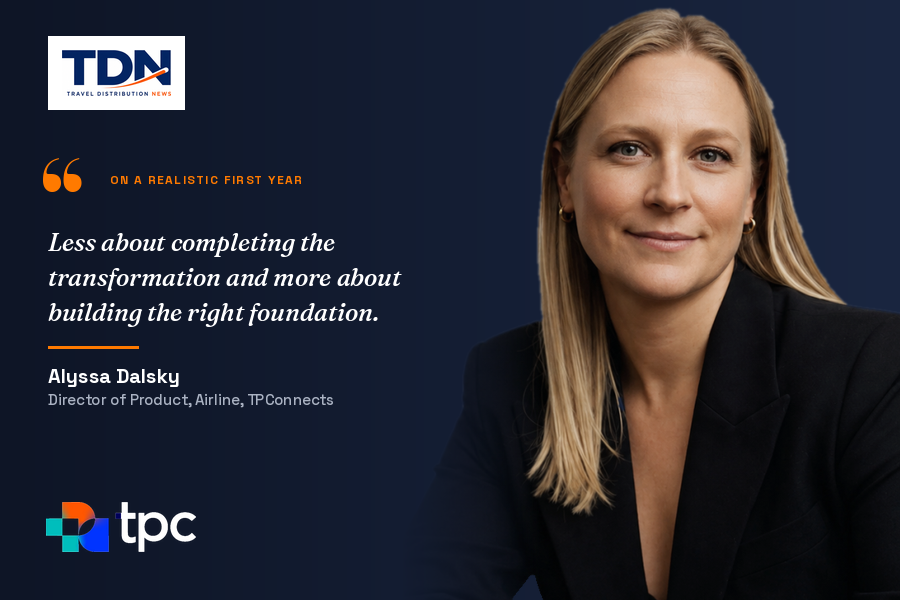
The third is a clear, phased roadmap, with realistic expectations that a complete transformation typically takes two to five years, depending on the airline’s size, complexity and chosen approach. The fourth is choosing vendor partners early, which she said enables faster pilot launches and helps an airline move from planning to execution within the first year. In her words, year one is “less about completing the transformation and more about building the right foundation”.
What airlines should take from it
The whitepaper sets out TPConnects’ proposed six-phase, 24-month path from shadow mode to legacy decommissioning. Alyssa’s answer places a full transformation at two to five years depending on the airline, which puts 24 months at the shorter end of that range and makes the starting point the main variable.
There is also a financial question behind the timeline. The value opportunity is not the same as the return on investment. Airlines must account for the cost of migrating systems, integrating distribution channels, training teams and potentially running legacy and modern retailing infrastructure in parallel, and the savings and additional revenue must eventually exceed those costs. Alyssa’s answers focus on the value side, and the time an airline takes to recover its investment will vary with its starting point. That makes the $7 a starting point for a business case. Whether an airline earns it depends on its own costs and revenue.
The most practical part of Alyssa’s answers is the methodology. For airlines in Africa and MENA, the task is to establish their own baseline, account for value already captured through existing retailing capabilities and measure each new implementation against it. That is how an airline can assess whether a provider’s business case, TPConnects’ included, reflects its own commercial reality rather than an industry-wide average.