
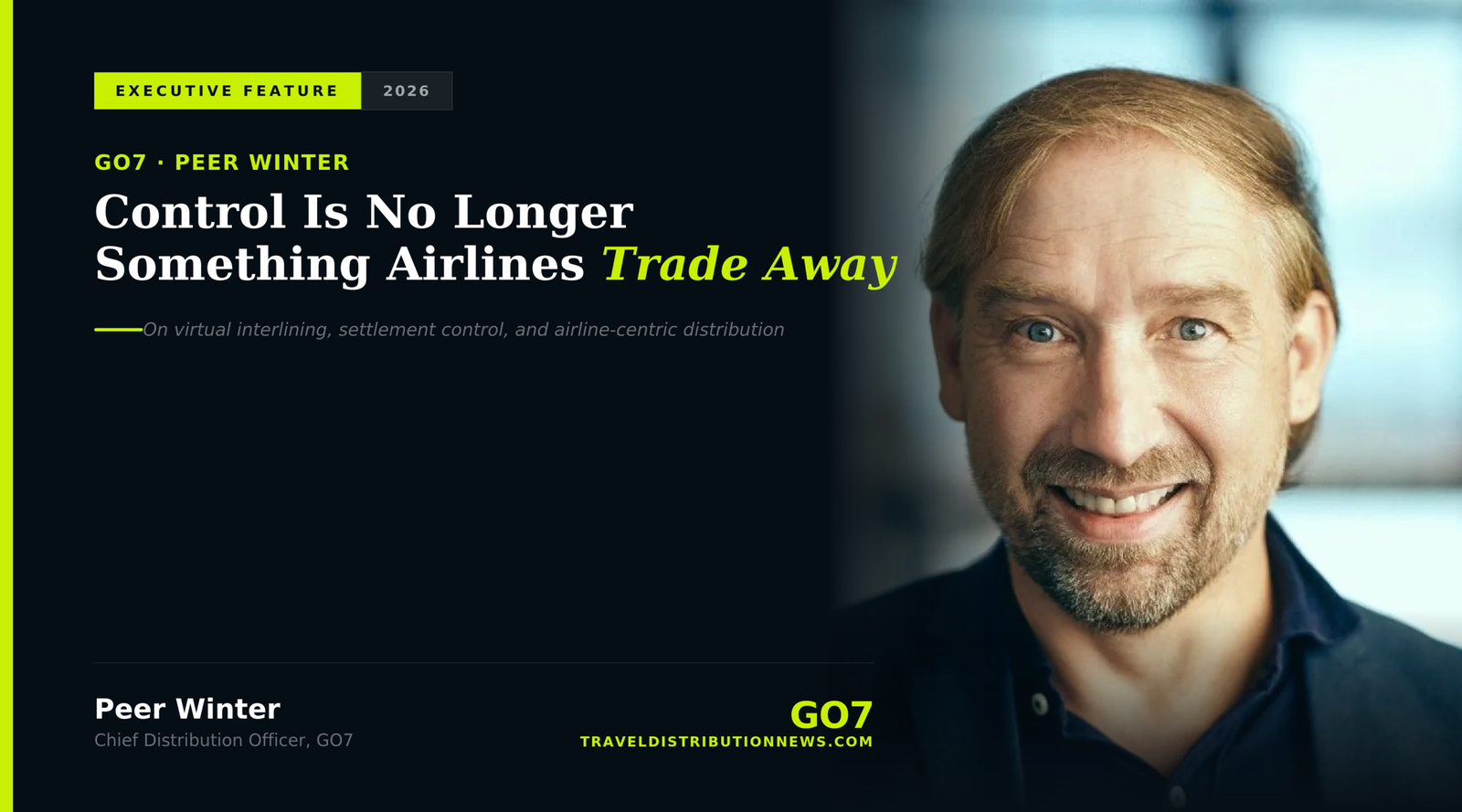
The Chief Distribution Officer of GO7 on why virtual interlining is being rebuilt from scratch, and what the industry keeps getting wrong about connectivity.
Virtual interlining has a reputation problem.
Not because the concept is flawed. The ability to connect carriers that have no interline agreement, opening up routes and itineraries that would otherwise not exist, is genuinely valuable. The problem is how it has been implemented. In the rush to build scale, the industry built a model that worked for platforms and marketplaces, but quietly worked against airlines. Fragmented payments. Lost visibility over passengers. Pricing that the carrier neither set nor controlled. Revenue that arrived as a net figure, already reduced.
For years, airlines accepted this as the cost of participation. Peer Winter thinks that era is ending.
As Chief Distribution Officer of GO7, Winter sits at the intersection of connectivity architecture and commercial strategy. His argument is not that virtual interlining is broken beyond repair. It is that the original model was built around the wrong priorities. And that there is now a better way to do it.
The Compromise That Became the Standard
To understand what GO7 is addressing, it helps to understand what virtual interlining actually required of airlines under the traditional model.
In most implementations, the platform acts as the merchant of record. The airline delivers its segment, receives a net payment, and hands off visibility over the rest of the transaction. It is a low-friction entry point. No need to renegotiate bilateral agreements, no settlement complexity to manage. But the simplicity comes at a price.
“Airlines invested heavily in building customer relationships,” Winter says. “They do not want to lose control over half of the payment process.”
That loss of control extends beyond payments. Pricing, ancillary offers, how the itinerary is presented to the traveller: these all shift toward the platform when the airline is not the merchant of record. For carriers building out retail capabilities, investing in NDC, and trying to deliver personalised offers, this creates a structural contradiction. The distribution model undermines the retailing strategy.
For a long time, this was tolerated. Virtual interlining was positioned as a niche product for low-cost connectivity plays, and the commercial stakes felt manageable. But as airlines have sharpened their retailing ambitions and the volume of self-connecting itineraries has grown, the gap between what airlines want from distribution and what traditional virtual interlining delivers has become harder to ignore.
Orchestrated VI: Rebuilding Around Airline Priorities
GO7’s response is what it calls Orchestrated Virtual Interlining, a model designed not to replace traditional virtual interlining but to redesign it around a different set of principles.
The core idea is flexibility of control. Airlines can still participate using the lower-risk model, accepting net payments and letting the platform act as merchant of record, if that fits their strategy. But they can also take on the merchant of record role themselves. When they do, they retain full ownership of the revenue, control their own pricing, and manage ancillary offers directly across the itinerary.
“When airlines take on that role, they keep the revenue in full and strengthen their relationship with the passenger,” Winter explains. “It comes with more responsibility, but it also creates more value.”
That optionality matters. Different airlines have different levels of operational readiness, different risk appetites, and different commercial priorities. A framework that forces a single model onto all participants will always serve some of them poorly. Orchestrated VI is built to accommodate both the airline that wants limited exposure and the one that wants full commercial ownership, within the same technical and settlement architecture.
Airlines can also decide the scope of their involvement. Whether they want to manage the entire itinerary or only their own segment is a strategic choice, not a constraint imposed by the platform. That flexibility makes the model usable across airline types, from full-service carriers with complex servicing requirements to point-to-point operators optimising for load factor.
The Settlement Problem Nobody Fixed
If pricing and merchant-of-record status are the commercial tension points of traditional virtual interlining, settlement is the operational one.
Split payments have been a persistent source of friction. When two separate carriers are involved in a single itinerary and the settlement flows are fragmented, airlines lose visibility, back-office reconciliation becomes complicated, and the passenger experience can break down at the seams. For full-service carriers in particular, this has been a significant barrier to engagement with virtual interlining products.
GO7 addresses this through settlement via the IATA Clearing House, the same infrastructure airlines already use for traditional interline settlement. This means no new systems to integrate, no unfamiliar counterparties to manage. The operational overhead of participation is deliberately minimised.
Critically, the model also gives airlines the option to avoid split payments entirely. The transaction can be handled as a single settlement flow, which restores the visibility and control that fragmented payment structures erode.
“Being able to operate through a single settlement partner reduces complexity and makes the model scalable without introducing additional administrative burden,” Winter notes. For airlines working with multiple connectivity partners, including smaller regional carriers where transaction volumes do not justify complex bilateral arrangements, that simplicity is not a minor feature. It is what makes participation commercially viable.
Distribution in the Offer and Order Era
The timing of GO7’s model matters as much as the architecture.
The industry is in the early stages of a shift toward Offer and Order-based retailing, a structural change in how airlines create, price, and fulfil travel products. Airlines are investing in the capability to construct dynamic, personalised offers in real time, and the expectation is that distribution infrastructure will support that capability, not constrain it.
Traditional virtual interlining, as it was built, does not fit that model. A system where the platform controls pricing and the airline receives a net settlement is fundamentally incompatible with an airline trying to deliver a tailored retail offer across a multi-carrier itinerary.
“With Orchestrated VI, airlines can deliver coordinated itineraries and retail offers across carriers without changing their existing operational or settlement processes,” Winter says. “Connectivity needs to evolve alongside retail transformation.”
That alignment with where the industry is heading, rather than where it has been, is central to the GO7 positioning. The carriers that will be best placed to capitalise on Offer and Order retailing are those building distribution infrastructure today that can accommodate it. A connectivity model that is already built around airline control over pricing and revenue is one less thing to rebuild later.
What Virtual Interlining Is Not
Winter is careful to frame virtual interlining accurately in the current distribution landscape. It is not a replacement for traditional interline agreements. It is not positioned as the primary distribution architecture. It is one component of a broader ecosystem where multiple models coexist and serve different purposes.
“Airlines are focused on being present wherever demand exists and maximising load factor,” he says. “Different models serve different purposes.”
That honesty about positioning is actually part of what makes the argument credible. Airlines are not looking for a single framework that solves every distribution challenge. They are looking for components that do their specific job well, integrate cleanly with existing infrastructure, and do not introduce new commercial or operational problems.
Traditional virtual interlining delivered reach. Orchestrated VI is an attempt to deliver reach without the compromises, and to make the commercial logic of connectivity finally align with what airlines are building their businesses around.
The Larger Signal
There is a broader pattern in what GO7 is doing that extends beyond virtual interlining specifically.
Across distribution, the balance of commercial power is shifting. Airlines have spent years accepting terms set by intermediaries because the infrastructure dependencies made alternatives difficult. NDC, direct channels, and now models like Orchestrated VI are each, in different ways, expressions of the same underlying shift: airlines are no longer willing to trade control for convenience.
The industry’s intermediaries, technology providers, aggregators and platforms, are being evaluated on a different basis than they were five years ago. The question is no longer just “can you connect us to demand?” It is “can you do it in a way that supports what we are building, on terms that align with our commercial strategy?”
For GO7, that is precisely the ground on which Orchestrated Virtual Interlining is being positioned.
Whether the model achieves the scale required to reshape the virtual interlining landscape will depend on adoption, and on whether the airlines that most need this kind of control are ready to take it on. But as a signal of where distribution thinking is heading, it is pointed in exactly the right direction.
Control is no longer the trade-off. It is becoming the requirement.
Peer Winter is Chief Distribution Officer of GO7. GO7 provides virtual interlining and connectivity solutions for airlines globally, with a focus on commercial flexibility and airline-centric distribution architecture.
Travel Distribution News covers the business of airline distribution, NDC, GDS dynamics, payments, and emerging markets.
By TDN Editorial Team