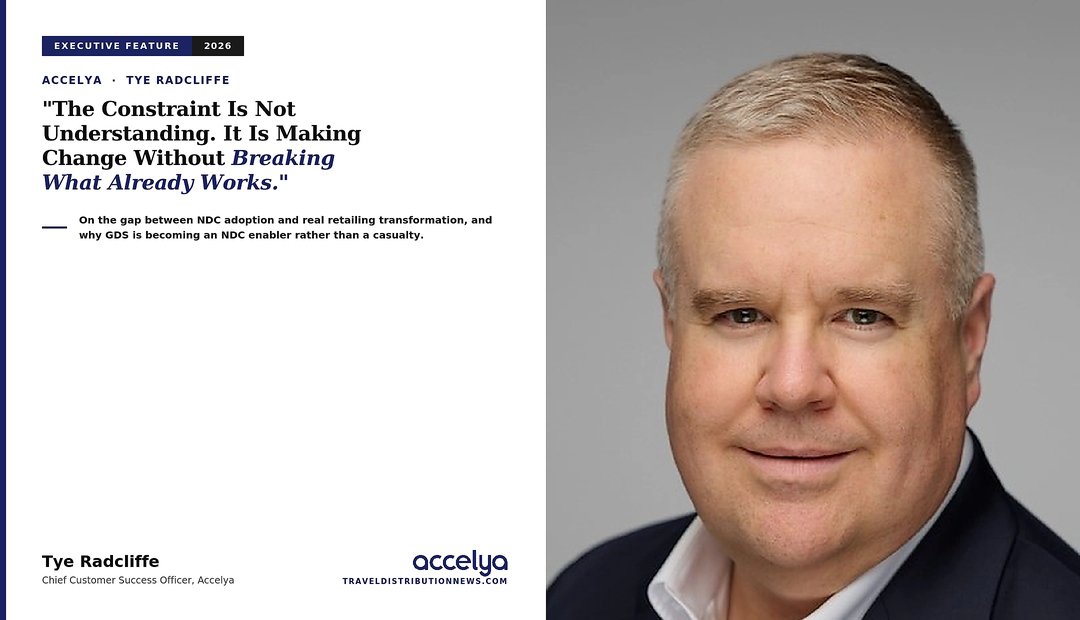
The Chief Customer Success Officer of Accelya on the gap between NDC adoption and real retailing transformation, why GDS is becoming an NDC enabler rather than a casualty, and what airlines in emerging markets need instead of a big bang transformation.
The debate over whether airlines will modernise their retailing model is over. Tye Radcliffe, Chief Customer Success Officer at Accelya, opens with that point and does not revisit it.
“The shift to Modern Airline Retailing is no longer up for debate,” he says. “McKinsey describes it as a matter of when and how rather than if, with their data showing improved retailing could deliver up to 45 billion dollars in value to the airline industry by 2030.”
The more useful question, in his framing, is not whether transformation happens but why it is taking so long to move from intent to execution, given how widely the industry already agrees on the destination.
A Foundation Built, A Building Not Yet Started
The adoption data Radcliffe cites draws a clear line between where airlines have made real progress and where they have not.
Around two-thirds of airlines, 66 percent, are already implementing NDC in some form. The distribution foundation, in that sense, is largely in place. But the picture changes sharply once the question shifts to end-to-end retailing, specifically Offer and Order architecture. Only about 27 percent of airlines have taken meaningful steps in that direction, and more than half have yet to define a strategy at all.
“That gap isn’t about a lack of understanding,” Radcliffe says. “Seventy-two percent of airlines consider the transition to retailing important. They’re clear on the need for change.”
What separates intention from execution, in his assessment, is risk. Airlines can design better commercial offers relatively quickly. The constraint emerges when those offers have to flow through legacy systems that keep daily operations running, particularly at the airport or during disruption, where the experience frequently breaks down.
“There’s a natural tension between innovation on the commercial side and stability on the operational side, and that’s why progress can feel slow,” he says. He draws a direct parallel to AI deployment in the same industry: the models themselves are advancing quickly, but their real-world impact is constrained by the legacy systems they have to operate within.
The unresolved problem, as he frames it, is connecting offer creation, order management, servicing, and settlement into a single continuous process rather than a better front-end layered on top of disconnected back-end systems.
“Modular architectures are key to getting there,” he says, “allowing airlines to modernise step by step, connect new capabilities to existing systems, and reduce operational risk.”
NDC Was Never the Hard Part
Asked what is needed to unlock NDC’s full value globally, Radcliffe is direct that the standard itself is not where the difficulty lies.
“The biggest barriers aren’t the standard itself, but rather change management and commercial readiness,” he says. Airlines need internal alignment, teams, processes, and incentives reorganised around a fundamentally different retailing model, and the commercial freedom to build differentiated offers and define distribution strategy across both direct and indirect channels.
Technology’s role, in his view, is conditional on that organisational readiness. It only delivers value if it gives airlines genuine flexibility to display, price, manage, and service products properly, which means moving NDC beyond a pure distribution layer and connecting it to dynamic pricing, order management, and the financial and operational systems downstream of the sale.
“As airlines progress, many are seeing that the next value unlock comes from connecting NDC with broader capabilities such as Offer and Order,” he says. “That is where modern retailing becomes more than better content in a channel. It becomes an end-to-end operating model.”
Meeting Emerging Market Airlines Where They Are
On how Accelya approaches airlines in Africa and other emerging markets operating with constrained IT infrastructure and smaller distribution teams, Radcliffe’s answer rejects the idea of a uniform transformation playbook outright.
“Airlines in emerging markets are often balancing many competing challenges: existing systems they can’t easily replace, smaller teams, more competition, and tighter budgets,” he says. “The idea of a big bang transformation often isn’t realistic, and in some cases introduces more risk than value in the short term.”
The alternative Accelya builds toward is modularity, giving airlines the ability to modernise step by step, beginning with whichever areas deliver the most immediate, demonstrable impact. For many carriers in this position, that starting point is NDC distribution capability itself, which lays the foundation for greater ownership of distribution strategy and commercial model without requiring a wholesale systems replacement.
“That gives airlines more flexibility to reduce distribution costs, better position their brand, share richer content and ancillaries, and deliver more differentiated fares across channels,” he says.
The design principle behind that approach is integration rather than displacement. Accelya’s systems connect with what an airline already has running, rather than requiring carriers to remove infrastructure that remains operationally critical.
“That reduces risk and makes it easier to move forward with confidence,” he says. “It’s about making progress in a way that’s sustainable. Delivering value early, building momentum internally, and creating a path toward a more connected retail model over time.”
That framing lines up closely with positions TDN has heard independently from airline and aggregator leaders elsewhere in Africa and the Middle East: that phased, integration-first implementation, not forced migration, is what actually moves smaller carriers forward.
GDS Is Not the Casualty. It Is Becoming the Bridge.
On the long-running debate over whether GDS and modern retailing can coexist, Radcliffe rejects the binary framing entirely.
“This isn’t about replacing one model with another,” he says. “GDSs continue to play a critical role in global distribution, particularly in corporate and agency channels, and increasingly they’re also becoming important enablers of NDC distribution.”
The real shift, in his view, is about control, specifically where the offer is created and managed, not which distribution channel survives. Airlines want greater ownership over how their products are priced, packaged, and presented, while continuing to work with a broad distribution ecosystem to extend reach and support servicing at scale.
“We’re already seeing that evolve,” he says. “Airlines are distributing through a mix of direct channels, NDC connections, aggregators, and NDC-enabled GDS environments.” The fact that GDS providers are actively scaling their own NDC capability is, in his assessment, an important and underappreciated shift, since it brings richer content, ancillaries, and differentiated offers into exactly the corporate and agency channels that still depend on those platforms.
“Long term, modern retailing depends on collaboration across the ecosystem, combining airline control with the reach and scale of distribution partners,” he says.
What Full Transformation Actually Looks Like
Radcliffe’s definition of success for an airline that has genuinely completed the retailing transition is specific: the ability to act on its own intelligence quickly and consistently, without the delay or friction that characterises most current operations.
“Many airlines are making meaningful progress across parts of the retailing journey, but no one has fully brought it together end to end,” he says. “The industry is still early in that transition.”
Most airlines already have strong insight into pricing, demand, and customer behaviour. What they lack is the operational machinery to act on that insight without delay. In a mature model, offers can be created and delivered in near real time, orders are managed as a single entity rather than fragmented across separate tickets and documents, and the customer experience holds together across the entire journey, including when something goes wrong.
The commercial upside of getting even part of this right is already measurable. Real-time dynamic pricing, where it has been properly implemented, is driving revenue uplifts of up to 6 percent.
On timing, Radcliffe is candid that this is a multi-year undertaking, with most industry forecasts pointing to meaningful progress across the remainder of the decade. But he is careful to separate that long arc from the near-term opportunity.
“Value isn’t something airlines have to wait for,” he says. “The ones taking a step-by-step approach are already seeing measurable gains, and many are already beginning that journey today.”
From Insight to Execution
Looking 18 to 24 months ahead, Radcliffe identifies a single shift as the most consequential: airlines moving from generating better insight to actually executing on it in real time.
“For a long time, the industry has focused on improving decision-making: better forecasting, better pricing, better data,” he says. “The constraint has been how quickly those decisions can actually be implemented.”
That constraint, in his view, is what changes next. More airlines will connect their pricing and customer intelligence directly into how offers are created and delivered, replacing manual routing with automated execution. AI’s role in that shift, he is careful to specify, is not primarily about generating more insight, the industry already has plenty.
“Its value comes when systems can act on those insights within defined guardrails, automating areas like merchandising, offer creation and pricing decisions to deliver more relevant experiences to travellers, while speeding up execution across the retail lifecycle,” he says.
The competitive dynamic that follows is one Radcliffe expects to compress quickly. As soon as a handful of airlines begin delivering more responsive, personalised, and consistent experiences, that standard becomes the benchmark the rest of the industry is measured against.
“That’s when the pace of change accelerates,” he says. “Because at that point, it’s no longer about innovation, it’s about keeping up.”
Tye Radcliffe is Chief Customer Success Officer at Accelya, a global technology provider supporting airline retailing, distribution, and financial transformation.
Travel Distribution News covers the business of airline distribution, NDC, GDS dynamics, payments, and emerging markets. Subscribe at traveldistributionnews.com