
Airlines worldwide are projected to earn 145 billion dollars in ancillary revenue in 2026, a 5.5 percent increase on the prior year, representing nearly 14 percent of total airline revenue worldwide, according to IATA’s most recent financial outlook. For the world’s leading carriers, ancillary income sits at 15 to 30 percent of revenue for full-service airlines and as high as 60 percent for low-cost carriers, alongside ticket sales that make up only 60 to 70 percent of the total and cargo that can contribute up to 40 percent in some cases.
African carriers do not resemble that structure. Ticket sales provide up to 80 percent of income for airlines on the continent, cargo yields an average of just 9 percent, and ancillary services fall well below 15 percent. The gap is structural rather than incremental. It is the difference between an airline that treats the fare as one revenue line among several and an airline that treats the fare as nearly the whole business.
Part of the explanation is structural and easy to check. In the United States and much of Europe, checked baggage has been unbundled from the base fare for close to two decades, and carry-on fees have followed on the lowest fare tiers. Across Asia-Pacific and African markets, traditional airlines largely continue to include the first checked bag, and often hand luggage as well, across all fare types. That single difference in fare architecture accounts for a meaningful share of the gap on its own, independent of any question about distribution technology or digital retailing maturity.
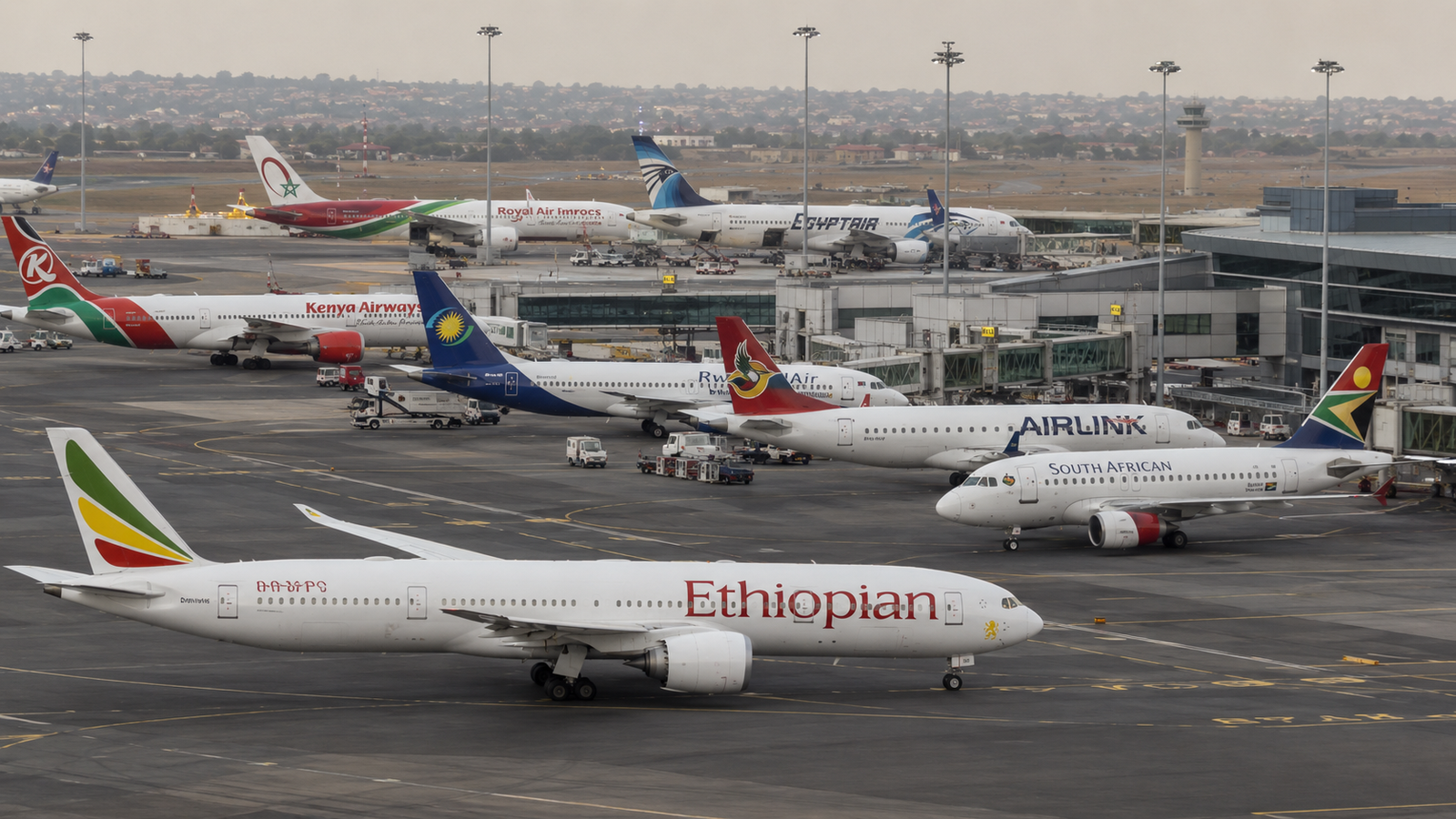
This is inference, not verified fact. The absence of public disclosure does not mean ancillary revenue does not exist; it means it cannot be compared, benchmarked or independently assessed alongside global peers. What is harder to establish, and worth stating plainly, is that the analysis above cannot be extended carrier by carrier. IdeaWorksCompany’s Yearbook of Ancillary Revenue, the industry’s most detailed source on the subject, compiles disclosed ancillary results for a set of airlines globally. None of Africa’s largest airlines publicly disclose ancillary revenue as a distinct reporting category, not Kenya Airways, not Ethiopian Airlines, not EgyptAir. Kenya Airways’ full-year 2025 results report total income and a full-year loss, but do not disaggregate ancillary revenue as a line item. Ethiopian Airlines and EgyptAir’s public reporting is similarly silent on it as a distinct, disclosed figure.
That distinction matters for how the industry should read the gap. A carrier not maximizing ancillary revenue is a commercial problem with a known playbook: unbundle fares, build merchandising into the booking flow, extend loyalty and co-brand partnerships. A carrier that cannot benchmark ancillary revenue externally faces a different and more fundamental challenge, one that sits upstream of any distribution technology conversation. It is difficult for outside observers, investors, and even the airline’s own board to evaluate a revenue stream that does not appear as a distinct figure in public reporting.
This is where the continent’s slower move to NDC-based retailing becomes relevant, though it should be treated as a contributing factor rather than the root cause. Modern retailing infrastructure is designed not only to increase ancillary sales but also to attribute them to individual products, channels and customer journeys, making them easier to manage and report. Carriers earlier in that transition are, almost by construction, both under-capturing the revenue and less equipped to report it externally in a comparable form. Payment infrastructure compounds it further: a booking flow that cannot easily support stored cards or one-click upsells will convert fewer ancillary offers regardless of how well they are merchandised.
None of this suggests the answer is simply to copy the Western unbundling model wholesale. Emerging markets with price-sensitive, first-time flyers have legitimate reasons to keep baggage bundled, and introducing bag fees without the retailing infrastructure to support meaningful customer choice risks looking like a fare increase rather than better retailing. But before African airlines debate how much ancillary revenue they should generate, they face a more fundamental question: how much do they generate today? Without consistent disclosure, there is no meaningful benchmark, no way to track progress against global peers, and no reliable basis for outside observers evaluating investments in NDC, digital retailing, loyalty or payments. The industry’s ancillary revenue challenge is therefore not only commercial. It is a reporting problem. Until ancillary revenue becomes a standard metric disclosed alongside passenger and cargo revenue, Africa’s largest airlines will continue asking outsiders to trust a business they cannot independently verify.