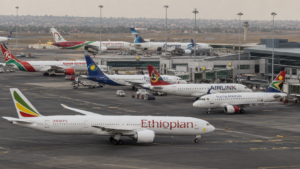

The Commercial Director of ASKY Airlines on what it actually takes to build a pan-African network from Lomé, why the Ethiopian Airlines partnership runs deeper than shareholding, and why fuel and taxes remain bigger commercial levers than distribution technology.
ASKY Airlines operates across more than 22 countries from a hub most global carriers would never have chosen: Lomé, Togo. That choice, and the network of 30 destinations across 27 countries it has grown into, says something specific about how a pan-African carrier gets built without the traffic base of a major economy behind it.
Martial Daté Tevi-Benissan, Commercial Director of ASKY, lays out a model built on financial structure, operational discipline, and an unusually candid view of where distribution technology actually ranks among the airline’s commercial priorities. It is one of the more grounded assessments of regional African aviation that TDN has published.
Building From Lomé
Tevi-Benissan organises ASKY’s network strategy around three pillars: operational reliability, market intelligence, and local partnerships. Each is concrete rather than aspirational.
The ownership structure underpins all of it. ASKY is privately held, with shareholders including Ecobank, BOAD, BIDC, and Ethiopian Airlines, a combination that provides financial stability, credibility, and aircraft access that a standalone regional start-up would struggle to assemble. The hub itself, Lomé, operates with support from the Togolese government. The fleet, currently 15 aircraft split between nine 737-800s and six 737 MAX 8s, is set to grow to 20 by 2027.
“Market intelligence means country-level teams tailoring capacity and pricing to local demand drivers,” he says. Partnerships with ground handlers, governments, and interline partners are what actually open new markets, while consistent revenue management and reliable, fairly priced service convert underserved routes into sustainable corridors over time.
“The secret is doing many small things correctly and growing methodically,” he says.
What the Ethiopian Partnership Actually Does
Ethiopian Airlines holds a strategic stake in ASKY, but Tevi-Benissan is precise about what that relationship is and is not. ASKY operates independently, with its own board and network strategy. The partnership functions through technical and commercial cooperation rather than direct control.
What that cooperation produces commercially is specific. Ethiopian feeds international traffic into ASKY’s network at Lomé, drawing on its global route map. ASKY reciprocates, feeding its own network traffic into Ethiopian’s system, including onto Ethiopian’s direct flights from Lomé to Washington and New York. ASKY flights also sell on Ethiopian codeshares into the United States.
“The two airlines feed each other,” he says.
The professionalisation effect extends beyond traffic flows into network planning, loyalty programme design, and interline distribution capability that ASKY would have taken longer to build independently.
Tevi-Benissan frames the relationship within a larger continental argument: the traffic potential of Africa remains largely untapped, with the majority of the continent’s air traffic still uplifted by carriers from outside Africa. In that context, cooperation between African carriers outweighs the case for competition between them.
“ASKY is evolving into a global carrier which upgrades its scale and scope of cooperation with Ethiopian,” he says, pointing to plans for ASKY’s own 737 MAX simulator in Lomé as one marker of that ambition.
The Distribution Balance
ASKY’s channel strategy is explicitly hybrid rather than committed to a single direction. GDS remains essential for corporate and agency bookings, with ASKY bookable through major GDS systems and OTAs including Wakanow. Direct channels, the website and mobile app, are growing quickly, supported by online-exclusive discounts, extra baggage options, and full booking, payment, and check-in functionality.
“Our digital at the heart strategy views online sales as a key pillar,” Tevi-Benissan says.
The approach is to strengthen both sides simultaneously rather than treat the shift to direct as a reason to under-invest in agency relationships. ASKY continues optimising GDS merchandising while building out direct digital retail, ancillaries, and loyalty capability. Local agency training and incentive structures remain a deliberate priority, not a legacy obligation being phased out.
“We will not abandon agencies but will increase direct share as smartphone penetration grows,” he says.
Why NDC Is Not the Priority Yet
Asked directly where ASKY stands on NDC, Tevi-Benissan gives one of the most commercially honest answers on the topic that TDN has published from an African carrier.
“NDC enables richer retailing, which ASKY aspires towards,” he says. But the framing that follows is pointed. For a regional carrier operating on tight margins, NDC has to function as a commercial tool with a clear return, not a transformation project pursued because the rest of the industry is talking about it.
“Fuel and taxes account for roughly one-third of ticket cost,” he says. “They are far bigger levers than distribution savings.”
That observation reorders the priority list that vendors pitching NDC to African carriers often assume. If the largest controllable cost components in a ticket are fuel and tax exposure rather than distribution fees, then a carrier acting rationally on margin will direct scarce transformation capital toward those levers first.
His timeline reflects that ordering. Global NDC adoption sits around 20 percent of bookings today, with industry forecasts projecting roughly 21 percent adoption by 2028. For a carrier at ASKY’s scale, meaningful traction is realistic within two to four years, contingent on technology partners investing properly in integration and on reducing local friction points around payments and connectivity. Tevi-Benissan places the more realistic entry point for ASKY beyond 2028 or 2029.
“For now, priority remains building our digital foundation,” he says. Agency incentives, standardised offers, and hybrid distribution models are the accelerators he identifies as most likely to move that timeline earlier.
The Real Cost of Flying in Africa
On why intra-African travel remains expensive relative to intercontinental routes, Tevi-Benissan identifies two structural barriers that compound each other.
The first is market fragmentation driven by the non-operationalisation of the Single African Air Transport Market. Despite the policy framework existing since 2018, many governments continue to revert to protectionist positions. The scale of the missed opportunity is significant: genuine liberalisation could increase intra-African traffic by 51 percent while lowering fares substantially. Airlines can push on this from their side, optimising fleets, advocating for regulatory reform on taxes and bilateral simplification, and partnering with tourism boards and diaspora-focused channels to build demand.
“A 10% rise in connectivity yields a 2% rise in jobs,” he says, framing aviation’s economic multiplier effect as part of the case for liberalisation.
The second barrier is the structurally higher cost of operating an airline in Africa compared with other regions: higher fuel costs, higher taxes and charges, and higher financing costs for aircraft and maintenance, often denominated in foreign currency. AFRAA is actively lobbying African governments on this cost structure on behalf of its airline members, while AFCAC leads the African Union’s SAATM implementation effort alongside work to reduce charges and fees across the continent.
“Affordability improves fastest when carriers, airports, and regulators collaborate to reduce structural costs,” he says.
Operating Across Francophone and Anglophone Markets
ASKY’s network spans both Francophone and Anglophone West and Central Africa, environments that differ commercially as much as linguistically. Tevi-Benissan describes the airline’s approach as local-first within centralised standards.
Safety and consistency are centrally managed. Pricing, payment methods, and agent relationships are adapted by country teams to local conditions. ASKY accepts mobile money, local cards, cash, and major credit cards depending on what each market actually uses. Bilateral agreements secured through Togo provide the flying rights that connect language zones, while codeshare partnerships, including with Air Senegal, bridge network gaps that bilateral access alone cannot close.
“What works: strong local partnerships, flexible payments, culturally relevant communication,” he says. “What doesn’t: one-size-fits-all digital approaches.”
His broader observation is that the underlying customer needs, reliable connectivity, fair pricing, accessible payments, are remarkably consistent across both language zones, even when the specific solutions required to meet them differ market by market.
“Scale through platforms, but win locally through adaptation,” he says.
SAATM: Real Progress, Real Gap
On the Single African Air Transport Market’s progress since its 2018 launch, Tevi-Benissan’s assessment is measured but unambiguous about how far implementation still has to go.
“SAATM’s vision is right, and progress exists: pockets of liberalisation, workshops, and administrative recruitment,” he says. ASKY’s own growth to 30 destinations across 27 nations is, in his view, evidence of a more flexible regulatory framework than existed previously. But he does not let that progress stand in for the original ambition.
“Truly open skies have not been delivered,” he says.
Two changes are necessary to close that gap. The first is consistent enforcement, with clear timelines, functioning dispute resolution mechanisms, and real accountability when commitments are not honoured. The second is a more fundamental mindset shift among policymakers: treating aviation as a development tool rather than a revenue source to be taxed.
“SAATM requires political commitment to remove traffic rights barriers, harmonise regulation, and reduce charges that inflate fares,” he says.
The Next Three to Five Years
ASKY’s near-term network strategy centres on deepening rather than just expanding. Core routes move from daily to twice-daily frequency. New secondary destinations are added annually. Cargo and charter operations grow alongside scheduled passenger service, and digital retailing capability continues to mature.
One specific milestone stands out: long-haul service to Paris, pending regulatory approval, alongside continued fleet growth.
What ASKY says it needs from the broader ecosystem is itemised precisely. From airports, efficient handling, competitive charges, and better infrastructure. From regulators, full SAATM implementation, tax relief, streamlined overflight fees, and genuinely liberal market access. From technology partners, flexible retailing and payment solutions actually tailored to African market conditions rather than adapted from systems built elsewhere. From fellow carriers, deeper interline, codeshare, and cargo alliance arrangements.
“Collaboration is the multiplier,” Tevi-Benissan says.
He closes with a description of ASKY’s identity that captures the discipline running through the entire interview: a profitable, independent pan-African airline, built through partnership rather than dependency, growing the continent’s connectivity one well-executed route at a time.
“ASKY remains the son of our own father,” he says, “a profitable, independent pan-African airline connecting the continent.”
Martial Daté Tevi-Benissan is Commercial Director of ASKY Airlines, a pan-African carrier headquartered in Lomé, Togo, operating across 27 countries in West and Central Africa.
Travel Distribution News covers the business of airline distribution, NDC, GDS dynamics, payments, and emerging markets. Subscribe at traveldistributionnews.com