

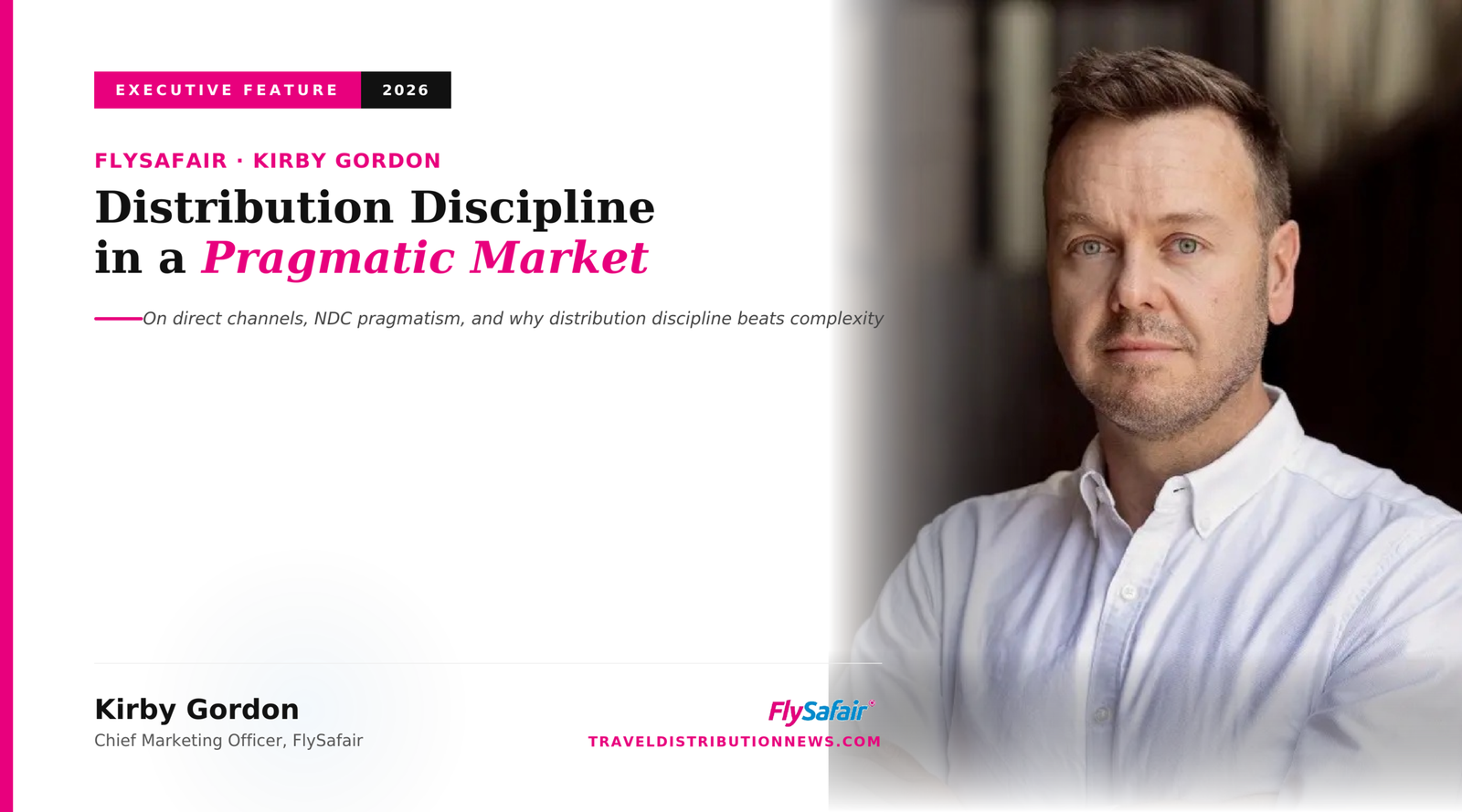
The Chief Marketing Officer of South Africa’s leading low-cost carrier on distribution discipline, the TPConnects integration, and why NDC is a tool not a target.
In a regional aviation market still finding its footing after years of disruption, FlySafair has done something most African carriers struggle to do consistently: it has grown profitably while keeping its cost base tight and its customer proposition simple.
Kirby Gordon, Chief Marketing Officer of FlySafair, is not interested in industry fashion. He does not talk about transformation for its own sake, does not reach for buzzwords, and does not pretend that every technology development in airline distribution is equally relevant to a domestic low-cost carrier operating in South Africa. What he does instead is think carefully about what his market actually needs, and build around that.
That clarity of thinking is precisely what makes FlySafair’s distribution strategy worth examining.
Direct First, But Not Direct Only
FlySafair’s distribution architecture starts where most LCC playbooks start: direct channels first. The website, mobile app, and AI-assisted booking agents form the core of the business, giving FlySafair maximum control over the customer experience and the most cost-effective route to conversion.
But Gordon is explicit that direct-only is not the strategy. A meaningful share of South African travellers, particularly in the corporate and TMC segment, book through intermediaries. Abandoning that segment to protect channel purity would be commercially irrational.
“It is less about choosing one over the other and more about making sure each channel works efficiently and delivers value,” he says.
That framing matters. Many carriers have treated the direct versus indirect debate as an ideological one, forcing a choice between cost efficiency and reach. Gordon refuses that trade-off. The question is not which channel to prioritise philosophically. It is whether each channel is performing on its own commercial terms.
The TPConnects Integration: Reach Without Complexity
The most operationally significant development in FlySafair’s recent distribution history is its integration with TPConnects Iris, which gives travel agencies unified access to FlySafair content alongside NDC, EDIFACT, and other LCC inventory in a single workflow.
For FlySafair, the value proposition is straightforward: reach into the corporate and TMC segment without the cost and complexity of building bespoke connections to every agency or consolidator individually. The integration extends the distribution footprint while keeping the operational overhead contained.
“It gives agencies a way to access our fares and ancillaries in a format that sits alongside their existing workflows,” Gordon says. “For us, the value is reach, particularly into the corporate and TMC segment, without having to build bespoke connections to every agency or consolidator individually.”
This is a commercially intelligent approach for a domestic carrier of FlySafair’s scale. Full GDS participation carries costs that erode the LCC margin model. Proprietary API connections to every major agency require engineering resources and ongoing maintenance. A normalised aggregation layer like TPConnects Iris threads the needle: the content is accessible where buyers are looking for it, without the infrastructure overhead that would undermine the economics.
It is also a signal of where LCC distribution is heading more broadly. The old binary, GDS or direct, is giving way to a more nuanced architecture where carriers can be present across channels selectively, on terms that reflect their cost structure and commercial priorities.
NDC: Useful When It Solves a Real Problem
On NDC, Gordon is refreshingly straightforward. FlySafair watches the standard closely, understands how it is evolving globally, and will adopt it when it solves a real problem. What it will not do is chase the standard because the rest of the industry is talking about it.
“We are not chasing technology for its own sake, because what really matters is whether it solves a real distribution problem for us and for our partners,” he says.
This is a more sophisticated position than it might initially appear. For full-service carriers with complex fare structures, rich ancillary catalogues, and global distribution requirements, NDC represents a genuine step change in what they can offer through indirect channels. For a domestic LCC with a leaner product architecture, the calculation is different. The standard adds implementation cost and operational complexity. The return depends entirely on whether the distribution problems it solves are the ones FlySafair actually has.
Gordon’s pragmatism here is not conservatism. It is resource allocation discipline. A carrier that chases every technology development because the industry says it matters will burn engineering capacity and management attention on problems it does not have, while underinvesting in the distribution challenges it does.
Ancillaries: Consistency Over Complexity
FlySafair’s ancillary model is built on the fundamentals: checked baggage, seat selection, flexible fare options. Gordon is clear that the priority is not product invention but consistent presentation across all booking channels.
“The focus for us is less about inventing new products and more about making sure the ones we have are presented clearly and consistently, regardless of where the customer books,” he says.
That discipline reflects a broader truth about ancillary revenue that many carriers miss. The upside in ancillary performance for most airlines is not in adding new product categories. It is in closing the gap between what is available and what is actually being offered at the point of purchase. A carrier that presents checked baggage clearly and consistently across every channel will outperform one with a more exotic ancillary catalogue that disappears the moment a booking moves to an agency or OTA.
The ongoing technical and commercial effort Gordon describes, ensuring consistent ancillary presentation across all channels, is unglamorous work. It is also where the real revenue is.
The South African Market: Value as the Common Thread
South Africa’s traveller mix is genuinely diverse. Price-driven domestic commuters who respond to promotions sit alongside corporate travellers who prioritise schedule reliability and a hassle-free experience. The segments have different sensitivities and different booking behaviours.
Gordon’s insight is that value is the common thread across all of them, even if the definition of value varies.
“At one end, you have highly price-driven customers who are flexible and responsive to promotions. At the other, corporate and time-sensitive travellers who prioritise reliability and schedule,” he says. “Our approach is to stay consistent on the fundamentals: low fares, high on-time performance, and a predictable hassle-free experience.”
The commercial opportunity Gordon identifies is not in the premium end of that spectrum. It is in expanding the base. Making air travel accessible to more South Africans, through pricing and reliability that removes the barriers to first-time and infrequent flyers, is where FlySafair sees its largest addressable growth.
That is a market development thesis, not just a competitive positioning statement. It says something about where FlySafair believes the South African aviation market has room to grow, and about the role it intends to play in that growth.
2027: Disciplined Growth, Not Distraction
Gordon’s outlook for the next 12 to 24 months is consistent with everything else he says: disciplined, specific, and grounded in operational reality.
The priorities are frequency, reliability, and cost discipline in the core domestic operation, combined with selective investment in regional expansion and technology that extends reach and reduces cost. The goal is not to become a full-service carrier or to compete on every dimension. It is to be the most accessible and dependable option in the South African market.
“Success by 2027 looks like a broader, more diversified customer base, stronger trade partnerships, and a distribution infrastructure that lets us compete effectively as the market evolves,” he says.
What is notable in that framing is what is absent. There is no talk of pivoting to a new model, no aspiration to become something fundamentally different. FlySafair knows what it is, knows what it is good at, and is focused on doing those things better and at greater scale.
In a regional aviation market that has seen carriers attempt ambitious transformations and fail, that kind of strategic clarity is not a limitation. It is a competitive advantage.
The Broader Signal for African Aviation
FlySafair’s distribution approach carries lessons beyond South Africa.
The carrier has demonstrated that a domestic LCC can build a credible, scalable distribution architecture without full GDS participation, without comprehensive NDC implementation, and without the complexity that characterises full-service carrier distribution. The TPConnects integration shows that normalised aggregation can deliver the reach of indirect distribution at a fraction of the traditional cost.
For African carriers operating in markets where distribution infrastructure is fragmented, where GDS participation costs erode thin margins, and where the trade channel matters but is hard to reach efficiently, FlySafair’s model is a practical reference point.
The lesson is not that NDC or GDS are wrong. It is that distribution strategy has to be built around the commercial reality of the specific market, not around what the global industry says everyone should be doing.
Gordon would probably put it more simply. Make it easy to book, make sure the experience is consistent, and focus on the problems you actually have.
In airline distribution, that is harder than it sounds.
Kirby Gordon is Chief Marketing Officer of FlySafair, South Africa’s leading low-cost carrier. FlySafair operates a domestic network across South Africa’s major routes.
Travel Distribution News covers the business of airline distribution, NDC, GDS dynamics, payments, and emerging markets. Subscribe at traveldistributionnews.com