Ink Innovation may not be a household name in airline retailing circles, but the company has been quietly working on aviation’s digital transformation since 2003, long before “cloud” or “NDC” entered the industry’s vocabulary. As part of TDN’s T2RLEngage 2026 coverage, Shawn Richards, Co-Founder and CEO of Ink Innovation, spoke to TDN about what modern retailing actually looks like for airlines still carrying decades of legacy infrastructure, and why he believes Africa may be better positioned than anyone assumes.
Ink was first incorporated in the UK in 2003 and later in Spain in 2011. Richards is candid that many in the industry still don’t know the company, despite its long history. “Back then, the mission was to digitise manual processes and move them to the browser based web. Cloud was not a thing back then,” he said. In the 2010s, that mission evolved into moving aviation to the cloud, self service, and mobile. Today, he says, it spans all of the above plus migrating workloads to AI assisted and fully autonomous execution.
That evolution matters because the airlines Ink Innovation works with most closely, LCCs and hybrid carriers, don’t have the luxury of building on a clean slate. Richards is blunt about the scale of what airlines are actually working with: 75 percent or more legacy infrastructure in distribution, 99 percent or more in PSS, 90 percent or more at the airport, and effectively 100 percent legacy in interlining, baggage, and messaging. “There’s a lot of legacy,” he said. “And any modernisation effort needs to incorporate a strategy to interoperate with this real world, notwithstanding the glacial pace of innovation in aviation.”
For Richards, the real obstacle isn’t technology, it’s mandate. RFPs for new technology bolted onto a legacy ecosystem, he argues, will not go nearly as far as a concrete board level mandate to transform the business with technology built to support that transformation. There will always be a long tail of partners also moving away from legacy, which means an airline has to build the case and commit to the journey. “Once they’ve decided to walk that path, there is no end to the innovation cycles,” he said. “The challenging part is getting them to embark on the journey rather than obsessing over how long it will take to get there.”
That framing is what makes Richards’ read on emerging markets notable. Asked where Ink Innovation is seeing the strongest demand for its platform right now, he pointed first to the Middle East, where decision paths are shorter and executive level consensus is easier to reach. “Their sustained and funded modernisation drive is only matched by China,” he said.
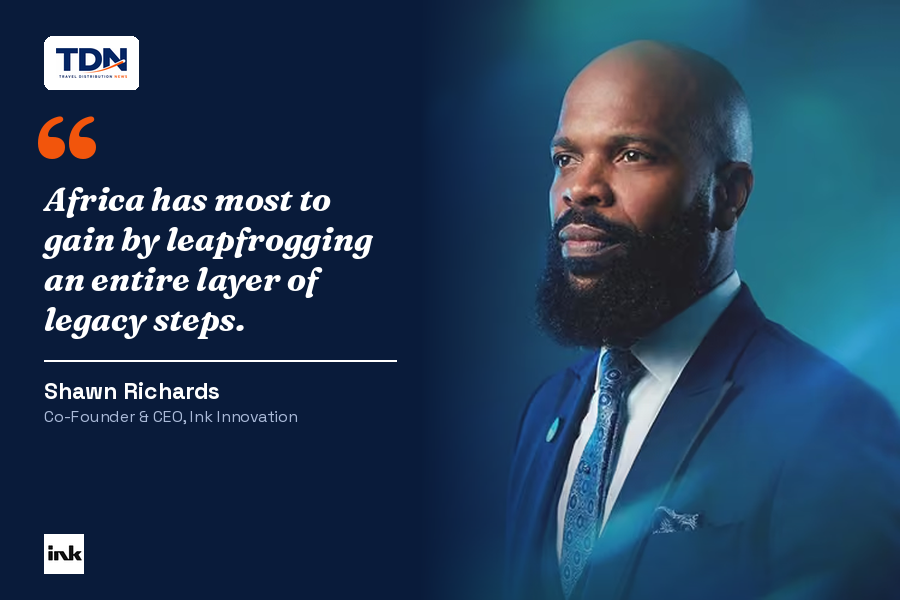
But it was his assessment of Africa that stood out most. Rather than framing the continent as behind, Richards sees an opportunity most of the industry overlooks. “Africa has most to gain by leapfrogging an entire layer of intermediate legacy steps and just building immediately for the latest generation of tech,” he said. He also pointed to Latin America, where he sees robust demand driven by airlines seeking freedom from incumbent vendors.
Asked what Ink Innovation hopes to walk away from T2RLEngage 2026 with this year, Richards kept it simple: new relationships.