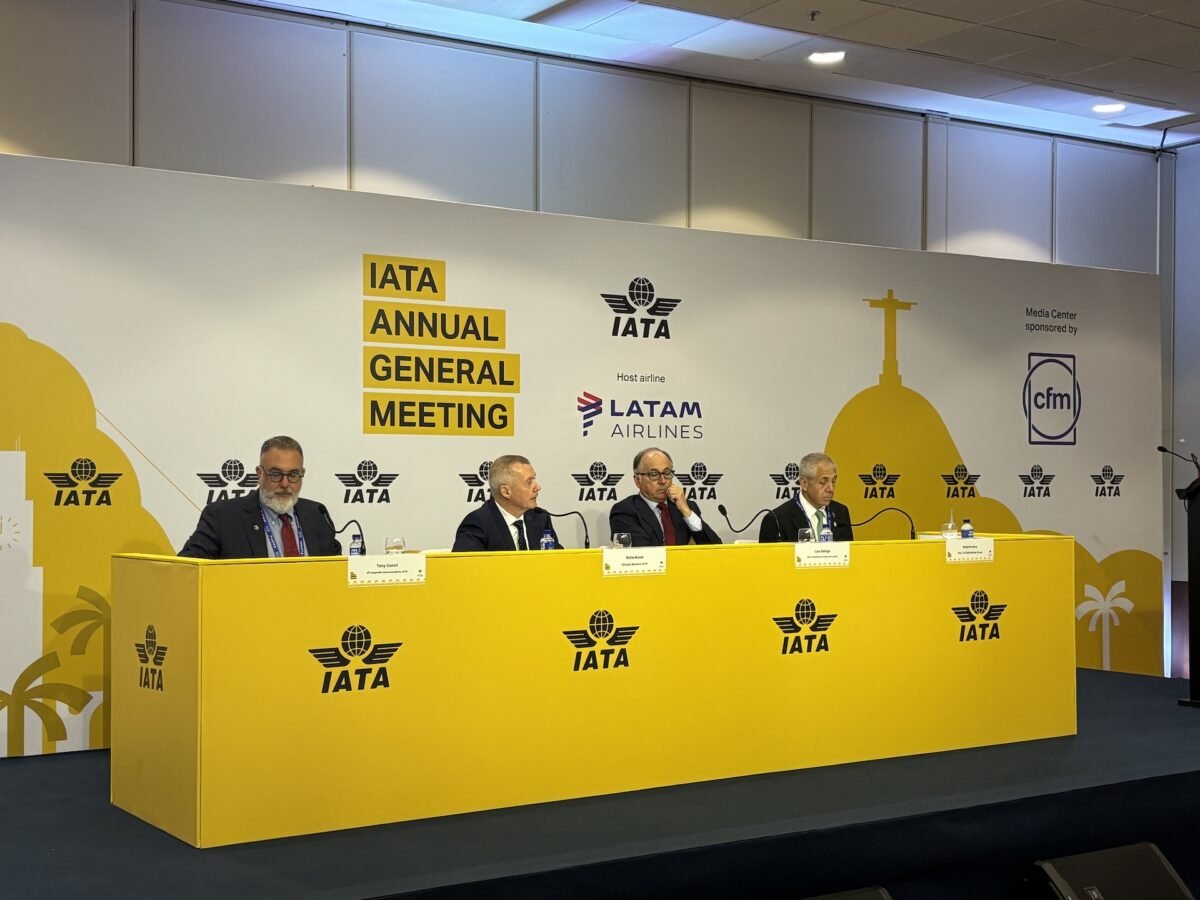
The 82nd IATA Annual General Meeting closed in Rio de Janeiro on Sunday. Some 1,500 airline executives, policymakers, manufacturers, and industry suppliers gathered under the banner of global aviation’s most important annual event. The conversations were urgent. The numbers were sobering. And for African aviation, the message from the floor was both clarifying and uncomfortable: the industry faces its worst profitability shock since COVID, and the carriers with the least cushion will feel it most.
The Numbers Tell a Hard Story
IATA released its 2026 financial outlook at the summit, and the figures are among the most sobering the industry has seen since the COVID recovery began. After years of rebuilding, the industry is heading into a significant contraction driven by a single, brutal force: the cost of fuel.
According to IATA’s outlook, global airline net profits are forecast to fall from $45 billion in 2025 to $23 billion in 2026. Net margins are shrinking from 4.2% to just 2.0%. Operating profit is expected to drop from $76.4 billion to $48.0 billion. And net profit per passenger, the most human measure of the industry’s financial health, is expected to fall from $9.10 last year to just $4.50 in 2026.
Walsh did not soften the picture. Commenting on the per-passenger figure, he said it “won’t even buy you a hot dog at most of the FIFA World Cup venues.”
The cause is a jet fuel price shock of historic proportions. IATA data shows jet fuel averaging $152 per barrel in 2026, up almost 70% on the $90 per barrel average in 2025. That single shift is expected to lift the fuel share of total airline operating expenses from 25.4% to 31.4%, adding roughly $98 billion to the industry’s collective fuel bill compared to last year.
Total industry revenues are expected to reach $1.165 trillion in 2026, up 9.4% on 2025. But operating expenses are growing faster, at 13%, which is why profits are being cut in half despite record load factors of 84.0% and passenger numbers of 5.1 billion.
Walsh was direct about who is feeling it most: “War-related disruptions in the Middle East and rising fuel costs have shifted the outlook for airlines to the worse. Smaller carriers that started the year with weak balance sheets are certainly struggling.”
That statement was not written about Africa specifically. But it describes Africa precisely.
Africa’s Numbers: The Real Story Behind the Global Headlines
IATA publishes regional breakdowns alongside its global outlook. The Africa figures deserve to be read slowly.
In 2025, African airlines collectively earned an estimated net profit of $0.3 billion, with a net profit margin of 1.6% and net profit per passenger of $2.10. Those numbers were already among the thinnest of any region in the world.
In 2026, IATA projects Africa’s combined net profit will fall to just $0.1 billion. The net profit margin collapses to 0.2%. And net profit per passenger drops to $0.40.
To put that in Walsh’s own terms: the global industry will earn $4.50 per passenger this year, which he described as barely enough for a hot dog. African carriers will earn $0.40. That is not a rounding error. That is the structural reality of African aviation in 2026.
IATA is direct about why. Africa’s hub carriers are seeing some traffic gains as routes are re-directed to avoid Middle Eastern airspace. But the region’s cost-side vulnerabilities, particularly around fuel supply and pricing, are overwhelming any revenue upside. Weak infrastructure, fragmented airspace, limited cross-border coordination, and restricted access to capital are all compounding the pressure.
The prognosis for smaller operators is bleaker still. IATA notes that any gains in 2026 are likely to be concentrated among the limited number of hub carriers with established long-haul connectivity. Smaller and more fragmented operators are expected to bear the brunt of the challenging operating environment.
That means Ethiopian Airlines and Kenya Airways may navigate 2026. The carriers below that tier face a genuinely difficult year.
The Fuel Shock in Context
To understand what a 70% rise in jet fuel costs means for African carriers specifically, it helps to understand where they were starting from.
African airlines operate with some of the highest unit costs of any region in the world. They typically hedge little of their fuel exposure, because the financial instruments available in most African markets are limited. They operate older fleets, because supply chain delays have made new aircraft effectively impossible to source at scale. The global aircraft backlog has now reached 18,100 units as of May 2026, up from 17,000 in 2024, representing more than 50% of the active global fleet. African carriers are not at the front of that queue.
Older aircraft burn more fuel. More fuel burn at $152 per barrel is a compounding problem that the balance sheet of a typical African carrier is not built to absorb.
Meanwhile, the crack spread, the premium for jet fuel over crude oil, has hit a historic high of $57 per barrel in 2026. African carriers, who typically do not hedge against crack spread movements even when they do hedge against crude, are fully exposed to that premium.
North American airlines, by contrast, are absorbing the same fuel shock but with stronger balance sheets, more sophisticated hedging programs, and fleet compositions that are on average newer and more efficient. European carriers entered 2026 with roughly 70% of their fuel needs hedged. African carriers entered 2026 with far less protection.
The same shock. Very different capacity to absorb it.
The Distribution Question Nobody Asked in Rio
The 2026 AGM agenda was heavy on sustainability, SAF mandates, cargo tariffs, airspace constraints, and the macro-economic outlook. These are real and urgent issues. But the conversation that African aviation needs most — distribution cost, NDC adoption, and the economics of retailing transformation — remained largely at the margins.
This matters more in 2026 than it did in any previous year. When jet fuel is consuming 31% of total operating expenses globally, and a significantly higher share for African carriers with older, less efficient fleets, every cost line that can be improved becomes critical. Distribution is one of the few levers that carriers can pull without waiting for governments to act, fuel prices to fall, or new aircraft to be delivered.
Yet the gap between where global distribution is heading, toward Offers and Orders, modern retailing, and direct NDC channels, and where most African carriers currently sit remains wide. The technology investment required to make that transition is hard to justify when the immediate priority is covering the fuel bill.
IATA has been championing retailing transformation for years. The direction is right. But with African carriers now earning $0.40 per passenger, the gap between the industry’s stated direction and the practical capacity of African airlines to follow has never been more visible.
Distribution efficiency is not a luxury conversation. For African carriers in 2026, it is a survival conversation that is not being held loudly enough.
The Room Where Africa Was Not at the Center
One structural detail from the AGM is worth noting. IATA held dedicated regional briefings on the first day of the summit, covering North Asia, Europe, Asia Pacific, Africa and the Middle East, and the Americas. Africa had its session. Kamil Al-Awadhi, IATA’s Regional Vice President for Africa and the Middle East, represented the continent on the agenda.
But the main CEO panel, the high-profile, CNN-hosted session that drew the broadest global media coverage, featured airline chiefs from Oman Air, Pegasus Airlines, and LATAM. No African carrier CEO on the main stage. This is notable given that carriers such as Ethiopian Airlines, Kenya Airways, and South African Airways were among the African members present in Rio, airlines with significant continental footprint and stories that deserve a global platform.
This is not a criticism of IATA or of any individual. It is a reflection of where Africa sits in the architecture of the global aviation conversation. Important enough for a regional briefing. Not yet central enough for the main room.
That will change. African aviation traffic is growing. The continent’s demographics are undeniable. But change at the level of global industry conversation does not happen automatically. It requires data, advocacy, and consistent presence in the moments when the industry is paying attention.
The data from this AGM makes the case more urgently than ever. A region earning $0.40 per passenger, with margins of 0.2%, operating in an environment of historic fuel prices, fragmented airspace, and limited capital access, deserves more than a side briefing.
What African Aviation Needs From the Rest of 2026
The AGM closed with the industry aligned on the scale of the challenge. For African aviation specifically, three things matter most in the months ahead.
First, fuel cost mitigation at the fleet and network level. Airlines that can optimise routes, reduce unnecessary fuel burn, and defer non-essential capacity expansion will be better positioned to survive a fuel environment that is not expected to normalise quickly.
Second, distribution efficiency now, not later. This is a shorter-term lever than fleet renewal or SAF investment. African carriers that begin accelerating direct channel development, even partially, reduce dependence on distribution cost structures built for a higher-margin era. Every dollar recovered through smarter distribution is a dollar that does not have to come from an already threadbare margin.
Third, policy advocacy that reflects Africa’s specific realities. The IATA agenda is shaped largely by the economics of large, mature carriers operating in high-GDP markets. African carriers need a stronger, more coordinated voice that can translate global standards into realistic timelines for the continent’s actual operating context. A framework designed for Lufthansa does not automatically work for an airline earning $0.40 per passenger.
The 2026 IATA AGM delivered an honest and data-rich assessment of a difficult year for global aviation. What it could not deliver, and what no single global gathering can deliver, is a plan built specifically for where African aviation actually is.
The fuel bill may be global. The solutions will increasingly need to be local.
Travel Distribution News covers airline distribution, NDC, travel payments, and aviation technology with a focus on Africa and emerging markets. Subscribe at traveldistributionnews.com.