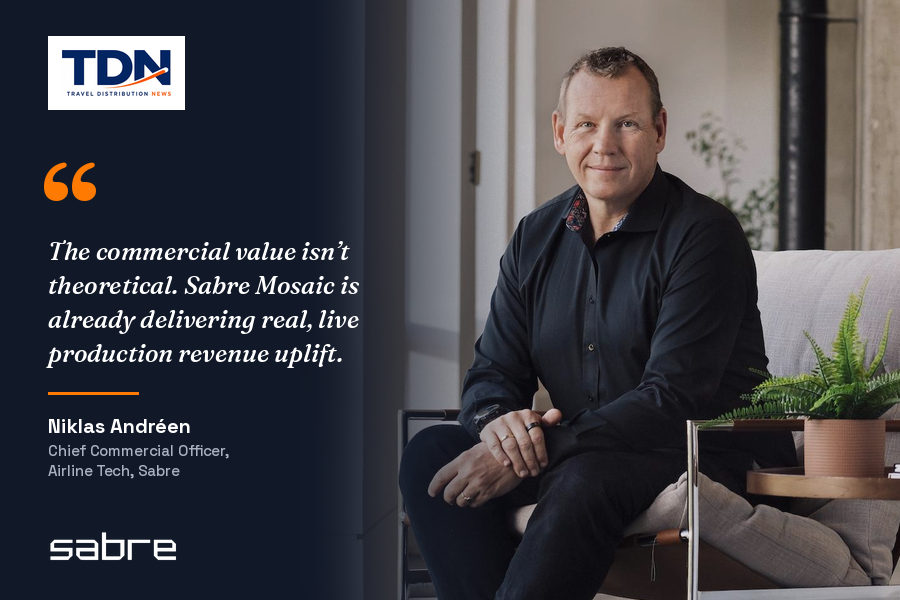
Sabre has closed a recent string of deals across Africa and the Middle East that TDN has covered in detail, including Kenya Airways’ retailing and PSS migration and the broader pattern of Sabre using retailing as the wedge into East Africa’s core systems market. As part of TDN’s T2RLEngage 2026 coverage, Niklas Andréen, Chief Commercial Officer, Airline Tech at Sabre, put those deals in a wider commercial context, and made the case that AI-driven retailing has moved well past the pilot stage in growth markets.
“The commercial value isn’t theoretical,” Andréen said. “Sabre Mosaic is already delivering real, live production revenue uplift and bottom-line margin expansion across growth markets in the Middle East, Africa, Latin America, and globally.” He pointed to Kenya Airways’ selection of Sabre to replace a core system that had served the airline for more than two decades, a deal Sabre and Kenya Airways marked alongside Acting Group Managing Director and CEO Habil Waswani at the Bullish Africa Annual Summit 2026 in New York. Andréen framed it as more than a technology swap. “It’s a deliberate move toward personalised, offer-and-order-based retailing, bringing shopping, booking, servicing and fulfilment together in a single customer-centric record.” As part of that shift, he said, Kenya Airways is adopting Sabre Mosaic Offer Optimization to introduce continuous learning and dynamic pricing across its network.
The same pattern, Andréen said, is playing out elsewhere. Riyadh Air is the launch customer for Sabre Mosaic Continuous Revenue Optimizer, which Andréen described as the industry’s first AI-native, classless pricing engine, moving beyond the traditional 26-fare-class structure to calculate optimal pricing for every individual shopping request in real time. He cited up to a 3.5 percent revenue uplift from the tool without adding capacity. In Ethiopia, Ethiopian Airlines, the continent’s largest carrier, has selected a full Sabre Mosaic bundle covering Fares Optimizer, Air Price, and Ancillary to support its Vision 2035 strategy. Air Tanzania is migrating its core passenger operations to Sabre while adopting Sabre Mosaic NDC IT, and LCCs like Avelo Airlines are layering AI tools such as Ancillary onto their existing PSS to price seats, bags, and upgrades dynamically. “Across all these airlines,” Andréen said, “the tangible benefit of choosing what works for them from our open, modular platform is simple: higher conversion, better yield per passenger, and the ability to capture immediate, measurable revenue growth in quarters, not years.”
Asked how Sabre balances continued NDC investment against the reality that many airlines and travel sellers in growth markets still rely heavily on traditional EDIFACT content, Andréen rejected the framing outright. “We view NDC and EDIFACT not as an either or ultimatum, but as a hybrid reality that will coexist for years,” he said. “Growth markets cannot afford operational disruption, which is why Sabre Mosaic operates as an open, multisource platform.” On the seller side, Sabre says its Mosaic Travel Marketplace unifies content from more than 40 NDC airlines, 150-plus low-cost carriers, and 420-plus EDIFACT airlines into a single normalised workflow, so agents in emerging markets can shop, book, and service both formats side by side without switching tools. On the airline side, Sabre has built what it calls Order Translators, which it says normalise data across NDC and EDIFACT formats so airline teams work from one consistent view of every order regardless of how it originated. Andréen linked the same philosophy to Sabre’s newer AI push: the company’s MCP server, launched in September 2025 and, according to Andréen, already in production with nearly 80 customers, gives AI agents the same open, direct access to Sabre data and inventory. “It’s the same principle applied to a new channel,” he said. “Don’t force a single path, give the market flexible, open access to the content and systems they need.”
On what airlines in emerging markets get wrong about modern retailing, Andréen pointed to two misconceptions. The first is assuming it requires a full, high-risk rip-and-replace of the core PSS. “Many regional carriers worry they have to dismantle their legacy systems overnight to compete,” he said. “The reality is that modern retailing should be modular and open by design.” Sabre Mosaic is built to be PSS-agnostic, letting carriers adopt individual AI modules and layer them onto whatever PSS they already run, Sabre’s own or a third party’s. The second misconception, he said, is equating NDC adoption alone with modern retailing. “The real hurdle isn’t publishing a fare, it’s end-to-end servicing: automated changes, exchanges, and refunds under enterprise load. Modern retailing is an architectural shift to executable offers and orders across the full lifecycle, not just a new way of distributing content.”
Asked what Sabre hoped to walk away from T2RLEngage 2026 with this year, Andréen framed it as sharpening the company’s read on what airlines need next, whatever stage they’re at. Sabre shared the stage this year with two carriers at different points in their retailing journeys, which Andréen said was deliberate, so airlines in the room could see their own path reflected back. Garry Wiseman, Sabre’s President of Product and Engineering, also spoke on how quickly travel is shifting from search bars to conversational AI, citing internal figures that more than 50 percent of active travellers are already using AI to plan and book, and that generative engine optimisation converts at 4.4 times the rate of standard search. Wiseman detailed how Sabre’s open MCP services and agentic-ready APIs let carriers plug their own conversational AI tools directly into live Sabre inventory and servicing rules without rebuilding their tech stack, including resolving disruptions in real time by automatically rebooking flights, adjusting hotel stays, or issuing lounge passes the moment a delay occurs.
“We see our role as the compass for airlines of every size to guide them to the pragmatic, staged path forward that starts with what matters to them,” Andréen said, “whether that’s a single AI pricing module they can turn on today to capture a 3.5 percent revenue uplift, or a complete offer and order transformation.”
Niklas Andréen is the Chief Commercial Officer, Airline Tech at Sabre