
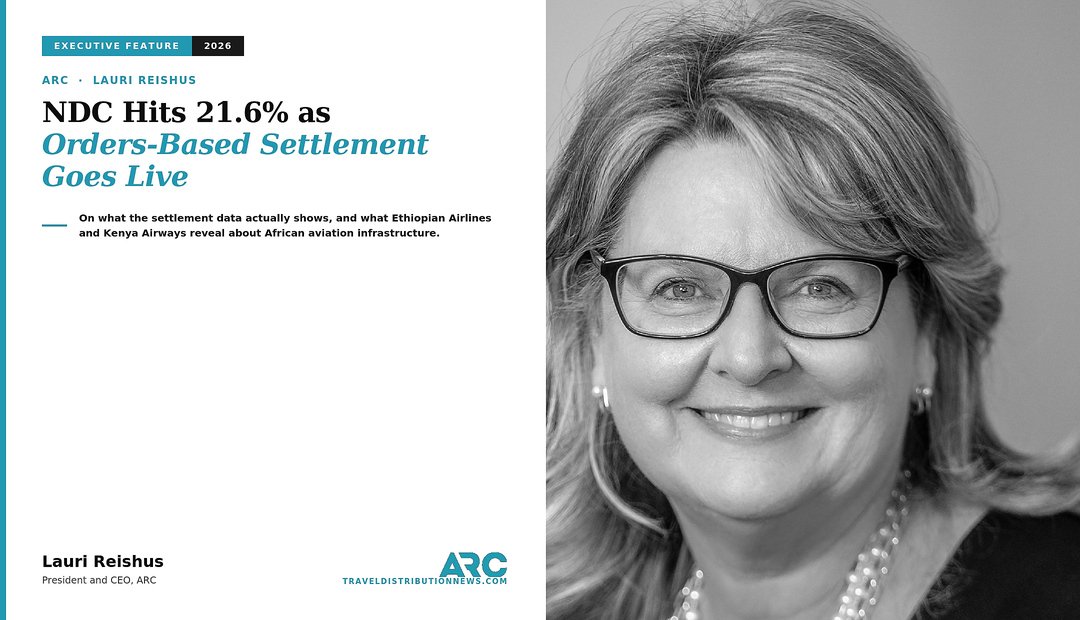
ARC’s Lauri Reishus on what the settlement data actually shows about NDC adoption, why order-based infrastructure is already live, and what Ethiopian Airlines and Kenya Airways reveal about the gap between African aviation ambition and infrastructure.
Most of the conversation about airline distribution transformation happens at the level of announcements, roadmaps, and vendor projections. ARC operates at a different level entirely.
As the settlement and data infrastructure processing airline ticket transactions by US-based travel agencies, ARC sees what actually happens rather than what airlines and technology companies say is happening. When Lauri Reishus, President and CEO of ARC, talks about NDC adoption, she is not citing survey data or industry estimates. She is citing transaction flows.
That distinction matters enormously in a market where the gap between narrative and reality is one of the most consequential and least discussed features of the distribution landscape.
What the Numbers Actually Show
The question the industry most wants answered about NDC is not what airlines are planning or what vendors are projecting. It is what is actually clearing through settlement.
NDC reached 21.6 percent of ARC-settled transactions in May 2026, issued by 1,200 travel agencies and processed across 40 airlines participating in ARC’s Direct Connect programme. At the same time, ARC’s order-based settlement infrastructure is already live, with the ability to process orders with cash as of January 2026.
That combination, real adoption data alongside infrastructure already in production, is the clearest signal yet that the orders transition is no longer a future state. It is underway.
The segmentation within the NDC figure is where the nuance sits. Online travel agencies and technology integration platforms are moving fastest, using NDC to build differentiated customer experiences and capture new business. Travel management companies face a more complex path. The integrated services they provide to corporate clients, policy enforcement, traveller tracking, reporting, and expense integration, require NDC to deliver capabilities that remain uneven across airline implementations.
“As NDC scales and continues to evolve, airlines are focused on improving the after-the-sale capabilities for their agency partners, which is helping to drive adoption,” Reishus says.
That post-booking capability gap is the single most cited barrier to corporate NDC adoption and ARC’s data confirms it remains the frontier where the most work is still to be done.
The Africa Dimension
ARC’s data footprint extends well beyond the US domestic market, and the African picture it reveals is more advanced than the broader market conversation suggests.
Both Ethiopian Airlines and Kenya Airways are processing NDC transactions through ARC Direct Connect. Ethiopian was the first airline globally, US or international, to onboard using ARC’s Transaction API. Kenya Airways is working to bring NDC content to its travel partners through the same infrastructure.
Beyond those two flagship carriers, ARC serves over 30 African-based airlines and more than 40 non-African airlines operating African routes. That is a more substantial African footprint than ARC’s US-centric reputation might suggest.
“Kenya Airways and Ethiopian Airlines are working diligently to bring NDC content to their travel partners,” Reishus says.
The significance of Ethiopian being the first airline globally to use ARC’s Transaction API is not purely symbolic. It signals that African carriers at the leading edge of distribution modernisation are building on the same infrastructure as the most advanced carriers in mature markets. The gap between African aviation distribution ambition and available infrastructure is real, but it is narrowing faster at the top of the market than the overall adoption statistics suggest.
Reishus recently extended ARC’s partnership with IATA through 2035, a commitment that explicitly includes developing new data solutions for Africa, Asia, and other emerging markets. That is a decade-long infrastructure investment in markets that are growing faster than any other region in global aviation.
The Orders Era Has Already Begun
The shift from ticket-based settlement to order-based settlement is the most fundamental infrastructure change in airline distribution in decades. It is also the change that the settlement layer has to get right before anything else in the distribution transformation can fully function.
ARC’s current settlement engine is built around ticket numbers and electronic miscellaneous documents. In an orders world, the unit of record becomes the Order ID. That is not a minor technical adjustment. It is a redesign of the central accounting record around which the entire settlement ecosystem operates.
ARC’s approach has been to build in parallel rather than migrate. The orders platform processes Order IDs rather than ticket numbers, and credit card form-of-payment settlement is the next release in active development.
“When early adopter airlines and agencies are ready to conduct business via an order, we will be ready to settle those orders.”
The governance model behind that commitment is significant. ARC’s Orders Council brings airlines, technology providers, and agencies into the development process before solutions go to market, addressing the coordination failure that has slowed other industry-wide infrastructure transitions. Settlement in the orders world, as Reishus describes it, becomes order-level reconciliation between what was offered, what was ordered, and what was paid. ARC’s role is the reporting and clearing layer between airline order management systems and agency financial systems.
Agency Health: Who Is Winning and Why
ARC’s agency transaction data provides one of the most reliable pictures of how the travel agency sector is actually performing, as opposed to how it is projected to perform by parties with interests in a particular outcome.
The data shows a sector that is growing but differentiating sharply. Over the last two years, US travel agency air ticket sales have experienced strong year-over-year growth across both leisure and corporate travel. The growing segment is not the traditional full-service agency model. It is the agencies that are moving fastest on distribution modernisation.
Two categories are outperforming. Premium cardholder-exclusive booking hubs, which combine traditional travel services with reward point redemptions, are growing particularly fast. And agencies that are adopting NDC are winning new business from airlines shifting their distribution strategy.
The pattern is consistent with what is happening in distribution more broadly. The agencies with the technology capability and commercial agility to adapt to changing airline strategies are capturing growth. Those operating on the assumption that legacy distribution models will remain stable are ceding ground.
When the Booker Is an Algorithm
Agentic commerce, where AI agents initiate travel bookings autonomously on behalf of consumers, is moving from theoretical scenario to active design challenge. For a settlement organisation like ARC, the implications are specific and immediate.
The existing ARC accountability model is built around accredited travel agents who are responsible for all airline bookings processed through their agency. That accountability structure does not automatically extend to transactions initiated by an AI agent operating within the agency environment.
ARC’s position is that accountability follows the agent accreditation. The risk mitigation tools, tokenisation, identity verification, real-time fraud detection, are being developed by card brands and technology providers, but the settlement accountability stays with the accredited agency regardless of how the transaction was initiated.
“ARC will continue to hold the ARC-accredited agent responsible for any fraudulent transactions that might be initiated by an agentic agent.”
That clarity matters. One of the most important unresolved questions in agentic commerce is where accountability sits when something goes wrong. ARC’s answer is straightforward: it sits where it has always sat, with the accredited agent.
The Settlement Ecosystem in Three to Five Years
Reishus is measured on the question of what airline distribution looks like three to five years from now. The answer she gives is less a prediction than a set of principles.
Standards are the foundation. The industry-wide frameworks represented by NDC, offers, and orders are the architecture within which everything else will be built. Alignment across the organisations involved in distribution, airlines, agencies, technology providers, and settlement infrastructure, is what accelerates progress.
What she is describing is the coordination challenge that has always been the hardest part of airline distribution transformation. Technology is the easier problem. Getting hundreds of airlines, thousands of agencies, and dozens of technology providers to move in a coordinated direction on a shared infrastructure timeline is where progress slows.
ARC’s role in that coordination, through the Orders Council, through its data partnership with IATA, through its relationships with carriers across every major market, is what makes it more than a settlement processor. It is the infrastructure around which industry alignment gets built, not just the pipe through which transactions flow.
The settlement layer is ready. The question, as it has always been, is whether the rest of the ecosystem moves fast enough to meet it.
Lauri Reishus is President and CEO of Airlines Reporting Corporation (ARC). ARC facilitates the financial transactions and data exchange between airlines and travel agencies, working with over 250 airlines and thousands of travel agencies worldwide.
Travel Distribution News covers the business of airline distribution, NDC, GDS dynamics, payments, and emerging markets. Subscribe at traveldistributionnews.com